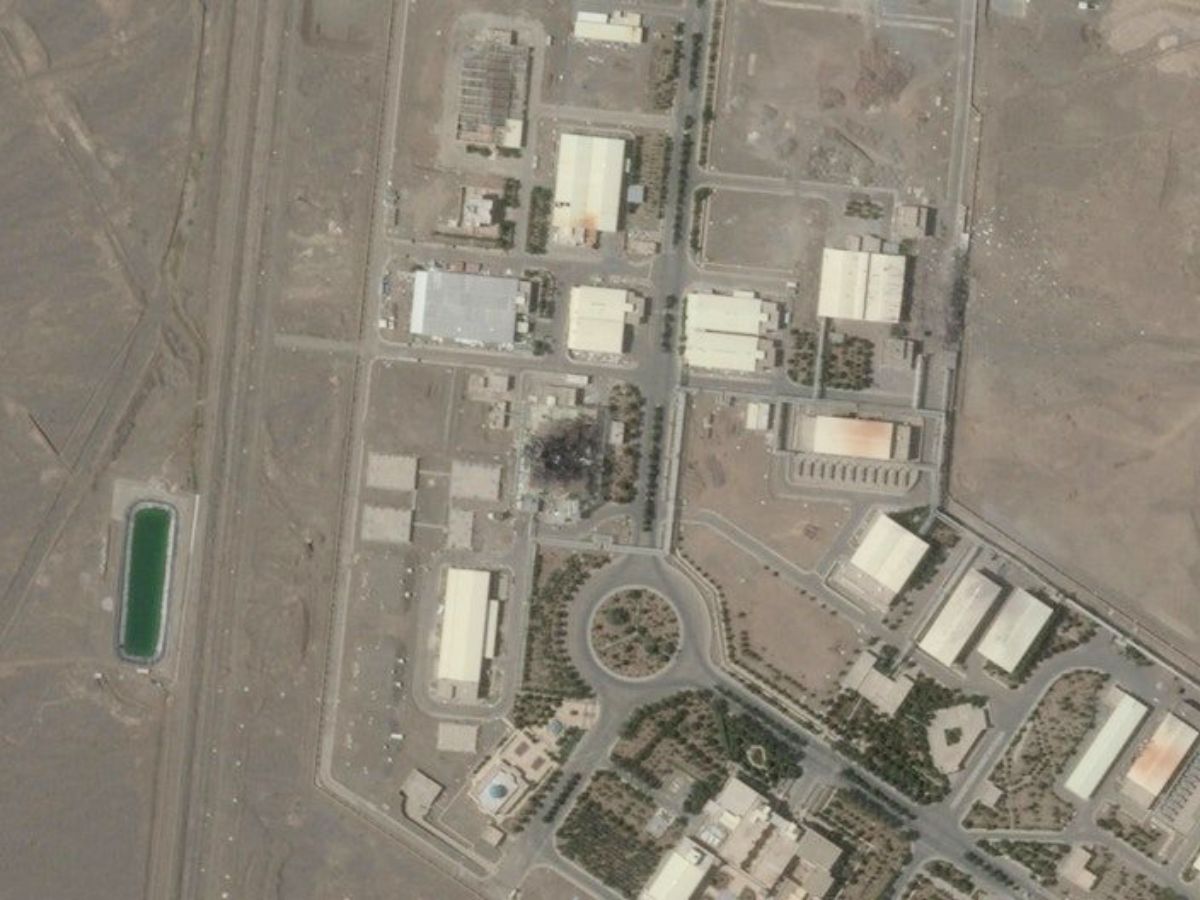
Iran claims US-Israel strikes hit Natanz nuclear site. (Photo: X/@FaytuksObs_TM)
Iran has claimed that its key nuclear complex at Natanz Nuclear Facility was targeted in recent US and Israeli military operations, escalating tensions in an already volatile regional conflict.
Speaking at a meeting of the 35-nation board of governors of the International Atomic Energy Agency (IAEA) in Vienna, Iran’s envoy Reza Najafi alleged that “peaceful, safeguarded nuclear facilities” were attacked, specifically naming Natanz.
The claims come amid reports of coordinated strikes under US and Israeli operations, significantly intensifying the confrontation between Tehran and its adversaries.
The Natanz complex, officially known as the Shahid Ahmadi Roshan Nuclear Facility, is Iran’s primary uranium enrichment site and a central pillar of its nuclear programme. Located near the city of Natanz in central Iran, the facility houses:
The commercial Fuel Enrichment Plant (FEP)
The Pilot Fuel Enrichment Plant (PFEP)
Much of the infrastructure is built deep underground reportedly 40–50 metres below the surface and protected by reinforced concrete shielding estimated at 7.6 metres thick.
The site contains thousands of centrifuges used to enrich uranium, a process that can produce fuel for civilian nuclear power or, at higher levels, weapons-grade material.
Under the 2015 Joint Comprehensive Plan of Action (JCPOA), Natanz was designated as Iran’s sole enrichment facility for 15 years, with uranium enrichment capped at 3.67% purity under strict IAEA monitoring.
Natanz is the backbone of Iran’s enrichment capability. It is where uranium hexafluoride (UF6) gas is fed into cascades of centrifuges that increase uranium purity levels.
The facility has long been at the centre of global scrutiny. It was first publicly exposed in 2002 by the opposition group the National Council of Resistance of Iran, triggering years of diplomatic standoffs and inspections.
Over the years, Natanz has faced multiple disruptions, including the infamous Stuxnet cyberattack a covert operation widely attributed to the US and Israel which damaged centrifuges and temporarily slowed enrichment activities.
Given its scale and technical importance, any strike on Natanz carries both strategic and symbolic weight.
IAEA Director General Rafael Mariano Grossi warned that the deteriorating security situation raises serious nuclear safety concerns.
Grossi stated that while there is currently no confirmed damage to nuclear installations including Natanz, the Bushehr nuclear power plant, or the Tehran research reactor the possibility of a radiological release “cannot be ruled out.”
He cautioned that a severe incident could potentially require evacuations “as large or larger than major cities,” though he clarified that there has been no detected rise in radiation levels in neighbouring countries so far.
The IAEA has placed its regional safety monitoring network on alert and is seeking to maintain communication with Iranian nuclear regulatory authorities.
Striking a nuclear enrichment facility during wartime carries complex risks.
Unlike nuclear power reactors, enrichment plants like Natanz do not contain large quantities of spent nuclear fuel. However, they do store enriched uranium and operate high-speed centrifuges handling uranium hexafluoride gas.
Damage to storage cylinders or enrichment cascades could release radioactive or chemically toxic material into the surrounding environment.
Because much of Natanz’s infrastructure is buried underground, bunker-busting munitions could increase the risk of structural collapse, fire, or localized contamination. While experts say the chances of a Chernobyl-style disaster are low, a contained radiological leak or toxic chemical release remains a possibility if critical systems are compromised.
In a region where multiple countries operate nuclear facilities, escalation also raises fears of broader nuclear safety threats.
The alleged strike on Natanz comes amid intensifying military exchanges between Iran, the United States, and Israel. While Tehran insists its facilities are peaceful and safeguarded, Washington and Tel Aviv have long accused Iran of advancing toward potential weapons capability.
The IAEA has urged “utmost restraint” from all sides, stressing that nuclear facilities must never become military targets. Grossi has also underscored that diplomatic engagement remains essential despite rising hostilities.
As of now, there is no independent confirmation of significant structural damage at Natanz. However, the situation remains fluid and the risks associated with military action near nuclear infrastructure continue to alarm global watchdogs.
ALSO READ: Qatar’s Big Warning For Iran As Tehran Launches Fresh Attacks In Gulf Nations, Target US Embassies
Sofia Babu Chacko is a journalist with over five years of experience covering Indian politics, crime, human rights, gender issues, and stories about marginalized communities. She believes that every voice matters, and journalism has a vital role to play in amplifying those voices. Sofia is committed to creating impact and shedding light on stories that truly matter. Beyond her work in the newsroom, she is also a music enthusiast who enjoys singing.
Kolkata preschool shock: 3-year-old dragged, forced into cupboard as punishment, leaves child traumatised, WBCPCR probes…
Outrage erupts as Indian cricketer Sanju Samson faces racist abuse on X after his match-winning…
Iran Supreme Leader’s wife Mansoureh Khojasteh Bagherzadeh killed after injuries from US-Israeli strikes, escalating Middle…
