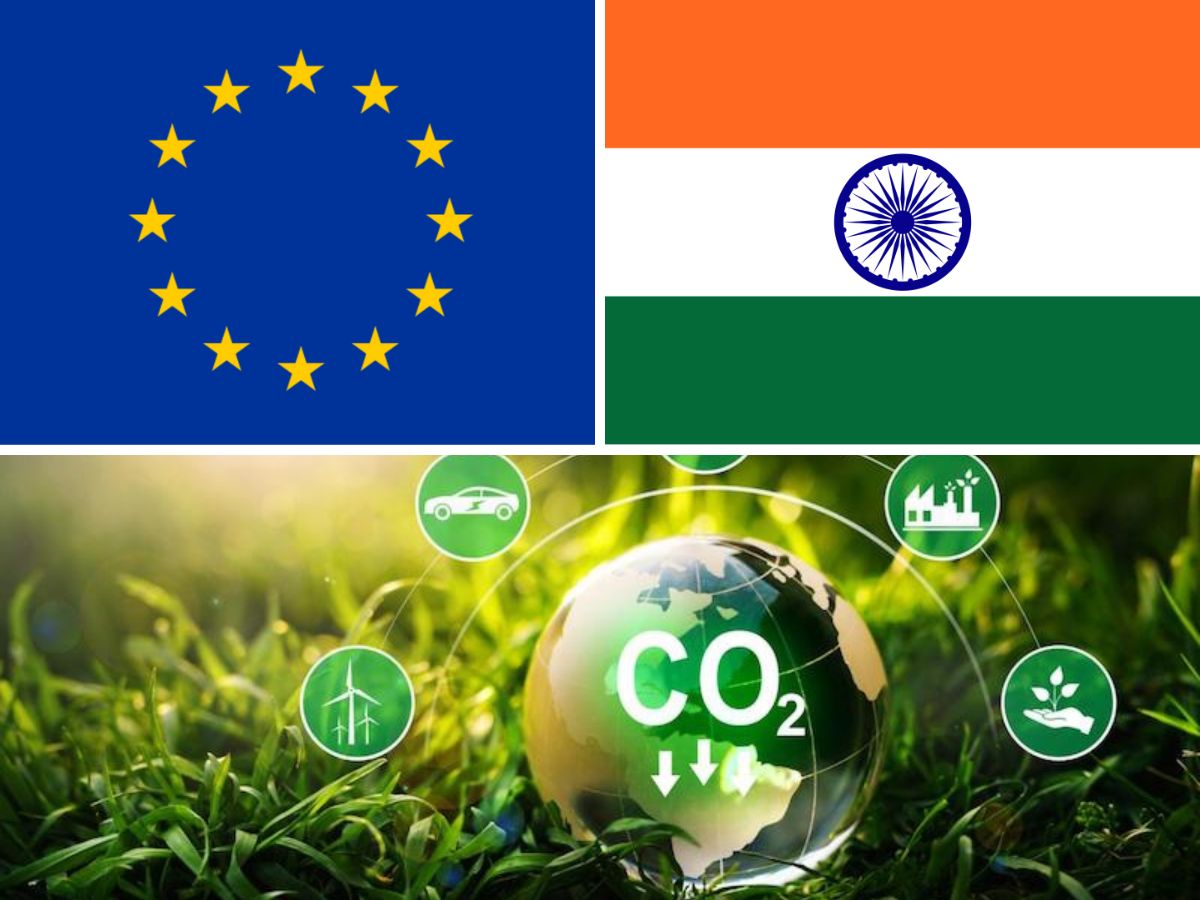
As sustainability has evolved from being a fashionable concept to being a requirement for uninterrupted businesses across the world, India’s export worth more than $13 billion covering carbon intensive sectors is at risk.
In the financial year 2022-23, India’s iron and steel exports to the EU represented 23.5% of its total steel exports. The European Union’s Carbon Border Adjustment Mechanism (CBAM) is set to become mandatory from January 2026 for all suppliers of Iron and steel, Aluminium, Cement, Fertilisers and Electricity to the EU market.
The carbon tax under the CBAM could cause some serious economic damage to the Indian exporters of iron and steel to the EU. Indian CBAM export to the EU stands around 0.2% of its GDP and the iron and steel make up for 90% of these exports.
These coupled with other reasons including lack of accurate data gathering infrastructure, high carbon intensity in iron and steel manufacturing process. These make the iron and steel sector of India, which is the second largest producer in the world.
A significant share of Indian steel exporters, particularly in the secondary sector, lack the necessary MRV (Monitoring, Reporting, and Verification) infrastructure and digital capabilities. As the Definitive Regime restricts the use of default values from 2026, real-time emissions tracking tools, carbon accounting platforms, and automated reporting systems will be critical
– Nilesh Bhattad, CBAM expert and CleanCarbon.ai founder
He also underlined that once the CBAM goes into definitive Phase in effect from January 2026, a carbon tax will be imposed on the embedded emissions of products, potentially increasing landing costs by 8–10%, depending on emission levels. Manufacturers who are not compliant will be unable to ship their products after January 2026.
There is a rising concern that India could witness negative impacts in its global business competitiveness due to CBAM tax. It could also make products covered under the CBAM expensive for the end consumer. These factors pose serious financial and compliance risks for exporters aiming to maintain their foothold in the EU market.
CBAM is currently under the Transitional Phase 1 (October 2023 to December 2025). During this phase, only submitting the quarterly report is mandatory. However, most of the CBAM reporting requirements, including accurate data collection, timely submission, EU-accredited report auditing, and cross-verification will become mandatory from 2026 when the Definitive Regime starts.
Moreover, the penalty for inaccurate report submission will only be applicable from 2026 and CBAM certificate submissions are compulsory from 2027, as per the updated rules under the Omnibus Package.
CBAM Risk for Iron and Steel Sector
There could be a significant shift in global trade regulations caused by CBAM, especially for India’s secondary steel sector that makes up for 40% of the nation’s steel production. CBAM could impose an additional 25% carbon tax on Indian CBAM-covered goods exports to the EU, including steel, significantly raising costs and reducing competitiveness, as per the Centre for Science and Environment.
Some major challenges are lack of information and unclear understanding of CBAM itself by many suppliers and industry players, no precision in emissions calculations, difficulty in maintaining data accuracy and audit readiness.
CBAM and Sustainability expert, Shubham Thakur while emphasising on the challenge said, “A major challenge to India becoming a fully green production hub is systematic and accurate carbon emissions data collection. Additionally, the massive amount of data needs to be managed and processed digitally for efficient outcomes.
CBAM could also affect India-EU trade relations in terms of continuity of trade. The introduction of CBAM poses compliance challenges for Indian steel exports, especially to the EU, pushing the industry to adopt sustainable practices to stay competitive, profitable and relevant globally.”
The way forward?
India’s emission intensity of steel production is at 2.54 T CO2/T Crude Steel (tCO2/TCS), which is significantly higher than the global average of 1.91, as per the Ministry of Steel report.
These figures are only set to witness a sharp spike in coming years due to rising India’s domestic demand and global requirements. If we look at the emission levels that the Indian steel industry is responsible for, credible data indicates that the steel industry of India accounts for 10-12% of India’s total emissions.
Hence, it is critical to decarbonize the Indian steel industry amid the rapidly changing global economy, which is witnessing the development of a stronger climate-conscious mindset. There have been attempts to decarbonise the Indian iron and steel industry through a recent Green Steel Taxonomy, which defines and rates green steel in India.
When it comes to CBAM, there are only two ways India could minimise its impact: developing a CBAM like mechanism under which carbon tax paid can be readjusted by EU CBAM and decarbonising the steel industry for seamless trade with early and accurate CBAM reporting.
It is critical to focus on investment in the right technology to not just defeat the double whammy but also use CBAM as an opportunity for more business expansions and economic gains.
Also Read: India’s Green Hydrogen Dream: Could This Clean Fuel Make India A Global Powerhouse?
Ankur Mishra is a journalist who covers an extensive range of news, from business, stock markets, IPOs to geopolitics, world affairs, international crises, and general news. With over a decade of experience in the business domain, Ankur has been associated with some of the reputed media brands. Through a sharp eye on global marketplaces along with deep insights and analysis of business strategies, Ankur brings simplicity to the complex economic matrix to decode market trends and empower people.
He is committed to entrenched data, facts, research, solutions, and a dedication to value-based journalism. He has covered trade tariff wars, international alliances, corporate policies, government initiatives, regulatory developments, along with micro- and macroeconomic shifts impacting global fiscal dynamics.
US officials verified that the F-35 made an emergency landing after it was hit and…
Bank Holiday: Banks across India will remain closed on March 21, 2026, on account of…
DRDO CEPTAM 11 Admit Card 2026: When And Where To Download Tier-I Hall Ticket
The Defence Research and Development Organisation (DRDO) will release the admit card for the Centre…
