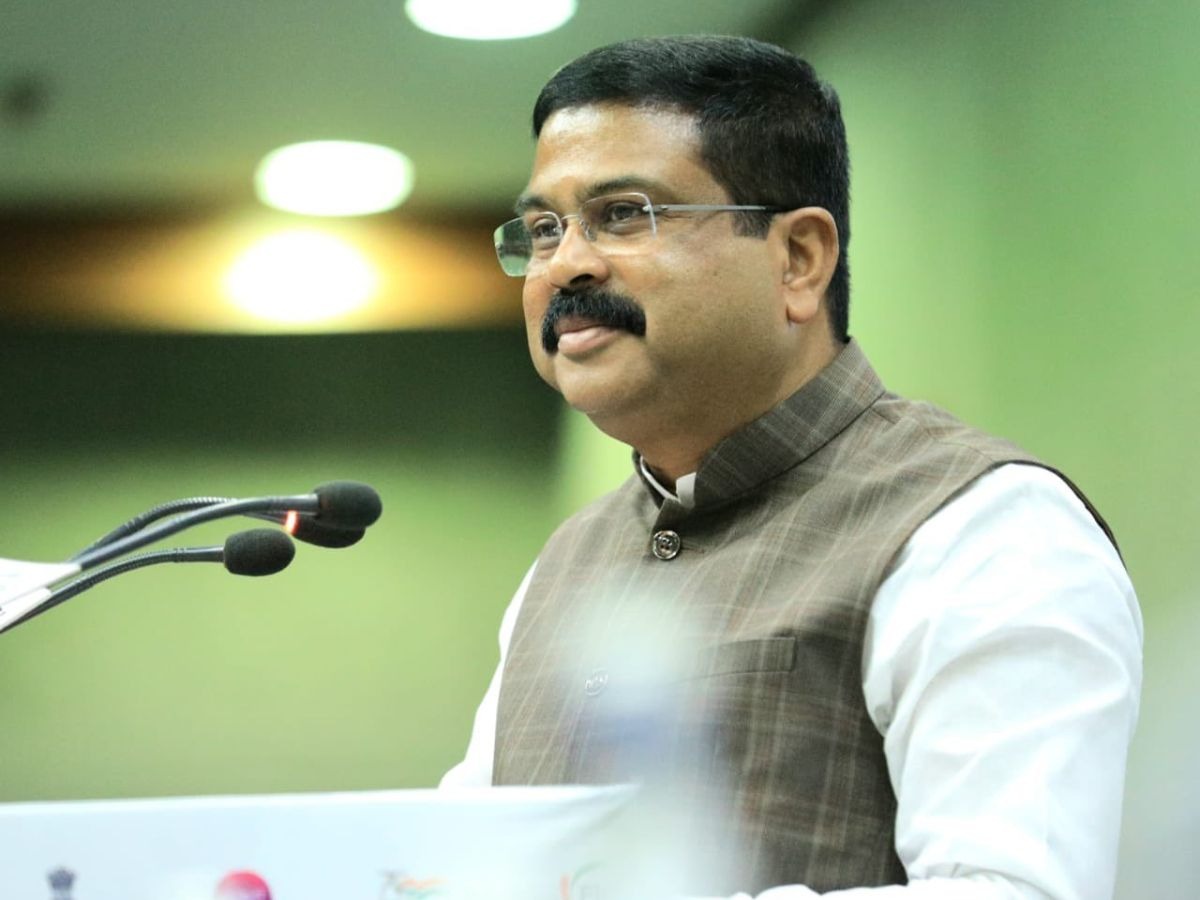
[Image Credit- X] Dharmendra Pradhan speaks on the occassion of 5th anniversary of NEP
As India marks the fifth anniversary of the National Education Policy (NEP 2020), Union Education Minister Dharmendra Pradhan announced that states across the country are actively planning to implement mother‑tongue or regional language as the medium of instruction during the foundational and preparatory stages of schooling. He described this shift as a “paradigm shift” and emphasized broad acceptance of NEP’s language recommendations nationwide.
Speaking at an Education Ministry event commemorating NEP’s fifth year, Pradhan stated that “all states, all administrative units” are preparing plans to roll out vernacular-medium foundational education. In the coming years, foundational schooling comprising pre‑primary (‘balvatikas’) and early grades will be mother‑tongue based, aligning with NEP’s vision. He also highlighted improvements in textbooks developed by NCERT as reflecting new pedagogical approaches advocated by the policy.
The NEP 2020 emphasizes home or regional languages as the medium of instruction up to at least Grade 5, and recommends continuation up to Grade 8 wherever feasible. It also promotes a three‑language formula with at least two native Indian languages, while preserving linguistic freedom for states and communities. Pradhan reiterated that no language is being imposed on education in states such as Tamil Nadu will, for instance, be in Tamil, not Hindi.
Efforts are underway to support this shift with resources: study materials including textbooks, playbooks, and play‑based tools for the foundational stage are being developed in 22 Indian languages listed in the Constitution, leveraging technology to reach diverse linguistic groups. In addition, Assam has been identified as a potential “laboratory” for mother‑tongue based education, given its exceptional linguistic diversity, with over 180 tribal languages spoken in the region.
Experts have weighed in on the benefits. Research indicates that early instruction in the mother tongue enhances conceptual understanding, cognitive development, and students’ engagement with learning. As one academic noted, children think and perceive more naturally in their native language, boosting creativity and comprehension.
Nonetheless, implementation challenges remain. Critics warn of possible disparities in quality across states, teacher shortages in regional languages, and inconsistent rollout. Some states, including Tamil Nadu, continue to challenge the three‑language framework as politically motivated and in tension with their own language priorities. Meanwhile, delays in material distribution and teacher training have hampered consistent adoption in urban‑rural and English‑medium versus vernacular‑medium schools.
As India moves forward, the success of NEP’s language reforms will depend heavily on state‑level execution, ensuring that children receive quality foundation‑stage education in a language they understand and identify with.
Also Read: IIT Kanpur director raises alarm over AI-driven cheating
The ICC has reacted to Pakistan’s refusal to play India in the ICC Men’s T20…
Merchant Navy Officer Rikshit Chauhan Returns Home Safely After Russian Tanker Seizure by US
A second woman has accused Prince Andrew of a sexual encounter linked to Jeffrey Epstein,…
