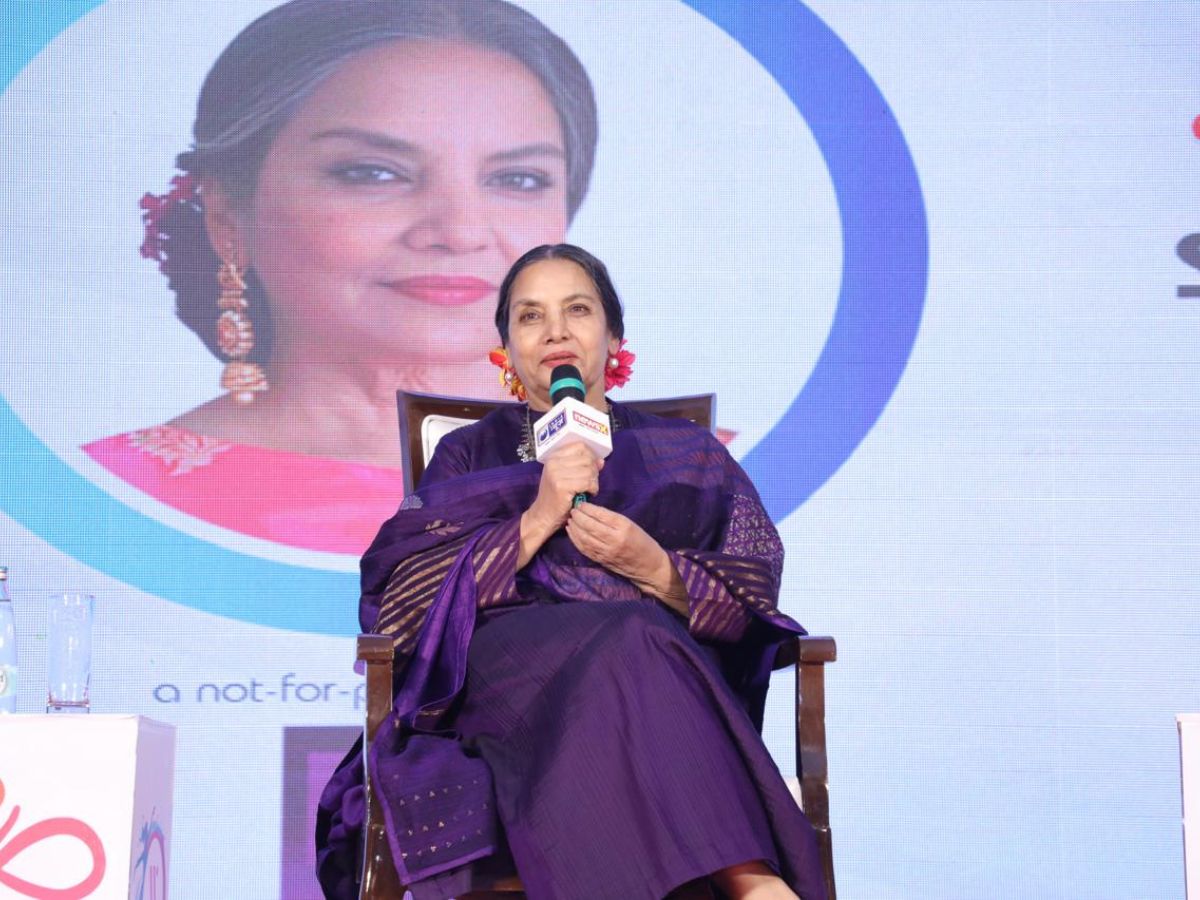
Shabana Azmi on 50 years in cinema, rejecting stereotypes, and shaping social change through film at We Women Want Conclave & Shakti Awards 2025. Photo/NewsX.
For Shabana Azmi, receiving the Shakti Award for Excellence in Entertainment at NewsX We Women Want Conclave 2025 was more than just another accolade in her illustrious career.
“If it means over a long career – which is 50 years in my case – obviously it’s not only for a particular performance but for a body of work, and I value that very much,” she said.
That “body of work” has been shaped by deeply held values instilled by her parents.
“They believed art should be used as an instrument for social change – those are the values that have always held me steady,” she explained, adding that moments of uncertainty, rather than being a weakness, often fuel creativity.
Azmi has never shied away from rejecting roles that diminish women or confine them to outdated stereotypes. “If I feel that the film in any way is suggesting that a woman has a secondary role and she should accept the stereotypes… that is something that would not attract me,” she said.
Her choices echo the ideals of her father, poet Kaifi Azmi, whose iconic poem Aurat urged women to rewrite history’s narrative.
“Kadar ab tak teri tareekh ne jaani hi nahin,
Tujh mein shole bhi hain, bas aashfishaanee hi nahin…
Apni tareekh ka unwaan badalna hai tujhe,
Uth meri jaan, mere saath hi chalna hai tujhe.”
When asked if her mother had ever advised her on living with a poet, Azmi replied with characteristic wit.
“Don’t marry a poet.” But she did, and admits she was drawn to the beauty of the words. Her husband, lyricist Javed Akhtar, she says, is not the hopeless romantic people imagine.
“He does not have a single romantic bone in his body,” she laughed, recalling his quip, “If you work in a circus, you don’t go home and keep hanging upside down like a trapeze artist.”*
Azmi sees cinema not as propaganda but as a way to create a “climate of sensitivity” where change can take root. “Your soil becomes moist, and when your soil becomes moist, the sapling will sprout,” she explained.
She believes real change must happen within the mainstream. “If you keep doing parallel cinema, then you are already preaching to the already converted,” she argued, citing Rocky Aur Rani Ki Prem Kahani as an example of mainstream entertainment carrying a strong social message without being preachy.
Tracing the evolution of female characters in Indian cinema, Azmi reflected, “earlier, silence was considered a woman’s virtue. Then came the “Rambo-lina” phase, where women mimicked male action heroes without nuance. Parallel cinema explored women in all their contradictions, refusing to reduce them to Madonna or whore’ stereotypes.”
Today, she notes, younger women in films are “no longer interested in only hanging around the man and playing his appendage.”
On whether she would still play the lead in Arth, Azmi rejected the idea that the character was a “silent suffering wife.”
She described it as a story of transformation – from dependence to independence – culminating in the protagonist choosing her own path over another romantic relationship. “That film really transformed people’s lives,” she said.
When approached for her role in the film, Azmi credits not just Karan Johar but also designer Manish Malhotra for reimagining her character. Initially conceptualised as a stereotypical Bengali bhadramahila in saris and buns, the final look broke away from clichés.
Recalling a humorous moment, she said, “I’m cooking fish in a kitchen in a silk sari with my long hair open – I said, ‘All my hair will go into the fish curry!’ Karan said, ‘This is a Karan Johar film, it happens here.’ So I surrendered to him – and I think that surrender worked.”
Azmi revealed that Shekhar Kapur is directing Masoom: The Next Generation, featuring Naseeruddin Shah, Manoj Bajpayee, and Kapur’s daughter Kaveri Kapoor.
“It’s not about Jugal Hansraj growing up and having an extra-marital affair,” she clarified. Instead, it explores family, identity, and the quiet transformations brought by a changing city.
In a rapid-fire round, Azmi shared that her favourite snack is the humble samosa, so much so that she once ate it daily at 5 pm in Juhu.
“In my dreams, it’s not kebab, it’s not biryani – it is that samosa,” she laughed, recalling that even Nelson Mandela once asked her to pass him a samosa at a shared table.
She is “definitely” a mountain person, heading to Iceland with a group of girlfriends, all over 65, for her next holiday. Their group name? “Baap Re Baap, Baap Re Baap.”
Her favourite film is MS Sathyu’s Garm Hava, her favourite co-star is Naseeruddin Shah, and if she could have a superpower, it would be invisibility, “so I could hear everything that is going on.”
Zubair Amin is a Senior Journalist at NewsX with over seven years of experience in reporting and editorial work. He has written for leading national and international publications, including Foreign Policy Magazine, Al Jazeera, The Economic Times, The Indian Express, The Wire, Article 14, Mongabay, News9, among others. His primary focus is on international affairs, with a strong interest in US politics and policy. He also writes on West Asia, Indian polity, and constitutional issues. Zubair tweets at zubaiyr.amin
The 50 will begin streaming on February 1 at 9 pm on JioHotstar. Based on…
BREAKING: Pakistan To Boycott T20 World Cup 2026 Match Against India
Pakistan will not play India in the T20 World Cup 2026 fixture scheduled for February…
Veer Pahariya celebrated his 31st birthday with a star-studded bash in Mumbai attended by Janhvi…

