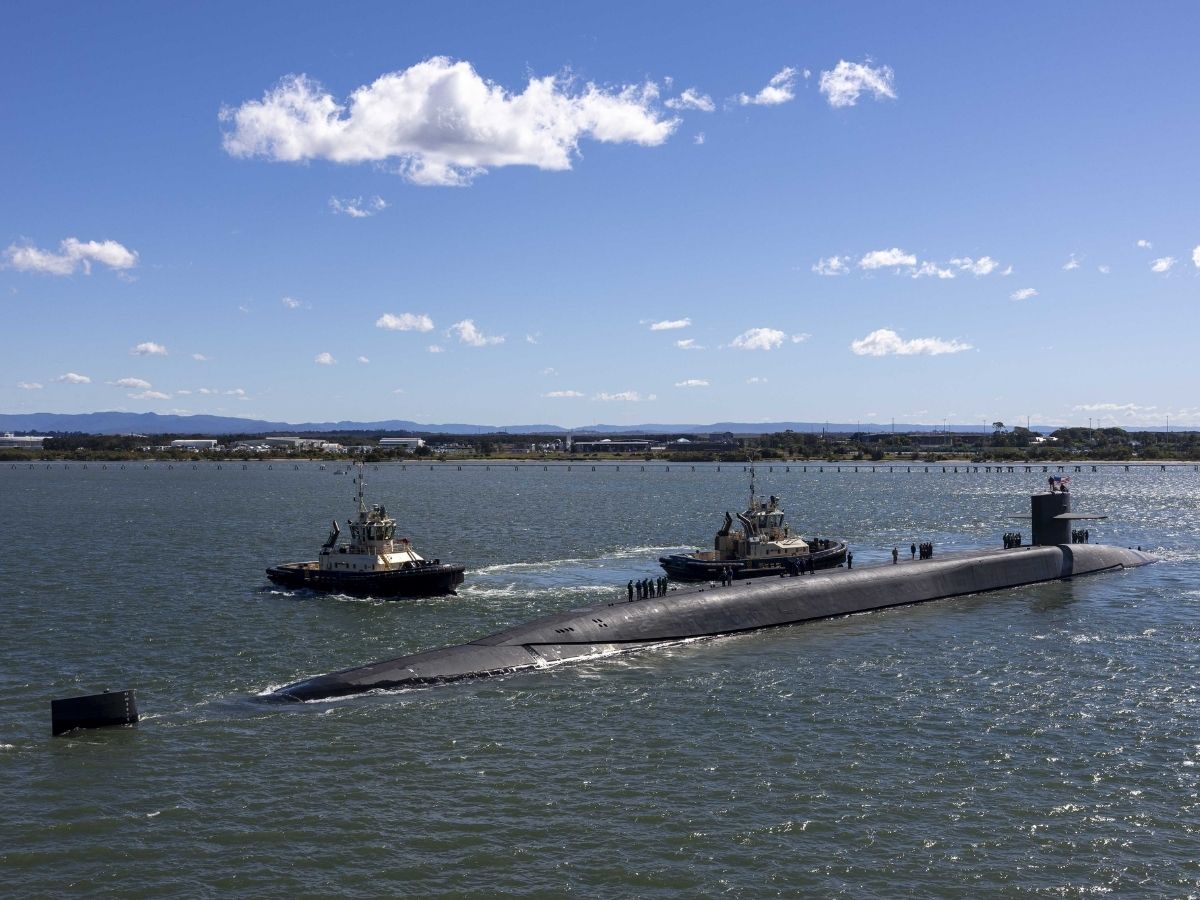
America's Submarine Fleet: President Donald Trump has ordered nuclear submarines into position after Russian threats from the country's former president Dmitry Medvedev. (Photo: X/@USNavy)
President Donald Trump announced on Truth Social that he had ordered two US Navy nuclear submarines to “appropriate regions” in response to “inflammatory” remarks made by Dmitry Medvedev, Russia’s former president and current deputy chairman of its Security Council.
“Just in case these foolish and inflammatory statements are more than just that,” Trump wrote, adding that the subs were being moved “to be prepared.”
While he didn’t specify the class of submarines or their destinations, experts say that’s standard practice as the Pentagon is usually required to stay quiet on the movements of its undersea fleet. The move, however, raises the question: what kind of submarines does the US. Navy actually have, and what are they capable of? Here is all you need to know:
The US submarine force is made up of three classes of nuclear-powered submarines:
While all of these submarines are powered by nuclear reactors, not all of them carry nuclear weapons.
The 14 Ohio-class SSBNs, known as “boomers”, carry Trident II D5 submarine-launched ballistic missiles (SLBMs), each capable of multiple, independently targetted nuclear warheads.
According to the US Navy, “SSBNs are designed specifically for stealth and the precise delivery of nuclear warheads.”
With a range of up to 4,600 miles, these submarines can strike from almost anywhere in the world – whether it’s the Pacific, Atlantic, or even Arctic Oceans. They operate on 77-day patrols with alternating Blue and Gold crews, a system that maximises their time at sea.
Each Ohio-class SSBN is 560 feet long, displaces nearly 19,000 tons submerged, and carries a crew of 159.
Originally built as ballistic-missile submarines, four Ohio-class subs were converted in the early 2000s into guided-missile submarines (SSGNs): USS Ohio, USS Michigan, USS Florida, and USS Georgia.
Each SSGN can carry up to 154 Tomahawk cruise missiles, which are conventional weapons used for precision land strikes. They also support Special Operations Forces (SOF)missions, with space for up to 66 personnel and lock-out chambers for stealthy deployments.
These subs are essentially floating covert bases, offering “unprecedented strike and special operation mission capabilities from a stealth, clandestine platform,” according to the US Navy.
With an estimated 53 vessels in service, fast-attack submarines (SSNs) are the largest segment of the American fleet. These subs are versatile as they track down enemy ships, can launch Tomahawks, gather intel, and support special forces.
There are three classes:
First launched in the 1970s, 23 of these subs are still reportedly active. These are 360 feet long and can hit over 25 knots submerged. These subs, the US Navy says, are armed with Tomahawk missiles and torpedoes, and some have Vertical Launch System (VLS) tubes.
Only three of the Seawolf Class submarines were built, reportedly due to high costs. The USS Jimmy Carter, the most advanced version of these subs, includes a 100-foot hull extension for classified operations.
“This hull section provides for additional payloads to accommodate advanced technology,” per the US Navy.
The most modern and steadily expanding class of the US fleet, 23 Virginia-class subs reportedly remain active. They feature digital periscopes, flexible payload tubes, and are built for both deep-ocean and shallow-water missions.
These subs are designed for flexibility. Their Virginia Payload Modules (VPM), included in newer blocks, can carry 28 additional Tomahawks and enable dry-deck shelter support for SOF teams.
While the Ohio-class SSBNs are still patrolling the world’s oceans, the next generation — Columbia-class — is believed to be under construction. The first such sub, reports suggest, is expected to be on patrol by 2030, with the mission of maintaining nuclear deterrence well into the 2080s.
The American submarine fleet packs enormous power. According to the US Navy, ballistic-missile submarines alone carry 54% of the country’s nuclear deterrent.
With threats escalating amid rising geopolitical tensions, analysts say America’s ability to move submarines to global hotspots plays a crucial role in the country’s defense strategy.
(With inputs from the US Navy’s official submarine force publication, CNN and Commander, Submarine Force Atlantic fact sheets)
Chinese EV giant BYD reported a 30% year-on-year drop in January sales, extending its losing…
Two men of Indian origin, including a University of Toledo student, have been charged in…
Yash-starrer Toxic sparked backlash over its explicit teaser, forcing actress Beatriz Taufenbach off social media.…
