
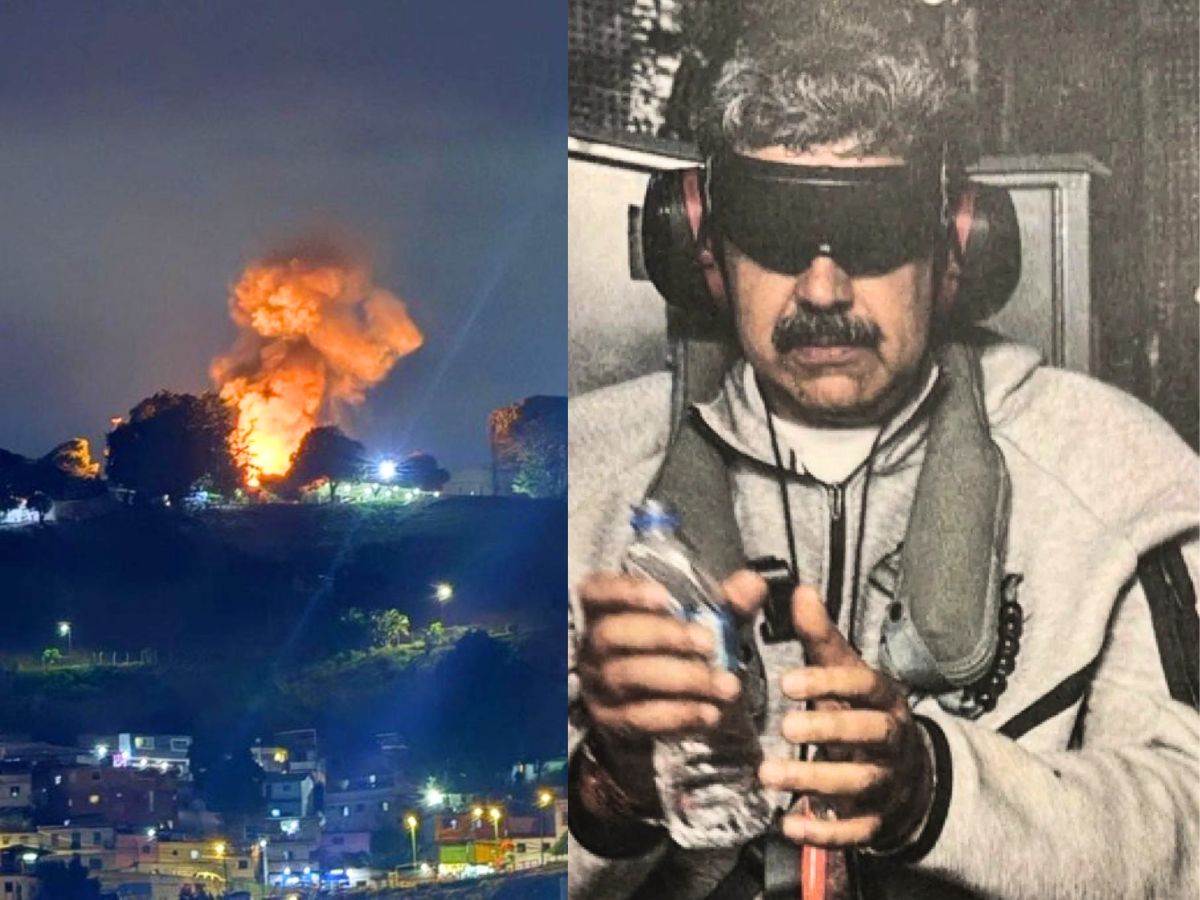

A dramatic US military operation that resulted in the capture of Venezuelan President Nicolas Maduro and his wife, Cilia Flores, has sparked international shock, debates and intense scrutiny.
According to multiple media reports citing US officials, intelligence sources and people briefed on the mission, the operation was the result of months of meticulous planning involving CIA assets, stealth drone surveillance and elite American special forces under the Donald Trump administration.
The operation followed large-scale US strikes across Venezuela early Saturday and was publicly acknowledged by Trump himself at 4:21 am local time through a post on his Truth Social account.
Calling it a bold and unprecedented mission, Trump claimed the United States had successfully captured Maduro, a leader Washington has long accused of ‘narco-terrorism’ and ‘drug trafficking’.
CIA Source Inside Venezuelan Government Played Key Role
Central to the mission was human intelligence gathered from within Venezuela’s own power structure. According to reports by The New York Times and Reuters, the CIA had cultivated at least one source inside the Venezuelan government who was able to monitor Maduro’s whereabouts in the days and even moments leading up to the raid.
This asset reportedly provided real-time intelligence on Maduro’s location, allowing US special operations forces to pinpoint his movements with precision. The presence of an insider significantly reduced uncertainty during the final stages of the operation, officials said.
Tracking Maduro’s ‘Patterns of Life’ Since August
Beyond human intelligence, the CIA is said to have deployed a small team to Venezuela as early as August to study Maduro’s daily routines referred to in intelligence circles as “patterns of life.” These included where he slept, what routes he used, his clothing habits, meal timings and even details about his pets.
According to Reuters, the intelligence agency also relied on an asset close to Maduro who was prepared to confirm his exact location as events unfolded. This long-term surveillance ensured that when the operation was launched, there was minimal room for error.
Stealth Drones and Near-Constant Aerial Monitoring
Complementing on-the-ground intelligence was extensive aerial surveillance. A fleet of stealth drones reportedly provided near-constant tracking over Venezuela, monitoring movements around Caracas and key locations linked to Maduro.
These drones allowed US planners to map security arrangements, track changes in routine and assess threats in real time. Officials familiar with the operation said the drone network was crucial in synchronising air strikes with the ground assault.
Replica of Maduro’s Safe House Used for Rehearsals
One of the most striking aspects of the operation was the level of preparation undertaken by US special forces. Highly trained units, including the Army’s elite Delta Force, built an exact full-scale replica of Maduro’s Caracas safe house.
This mock-up allowed troops to rehearse breaching the heavily fortified compound multiple times, testing entry routes, timing and contingency plans. Officials said the rehearsals continued until every possible scenario had been accounted for.
Why the Operation Was Delayed
Although Trump authorised the mission four days before it was executed, military and intelligence officials advised delaying the operation due to unfavourable weather conditions. Cloud cover and poor visibility were seen as risks that could compromise air superiority and drone surveillance.
Once conditions improved, the final order was given shortly before midnight local time in Caracas, allowing US forces to operate under cover of darkness.
Massive US Military Build-Up in the Region
Ahead of the operation, the Pentagon quietly orchestrated a significant military buildup across the Caribbean. This included an aircraft carrier, 11 warships and more than a dozen F-35 fighter jets. In total, over 15,000 US troops were deployed to the region under the banner of long-running anti-drug operations.
In addition to fighter jets, the US positioned refuelling tankers, electronic jamming aircraft and reconnaissance drones, creating overwhelming air dominance during the mission.
‘Never Seen Anything Like This,’ Says Trump
Speaking on Fox News hours after the operation concluded, Trump described the mission as unlike anything he had witnessed before. “I’ve done some pretty good ones, but I’ve never seen anything like this,” he said.
Trump reportedly watched a live video feed of the operation from his Mar-a-Lago resort in Florida, accompanied by senior advisers including CIA Director John Ratcliffe and Secretary of State Marco Rubio.
Air Strikes Pound Caracas as Special Forces Move In
Late Friday night into early Saturday, US aircraft launched strikes on multiple targets in and around Caracas, including air defence systems and military installations. Trump later described the scale of the operation as involving a “massive number of aircraft,” adding, “We had a fighter jet for every possible situation.”
As the air campaign unfolded, heavily armed US special forces moved into Caracas. Social media videos posted by residents showed helicopters flying low over the city in convoy as explosions echoed through the capital.
Breaching Maduro’s ‘Fortress’ Safe House
When US troops reached Maduro’s safe house, described by Trump as a “very highly guarded fortress,” they encountered resistance. According to officials, the troops alongside FBI agents carried specialised equipment, including blow torches, to cut through reinforced steel doors if necessary.
“They just broke in,” Trump said later. “Steel doors that were put there for just this reason they got taken out in a matter of seconds.”
Maduro reportedly attempted to flee to a secure room but was overpowered before he could barricade himself inside.
Operation’s Aftermath and Global Reaction
By around 4:20 am local time, helicopters were seen leaving Venezuelan airspace carrying Maduro and his wife, who were placed in US custody and later transported toward New York to face criminal charges.
The operation has drawn sharp criticism from several international leaders and lawmakers, who questioned its legality and warned of dangerous precedents. US officials, however, defended the mission as necessary and argued that informing Congress earlier could have compromised operational security.
As global reactions continue to pour in, the capture of Maduro marks one of the most audacious and controversial US military interventions in Latin America in decades, reshaping the geopolitical landscape of the region.
Sofia Babu Chacko is a journalist with over five years of experience covering Indian politics, crime, human rights, gender issues, and stories about marginalized communities. She believes that every voice matters, and journalism has a vital role to play in amplifying those voices. Sofia is committed to creating impact and shedding light on stories that truly matter. Beyond her work in the newsroom, she is also a music enthusiast who enjoys singing.




