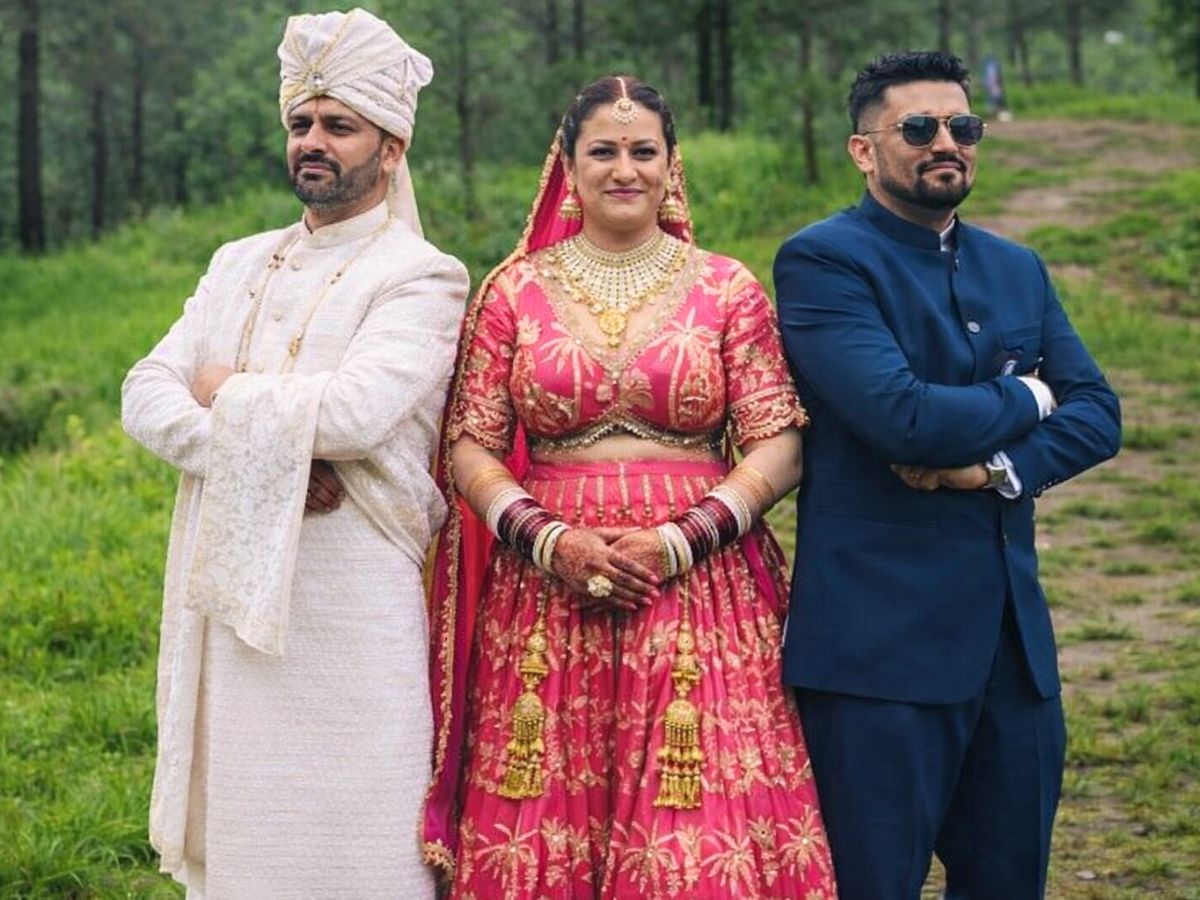
Himachal’s Jodidar marriage goes viral again. (Photo: AI)
A strange family from Himachal Pradesh has surprised the nation once again by combining an old custom with the curiosity of modern times. In a Sirmaur district, a woman who married two brothers in an ancient way known as “Jodidar” welcomed a baby bringing in new discussions on family, culture and parenting. While one of the fathers had a celebration inside his house, the other, who was working abroad, posted his happiness in a social media post that went viral. The story has received mixed reactions from netizens, some considering it a cultural practice based on history, while others see it as a new approach of parenting in a fast-changing world.
“Jodidar” , a type of fraternal polyandry, is an ancient custom observed in some parts of Himachal Pradesh, especially in Sirmaur and Kinnaur. It involves a woman marrying two or more brothers from the same family.
In the past, this system was developed to avert the splitting of ancestral land and wealth. By keeping the property of an individual in a single household, families were able to safeguard their economic interests.
As in many other communities, such as the Hatti tribe in Trans-Giri region, this practice was not only normal but a part of social life. It is less common today, but still exists in some pockets and is a reflection of the region’s deep-rooted traditions.
With the birth of a child in their family, the couple has now been thrust into the limelight. The ‘Trivial Marriage’ of Sunita Chauhan (to Pradeep Negi and Kapil Negi) has turned into a trending story with the birth of their little one.
What made the story gain even more prominence, was a social media post from one of the fathers living abroad. Sharing his joy and emotional involvement, he said the child’s arrival had ‘completed’ their lives and that he was now longing to return home. The post quickly went viral, drawing a lot of attention.
The arrival of the child has sparked fascination about how parenting works in a Jodidar marriage. The couple shares the responsibilities of parenting and the child is raised by both parents.
In the past, paternity was not given much importance. But nowadays, DNA testing is done to establish paternity for matters of inheritance. Yet, culturally, the child is treated as a member of the joint family and given equal responsibility by both parents.
The viral story has caused social media to buzz with reactions. Many have hailed the couple and expressed how beautiful such a family is and how it highlights cultural diversity and collective parenting. But others have expressed surprise and discomfort at how such a relationship can exist today and how we view marriage and families.
This reflects a larger issue in India about preserving the past versus embracing modern social norms. It has become a story beyond the viral incident, it is a story about changing attitudes towards relationships and family structure.
Polyandry especially fraternal polyandry has significantly waned over the years. Improved access to education, and the changing economic conditions, have led many joint families to become nuclear families.
In places like Kinnaur where this was more common practice, development and better connectivity has changed the way of life. But in some communities, we still have Jodidar and other such practices which are a glimpse into how people have balanced the past and the present.
It’s a story that is really about larger themes of what makes up a family in the twenty-first century. As social norms change, unconventional family structures are gaining a place in the public conversation.
The Himachal Jodidar marriage, which has now just celebrated the birth of a child, sits at the crossroads of tradition and modernity. It questions old notions of parenting, while at the same time also shows us the diversity of Indian culture. An oddity and a source of inspiration, the story continues to raise eyebrows and is a fascinating case study of how archaic traditions can still be relevant in the modern world.
Sofia Babu Chacko is a journalist with over five years of experience reporting on Indian politics, crime, human rights, gender issues, and stories about marginalized communities. She believes journalism plays a crucial role in amplifying unheard voices and bringing attention to issues that truly matter. Sofia has contributed articles to The New Indian Express, Youth Ki Awaaz, and Maktoob Media. She is also a recipient of the 2025 Laadli Media Awards for gender sensitivity. Beyond the newsroom, she is a music enthusiast who enjoys singing. Connect with Sofia on X: https://x.com/SBCism
Commercial Cylinder Gets Expensive In Delhi By Rs. 42, Check Latest Price Here
Commercial LPG cylinder prices have increased from June 1, with the 19 kg cylinder in…
Stocks To Watch Today: IndiGo, Reliance, NMDC Among Shares In Focus On June 1
Stocks To Watch Today, June 1: IndiGo, Reliance, Glenmark Pharma, Lupin, NMDC and Suzlon are…
Fact Check: Did Iran President Masoud Pezeshkian Resign? All About Shocking ‘Takeover’ Claim
Reports claimed that Iran President Masoud Pezeshkian submitted his resignation over growing tensions with the…
