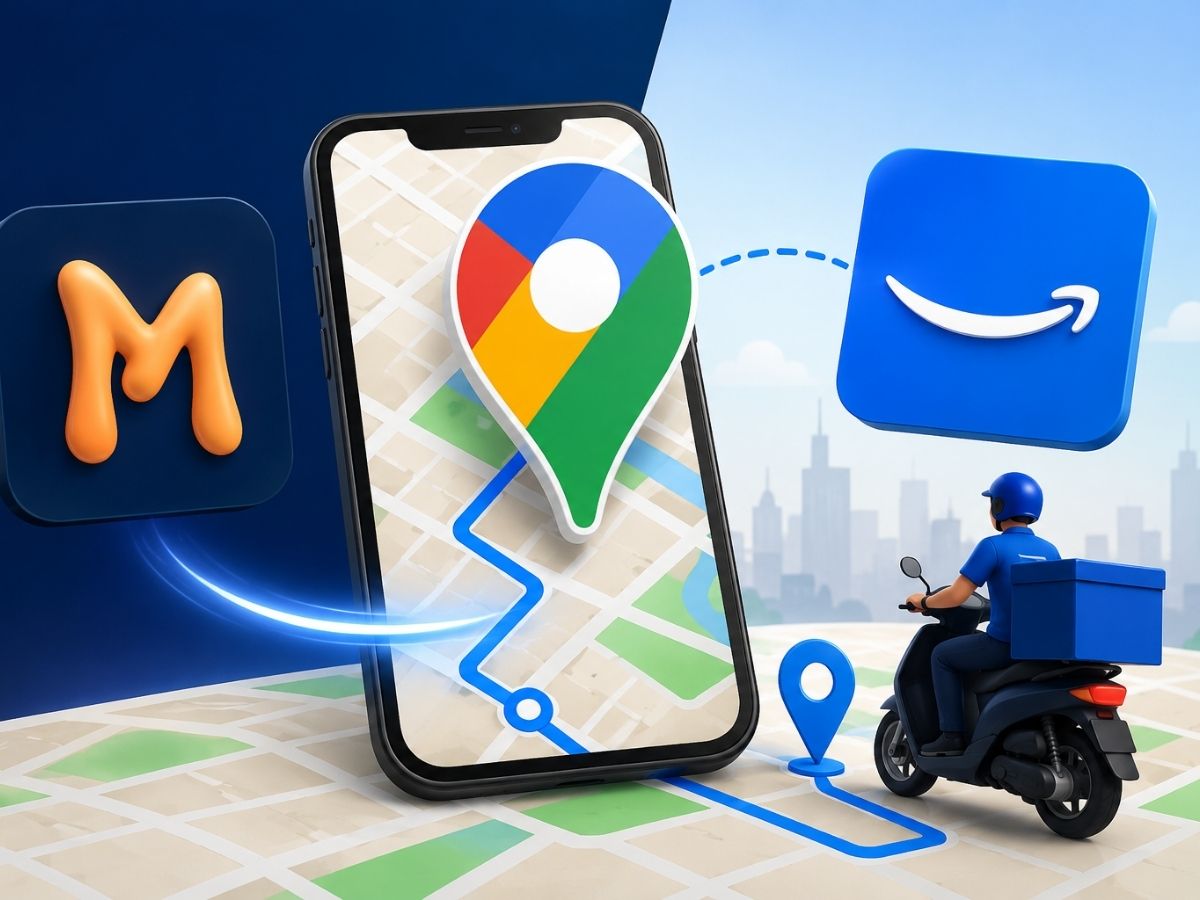
Amazon To Use MapmyIndia Mapple
US based tech giant Amazon has replaced Google Maps in India with MapmyIndia’s Mappls APIs and SDKs for its quick commerce platform, Amazon Now. The company has already made the integration live in Bengaluru and is now expanding to Mumbai, as per MapmyIndia’s director Rohan Verma during the company’s Q4 FY26 earnings call. This replacement marks a significant shift for Amazon’s fast-growing delivery service. Amazon Now is growing at roughly 25 per cent month-over-month in India, with further plans to expand to 100 cities supported by more than 1,000 micro-fulfillment centres.
That is a big number. And to make any of that work, Amazon needs its maps to be sharp, fast, and deeply rooted in Indian ground reality.
When someone orders groceries and expects them in 10 minutes, the entire operation runs on location data. Every turn a delivery rider takes, every address that needs to be verified, every route that gets optimised in real time. It all depends on the quality of the map underneath.
This is exactly where Google Maps started to fall short for hyperlocal delivery in India. Indian addresses are complicated. Lane names change block by block. Buildings share names. And many areas still do not have proper street-level data on global platforms.
MapmyIndia has spent years building maps specifically for Indian conditions. It has better local address intelligence, stronger road-level coverage in smaller lanes, and it meets domestic data regulations that global platforms sometimes struggle with. For a company running thousands of deliveries a day, that difference is real money and real time.
Rohan Verma put it plainly during the earnings call. He said Amazon is going very aggressive in quick commerce and that MapmyIndia is front and centre in their app. Anyone using Amazon Now will now see Mappls powering the experience. That is not a small thing. Amazon chose to self-integrate, which means it was a deliberate, considered decision and not just a default fallback.
This partnership did not come out of nowhere. Less than a year ago, in August 2025, MapmyIndia invested Rs 25 crore in Zepto, picking up a minority stake as the startup prepared for its much-anticipated IPO. That investment gave MapmyIndia direct exposure to how quick commerce platforms actually operate at scale, what breaks, and what works.
The Amazon Now contract builds on that experience. It shows that MapmyIndia is not just selling maps. It is positioning itself as the go-to geospatial backbone for India’s delivery economy.
Quick commerce in India is already intensely competitive. Blinkit holds close to 50 per cent market share. Zepto is gearing up for one of the most watched startup listings of the year. Flipkart is scaling its Minutes service fast, with plans to take it to 250 cities through a dedicated app. And now Amazon is pushing hard with a 100-city expansion target.
Analysts estimate the sector could touch nearly $40 billion by 2030. Every player in this race needs location technology that actually works in India, not just technology built for Western cities and loosely adapted here.
The shift from Google Maps to MapmyIndia inside Amazon Now is a sign of that change. India’s digital infrastructure is growing up, and Indian companies are increasingly the ones powering it.
Syed Ziyauddin is a media and international relations enthusiast with a strong academic and professional foundation. He holds a Bachelor’s degree in Mass Media from Jamia Millia Islamia and a Master’s in International Relations (West Asia) from the same institution.
He has work with organizations like ANN Media, TV9 Bharatvarsh, NDTV and Centre for Discourse, Fusion, and Analysis (CDFA) his core interest includes Tech, Auto and global affairs.
Tweets @ZiyaIbnHameed
Google Launches Fake Call Detection Against AI Spoofed Calls
Google has launched a new Android security feature called Fake Call Detection to combat AI-powered…
India has reacted cautiously to the United States' proposal to impose additional tariffs of up…
CBSE Class 12 Re-Evaluation Portal Delay Sparks Concern as Students Race Against Admission Deadlines
CBSE's delayed Class 12 re-evaluation portal access has left students worried as college counselling and…
