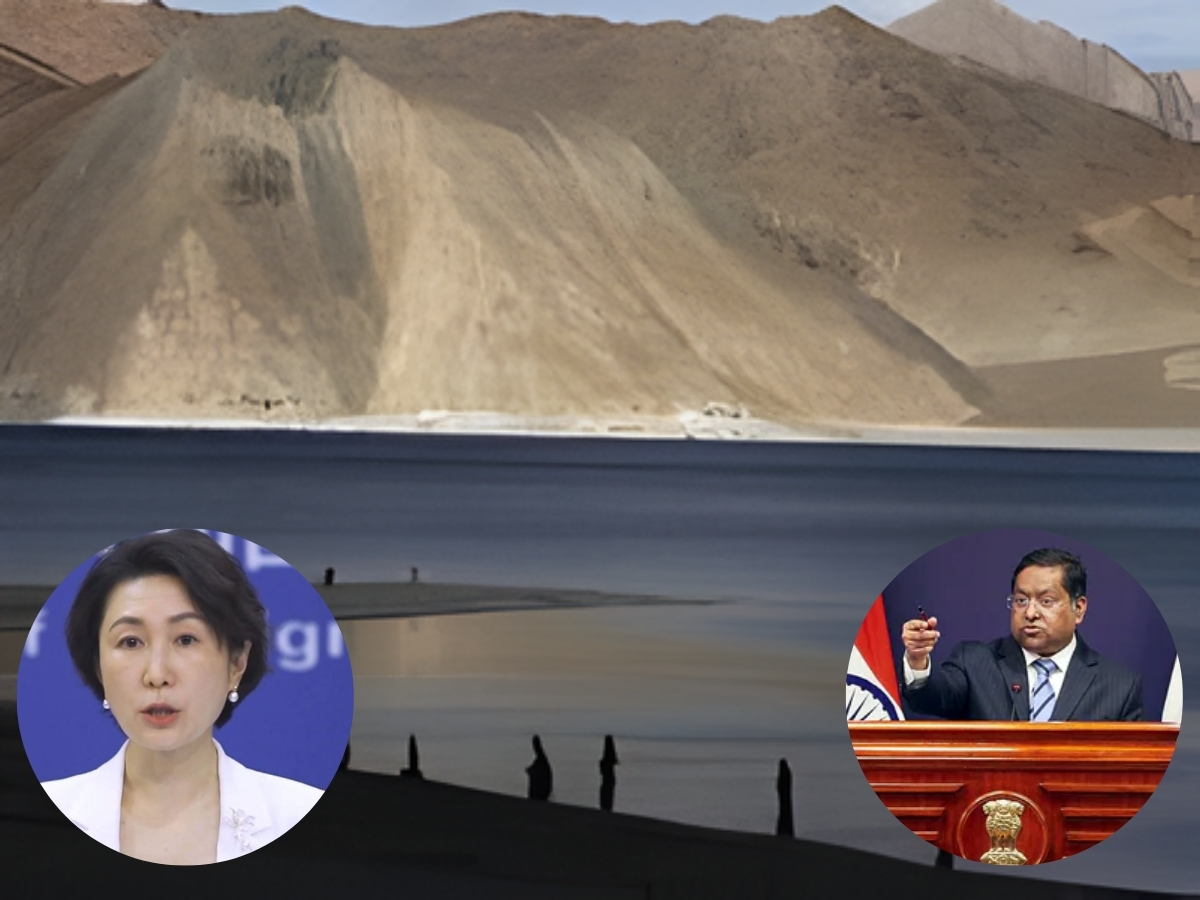
China repeats its illegal claim over the Shaksgam Valley construction after India objects to infrastructure development. Photos: ANI.
Shaksgam Valley Controversy: China and India are back to another big issue after the earlier Doklam and Galwan Valley incidents. Days after India reiterated that the Shaksgam Valley is part of its sovereign territory and objected to infrastructure development under the China-Pakistan Economic Corridor (CPEC), China has reaffirmed its illegal territorial claims over the strategically sensitive region and defended its construction activities.
India’s concerns have intensified amid reports that China is building a long all-weather road in the Shaksgam Valley, located just kilometres from Indian territory.
On Monday, Beijing rejected New Delhi’s objections and said that the Shaksgam Valley belongs to China. It said that the infrastructure projects in the area are legitimate and beyond reproach.
Responding to India’s objections last week, Chinese foreign ministry spokesperson Mao Ning said the Shaksgam Valley falls within China’s territory and that Beijing has every right to carry out development activities there.
“The territory you mentioned belongs to China,” Mao told reporters. “It’s fully justified for China to conduct infrastructure construction on its own territory.”
She further cited the 1963 China-Pakistan boundary agreement, under which Pakistan ceded approximately 5,180 square kilometres of territory in the Shaksgam Valley to China.
“China and Pakistan in the 1960s signed a boundary agreement and delimited the boundary between the two countries, which is the right of China and Pakistan as sovereign countries,” Mao said.
India has firmly rejected China’s position, reiterating that it does not recognise the 1963 China-Pakistan boundary agreement and considers the Shaksgam Valley part of Indian territory.
External Affairs Ministry spokesperson Randhir Jaiswal said on Friday last week, “Shaksgam Valley is Indian territory. We have never recognised the so-called China-Pakistan ‘boundary agreement’ signed in 1963. We have consistently maintained that the agreement is illegal and invalid.”
He added that the entire Union Territories of Jammu and Kashmir and Ladakh are “an integral and inalienable part of India.”
The Shaksgam Valley is a remote, high-altitude region located north of the Karakoram range. It borders China’s Xinjiang province to the north, the Northern Areas of Pakistan-occupied Jammu and Kashmir (PoJK) to the south and west, and the Siachen Glacier region to the east.
The valley lies adjacent to Pakistan-occupied Gilgit-Baltistan and close to Siachen and Aksai Chin.
Currently, the area is administered by China as part of Xinjiang. However, India maintains that it formed part of the former princely state of Jammu and Kashmir, now Ladakh, following the region’s lawful accession to India in 1947.
Pakistan occupied the area during the 1947–48 war and later ceded it to China in 1963 through the Sino-Pakistan Agreement, a move India continues to contest.
At the heart of the dispute is the question of who had the legal authority to decide the boundary.
Under the 1963 Pakistan-China boundary agreement, Islamabad transferred control of the Shaksgam, also known as the Trans-Karakoram Tract, to Beijing. India has consistently argued that Pakistan had no legal right to cede territory that New Delhi considers part of Jammu and Kashmir.
According to reports, China has already constructed nearly 75 kilometres of the road, estimated to be about 10 metres wide.
Citing satellite imagery from the European Space Agency, India Today reported that the road branches out from an extension of China’s Highway G219 in Xinjiang and disappears into mountainous terrain roughly 50 kilometres north of Indira Col, India’s northernmost point on the Siachen Glacier.
Defence experts have said that the expanding Chinese infrastructure could alter the status quo and complicate the security environment around Siachen. There are also concerns that the roads could potentially be used for military manoeuvres by Chinese and Pakistani forces.
Zubair Amin is a Senior Journalist at NewsX with over seven years of experience in reporting and editorial work. He has written for leading national and international publications, including Foreign Policy Magazine, Al Jazeera, The Economic Times, The Indian Express, The Wire, Article 14, Mongabay, News9, among others. His primary focus is on international affairs, with a strong interest in US politics and policy. He also writes on West Asia, Indian polity, and constitutional issues. Zubair tweets at zubaiyr.amin
Ayatollah Ali Khamenei remains unconfirmed by the Iranian authorities and the situation remains volatile as…
Through these behind the scenes photos, the white house is trying to provide the people…
The outlet further alleges that photos of the body of Khamenei were allegedly presented to…
