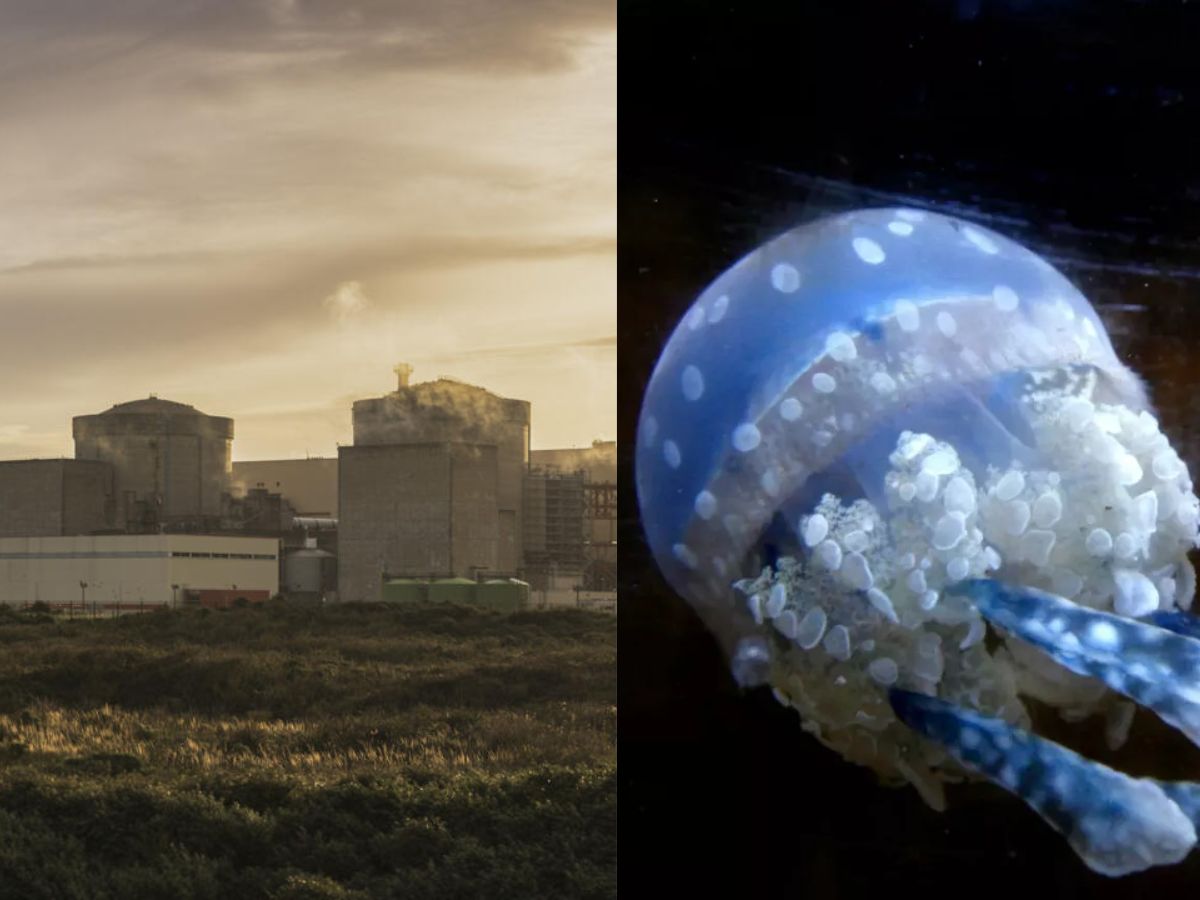
Jellyfish swarm shuts down four reactors at France’s Gravelines nuclear plant, raising climate change and invasive species concerns. Photos/X.
Four reactors at France’s Gravelines nuclear power plant were shut down late Sunday after a massive influx of jellyfish clogged the facility’s cooling water filters on Monday. The shutdown, likely linked to warming sea temperatures driven by climate change, temporarily halted operations at the entire plant.
EDF said reactors 2, 3, and 4 automatically went offline just before midnight when “massive and unpredictable” numbers of jellyfish blocked filter drums at the plant’s pumping stations. Reactor 6 followed a few hours later.
The company emphasised that the incident posed no risk to plant safety, staff, or the surrounding environment.
Also Read: Iran Secretly Hides Nuclear Scientists After Deadly Israeli Strikes – What Are They Planning Next?
Marine biologists attribute such blooms to warming oceans and invasive species.
“Jellyfish breed faster when water is warmer, and in areas like the North Sea, the reproductive window is getting wider and wider,” said Derek Wright, a marine biology consultant with the US National Oceanic and Atmospheric Administration Fisheries told Euro News.
The Asian Moon jellyfish, native to the Pacific Northwest, was first detected in the North Sea in 2020 and has been linked to similar nuclear plant disruptions in China, Japan, and India. It thrives in still, plankton-rich waters such as ports and canals and spreads globally by riding in the ballast tanks of large vessels.
Although the jellyfish near Gravelines lack a poisonous sting and pose no direct threat to humans, they remain a serious hazard to coastal infrastructure.
“Everyone talks about nuclear being clean, but we don’t think about the unintended consequences of heat pollution,” Wright noted. “Jellyfish can also hitch rides on tanker ships, entering the ships’ ballast tank in one port and often getting pumped out into waters halfway across the globe.”
Gravelines, one of France’s largest nuclear facilities, houses six reactors, each generating 900 megawatts for a total output of 5.4 gigawatts. The plant draws cooling water from a canal connected to the North Sea, an area that has seen steadily growing jellyfish populations in recent years due to warming waters and invasive species spread.
Jellyfish-related shutdowns have occurred worldwide for more than a decade. In 2011, plants in Israel, Japan, and Scotland were forced offline, followed by a similar incident in Sweden in 2013.
According to the Oceanic Invertebrate Research Institute, such events are becoming increasingly frequent due to overfishing, climate change, and expanding coastal development.
Also Read: How Many Nuclear Weapons Does Pakistan Have – And Who Really Controls Them?
Zubair Amin is a Senior Journalist at NewsX with over seven years of experience in reporting and editorial work. He has written for leading national and international publications, including Foreign Policy Magazine, Al Jazeera, The Economic Times, The Indian Express, The Wire, Article 14, Mongabay, News9, among others. His primary focus is on international affairs, with a strong interest in US politics and policy. He also writes on West Asia, Indian polity, and constitutional issues. Zubair tweets at zubaiyr.amin
A powerful bomb cyclone slammed North Carolina and parts of the Southeast, bringing record snowfall,…
The ICC has reacted to Pakistan’s refusal to play India in the ICC Men’s T20…
Merchant Navy Officer Rikshit Chauhan Returns Home Safely After Russian Tanker Seizure by US
