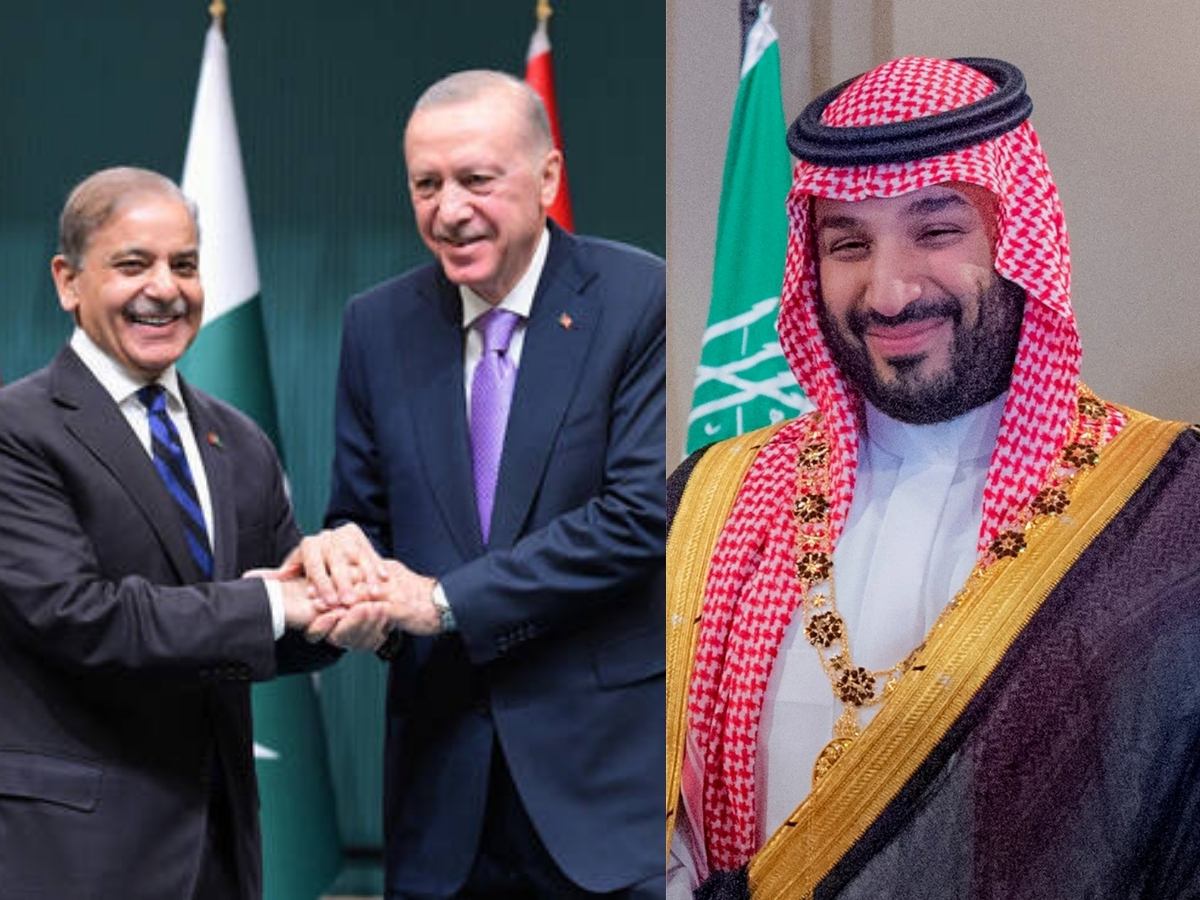
Turkey may join Pakistan-Saudi defence pact, forming a trilateral alliance. Photos: X.
Turkey is reportedly in advanced discussions to join a mutual defence pact between Saudi Arabia and Pakistan, according to Bloomberg. If finalized, the trilateral alliance could place Ankara under Islamabad’s nuclear umbrella. This could significantly alter the strategic landscape of the Middle East and South Asia.
The original Pakistan-Saudi agreement, signed in September 2025 during Prime Minister Shehbaz Sharif’s visit, was framed as a mutual defence pact. While it did not explicitly mention nuclear weapons, it stipulated that an attack on one signatory would be considered an attack on all.
Saudi Arabia, which does not possess nuclear weapons, entered the pact with Pakistan, the world’s only nuclear-armed Muslim-majority country, following Israel’s failed September 9 strike on Hamas leadership in Qatar. The attack sparked alarm and outrage across Gulf nations.
The emerging alliance has been described in some reports as a NATO-style framework for Muslim-majority states. For now, however, the so-called “Arab-Islamic NATO” remains largely a strategic slogan aimed at Israel.
Bloomberg reports that Turkey, which hosts US nuclear weapons as part of its NATO role, is “very likely” to join the pact. Analysts argue that Ankara’s entry would elevate the agreement from a bilateral framework into a trilateral security bloc, combining Saudi Arabia’s financial clout, Pakistan’s nuclear arsenal, ballistic missiles, manpower, and Turkey’s military experience and defence manufacturing base.
Nihat Ali Ozcan, a strategist at Ankara-based think tank TEPAV, told Bloomberg, “The proposed alignment brings together complementary strengths, including Turkey’s operational experience and defence industry, Pakistan’s nuclear capability, and Saudi Arabia’s financial resources.”
Despite Turkey’s NATO membership and possession of the alliance’s second-largest military, Ankara appears to be exploring parallel security frameworks amid uncertainty over Washington’s long-term commitment to the alliance.
Turkey–Pakistan defence ties have strengthened in recent years, extending beyond drone cooperation to include naval, air force, and training domains, bolstering Pakistan’s conventional military capabilities.
Analysts note that major regional powers like Saudi Arabia, the UAE, and Egypt maintain friendly ties with India and are unlikely to let Pakistan dominate the bloc’s agenda. Internal rivalries could also hinder coordination.
Nevertheless, Pakistan continues to position itself as the military vanguard of the Muslim world, seeking strategic depth and legitimacy amid domestic economic and political challenges.
Some observers have even expressed security concerns regarding Turkey’s potential inclusion, warning that the alliance could complicate India’s security environment, even if it does not constitute an immediate military threat.
Beyond South Asia, analysts suggest that the trilateral alignment could reshape power dynamics across West Asia and adjoining regions where India has significant energy, trade, and strategic interests.
Zubair Amin is a Senior Journalist at NewsX with over seven years of experience in reporting and editorial work. He has written for leading national and international publications, including Foreign Policy Magazine, Al Jazeera, The Economic Times, The Indian Express, The Wire, Article 14, Mongabay, News9, among others. His primary focus is on international affairs, with a strong interest in US politics and policy. He also writes on West Asia, Indian polity, and constitutional issues. Zubair tweets at zubaiyr.amin
Online video content features panicked travelers pressing around information boards and airlines offices to seek…
The governments in the Gulf have shut down their airspace, and most airlines canceled flights…
The lack of verification of their deaths highlights the subjective nature of the intensifying war,…
