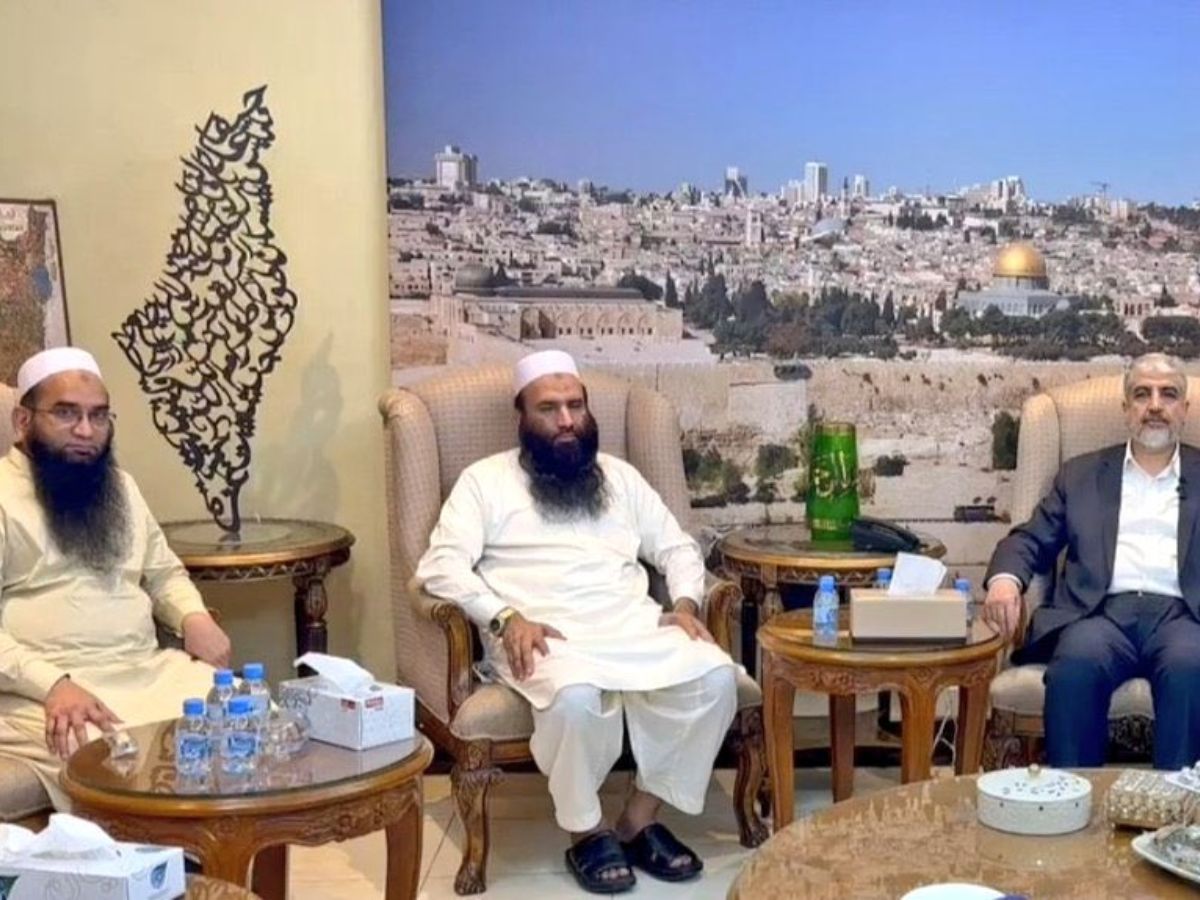
Pak-based Lashkar commander admits meeting Hamas leaders in Doha. (Photo: X)
A fresh controversy has erupted after a Pakistan-based Lashkar-e-Taiba-linked commander publicly admitted to meeting senior Hamas leaders, fuelling concerns of a deepening terror nexus with serious implications for regional and global security.
Faisal Nadeem, a commander of the Pakistan Markazi Muslim League (PMML) widely regarded as the political front of Lashkar-e-Taiba (LeT) has confirmed that he met senior Hamas leaders in Doha, Qatar, in 2024.
Nadeem says he was accompanied by Saifullah Kasuri during the meeting with senior Hamas leader Khaled Mashal. Both Lashkar-e-Taiba and Hamas are designated terrorist organisations by the United States and several other countries, making any coordination between them a matter of grave concern.
This is not an isolated incident. Throughout 2024, several videos surfaced showing Hamas commanders interacting with LeT-linked figures at public and private events, suggesting repeated contact between the two groups.
The latest disclosure comes days after visuals emerged from Pakistan, showing a senior Hamas leader attending a public event as a chief guest, allegedly hosted by Lashkar-e-Taiba affiliates.
According to intelligence inputs, Naji Zaheer, identified as a Hamas leader, recently participated in a PMML-linked event in Pakistan. Multiple videos circulating on social media show Zaheer addressing public gatherings, raising alarms within Indian security agencies.
Officials claim Zaheer fled Palestine before arriving in Pakistan and has reportedly visited the country nearly 15 times since October 2023, pointing to sustained engagement rather than sporadic contact.
Reacting strongly, India flagged the issue at the United Nations Security Council (UNSC), accusing Pakistan of continuing to use terrorism as an instrument of state policy.
“We have heard talk from the Representative of Pakistan about the ‘new normal’. Let me reiterate again that terrorism can never be normalised,” said India’s Permanent Representative to the UN, Ambassador Parvathaneni Harish.
“It is not normal to tolerate Pakistan’s continued use of terrorism as an instrument of state policy.”
The revelations gain further significance as PMML-linked operatives were earlier accused in the Pahalgam terror attack in Jammu and Kashmir, which killed 26 civilians.
In December 2025, the National Investigation Agency (NIA) filed a chargesheet naming seven accused, including a Pakistani handler, Sajid Jatt, and three Pakistani terrorists. The chargesheet invoked sections related to waging war against India and tied the conspiracy to Pakistan-based terror networks.
Naji Zaheer is believed to be involved in training local handlers and sharing combat tactics used by Hamas. Officials claim similar methods were attempted in India, including a foiled plot involving drone-based attacks using large quantities of ammonium nitrate.
Indian security forces reportedly destroyed nearly 3,000 kilograms of ammonium nitrate, averting what could have been a major terror incident.
Security agencies also allege that sections of Pakistan’s intelligence establishment and military facilitated these visits, allowing extremist ideologies to spread under the cover of religious and political messaging.
In one viral audio-video clip, references were reportedly made to linking Hamas’s conflict tactics with broader regional narratives, intensifying fears of cross-regional ideological coordination.
Counter-terrorism experts warn that the admitted Lashkar-Hamas links signal a strategic push towards a broader ideological and operational alliance, potentially involving training, fundraising, propaganda, and tactical collaboration.
Indian intelligence agencies are closely monitoring the developments and are expected to raise the issue at international platforms, including the Financial Action Task Force (FATF).
Analysts say the emerging trail of videos, public appearances, and admissions points to a coordinated front between Hamas and Lashkar-e-Taiba, marking a troubling evolution in the global terror network ecosystem.
As investigations continue, the key question remains: Is a new cross-regional terror axis taking shape and how prepared is the world to confront it?
Sofia Babu Chacko is a journalist with over five years of experience reporting on Indian politics, crime, human rights, gender issues, and stories about marginalized communities. She believes journalism plays a crucial role in amplifying unheard voices and bringing attention to issues that truly matter. Sofia has contributed articles to The New Indian Express, Youth Ki Awaaz, and Maktoob Media. She is also a recipient of the 2025 Laadli Media Awards for gender sensitivity. Beyond the newsroom, she is a music enthusiast who enjoys singing. Connect with Sofia on X: https://x.com/SBCism
India’s 2026–27 home season features white-ball series against West Indies, Sri Lanka and Zimbabwe, followed…
Tehran: Amid escalating tensions in West Asia, Iran is reportedly moving towards a controlled passage…
Bank of Baroda Recruitment 2026: Check Eligibility And Steps to Apply
The Bank of Baroda has announced a new recruitment drive for professional roles under its…
