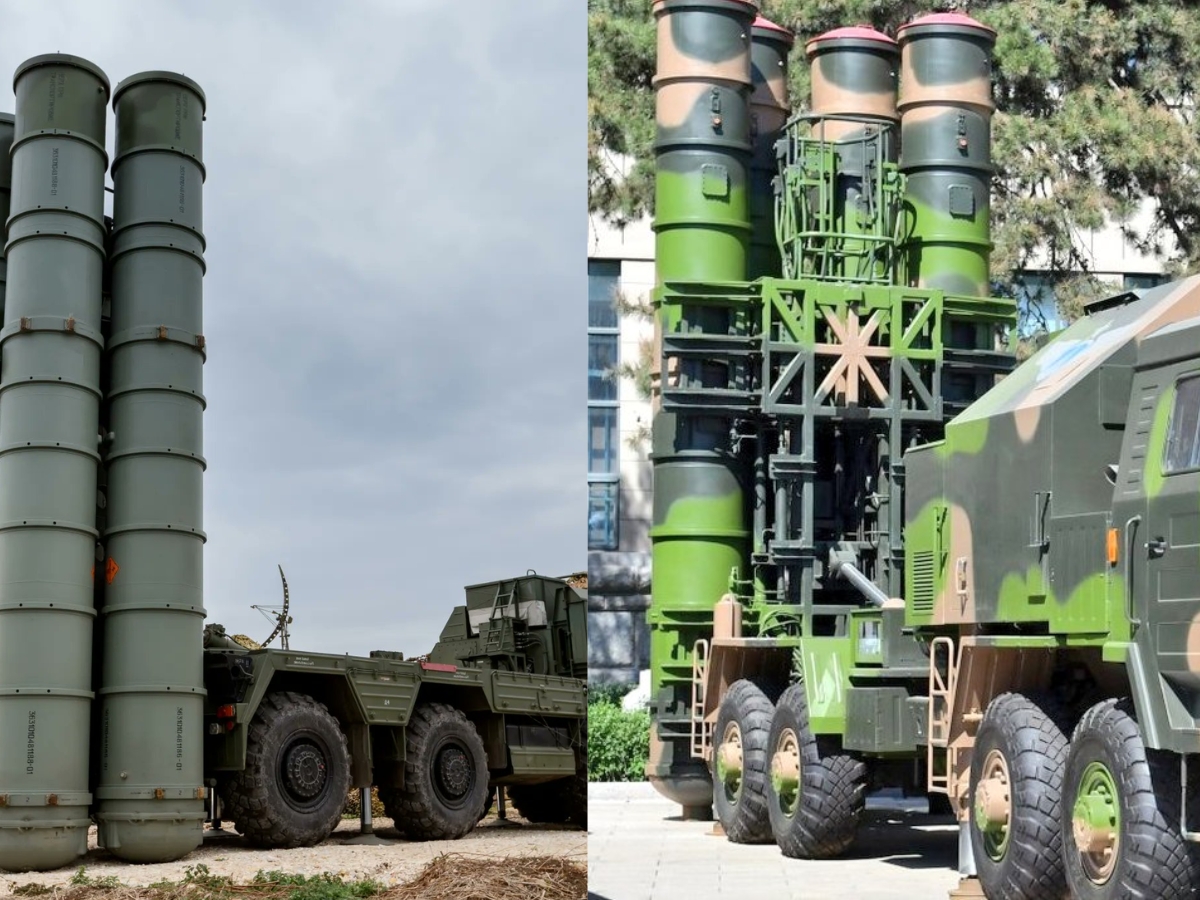
India’s S-400 outperforms Pakistan’s HQ-9 in range, speed, and radar capabilities, shaping South Asia’s air defence balance. Photos/X.
India’s S400 Vs Pakistan’s HQ-9: At China’s Victory Day military parade on Wednesday, marking the 80th anniversary of World War 2, a new air defence formation was showcased. The formation featured six types of air defence and antiballistic missile systems, many making their debut at the event. Various variants of HQ defence system were put on display.
The systems reviewed included HQ-11, HQ-20, HQ-22A, HQ-9C, HQ-19, and HQ-29, all appearing for the first time in Tiananmen Square. These weapons are capable of long-range, medium-range, and short-range air defence missions, along with multi-course, multi-layer antiballistic missile interception. They aim to build a robust barrier for air and aerospace defence, safeguarding national peace and stability.
Previously, the HQ-11 and HQ-22 were showcased at the 15th Airshow China in 2024. The HQ-11 functions as a terminal defence weapon, intercepting air-to-surface missiles, guided bombs, cruise missiles, fixed-wing combat aircraft, and helicopters. It provides mid-to-low altitude, short-range protection for high-value targets.
The HQ-22 is tasked with mid-to-high altitude and medium-range air defence, capable of intercepting aerodynamic targets such as third-generation combat aircraft, attack helicopters, and drones. It also boasts strong anti-interference and mobile combat capabilities.
India and Pakistan maintain distinct air defence capabilities, shaped by their geopolitical needs.
India acquired the S-400 Triumf from Russia in 2018, according to PIB Delhi, citing strategic security considerations. Features include:
Range – Tracks targets up to 600 km; intercepts threats at 250–400 km using the 48N6E3 ABM from 60 km.
Altitude – Engages targets from 10 meters to 30 km.
Speed – Neutralises hypersonic threats at Mach 14 (approximately 17,000 km/h).
Radar – 91N6E “Big Bird” AESA and 92N2E Grave Stone can track 300+ targets and engage 36 simultaneously with 360-degree surveillance.
Mobility – 8×8 transporter-erector-launchers (TEL) per battery, redeployable.
Warhead – 143 kg high-explosive fragmentation (48N6) or hit-to-kill (77N6) with proximity fuse.
Pakistan operates the HQ-9P, a customised variant of China’s HQ-9 (Hongqi-9 / Red Banner-9), according to IDRW.org. Features include:
Range: Base model 120 km, extended to 300 km in HQ-9B.
Altitude: Operational up to 30 km.
Speed: Engages targets up to Mach 4.2.
Radar: HT-233 phased array, tracks 100 targets, engages 50 simultaneously.
Mobility: Mounted on Chinese Taian TAS-5380 8×8 truck chassis with air-cooled diesel engine.
Warhead: 180 kg high-explosive fragmentation.
India currently operates three of five S-400 squadrons, with the remaining two expected by 2026. During Operation Sindoor (2025), India’s S-400s demonstrated formidable capabilities. Prime Minister Narendra Modi shared images from Adampur Air Base, tweeting, “brave air warriors and soldiers.”
S-400 – L-band radars are jam-resistant via frequency hopping.
HQ-9 – C-band HT-233 radars are vulnerable to Indian EL/M-2083 jammers.
The S-400 offers multi-layered interception with four missile types, creating overlapping zones of kill up to 400 km, forcing adversaries to operate from distant bases and reducing sortie rates by 40–60%.
The HQ-9 relies on semi-active radar homing requiring continuous illumination, making it vulnerable to anti-radiation missiles. Pakistan’s limited battery count (12–18 units) compared with India’s 40+ S-400 launchers results in coverage gaps.
Also Read: Su-57 vs F-35 vs Rafale: Comparison of Russia, US, and France’s Advanced Fighter Jets
Zubair Amin is a Senior Journalist at NewsX with over seven years of experience in reporting and editorial work. He has written for leading national and international publications, including Foreign Policy Magazine, Al Jazeera, The Economic Times, The Indian Express, The Wire, Article 14, Mongabay, News9, among others. His primary focus is on international affairs, with a strong interest in US politics and policy. He also writes on West Asia, Indian polity, and constitutional issues. Zubair tweets at zubaiyr.amin
Tom Cruise Digger: Tom Cruise has surprised fans by unveiling the first glimpse of his…
Greg Biffle: The former NASCAR driver Greg Biffle died at the age of 55 after…
Kristin Cabot: Kristin Cabot, the former Head of Human Resources at tech firm Astronomer, has…
