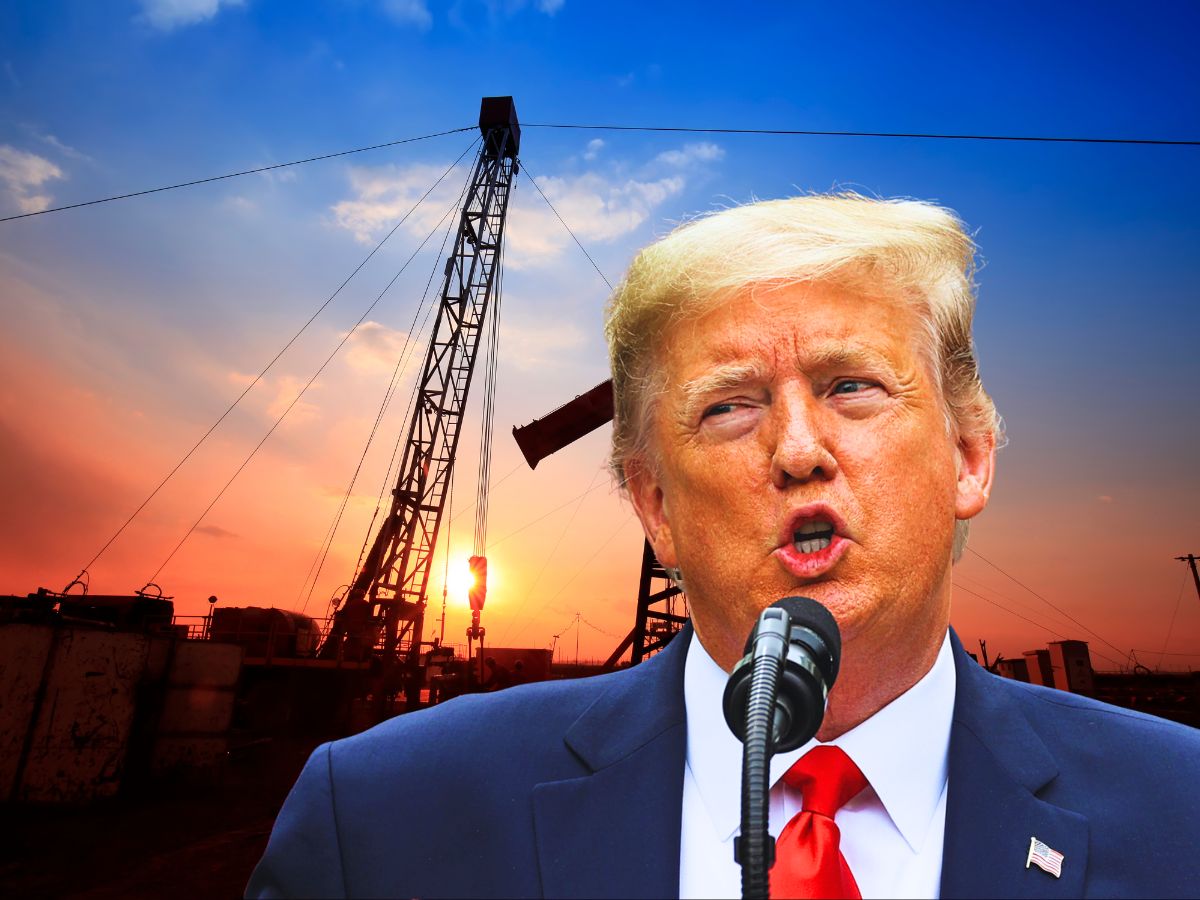
Trump signals no deadline on US control of Venezuela’s oil. (Photo: X, Canva)
US President Donald Trump has indicated that Washington expects to exercise long-term control over Venezuela, including drawing oil from the country’s vast reserves for years, according to an interview with The New York Times published on Wednesday (local time).
Speaking to the newspaper despite having sued it last year over its coverage of the Epstein files Trump said the United States would retain direct oversight of Venezuela for an extended period, with oil extraction forming a central pillar of its strategy.
When asked how long the US would continue to effectively run the South American nation, Trump replied: “Only time will tell,” adding that the arrangement was likely to last “much longer.”
Trump did not set any deadline for ending US control over Venezuela. When pressed on whether Washington’s role would last months or years, he indicated it would extend well beyond the short term.
According to the report, Trump said the interim administration in Caracas, composed of former loyalists of the now-imprisoned President Nicolás Maduro, was cooperating fully with Washington’s demands.
“They are giving us everything that we feel is necessary,” Trump said.
Trump said rebuilding Venezuela’s oil sector is central to the US approach, both to benefit American interests and to help lower global oil prices.
“We will rebuild it in a very profitable way,” he said. “We’re going to be using oil, and we’re going to be taking oil. We’re getting oil prices down, and we’re going to be giving money to Venezuela, which they desperately need.”
According to The New York Times, Trump said the US has already begun benefiting financially by taking oil that was previously under sanctions. He referred to an announcement made Tuesday night that Washington would obtain between 30 million and 50 million barrels of heavy Venezuelan crude, worth about $2.8 billion at current market prices.
However, Trump acknowledged that reviving Venezuela’s oil industry will take time.
US Energy Secretary Chris Wright offered the clearest articulation yet of Washington’s strategy to monetise Venezuelan crude.
“We’re just going to get that crude moving again and sell it,” Bloomberg quoted Wright as saying. “First this backed-up stored oil, and then indefinitely going forward, we will sell the production that comes out of Venezuela.”
The Energy Department said the plan includes selectively rolling back sanctions on Venezuela’s oil sector. Chevron remains the only major US company operating in Venezuela under a special licence, while ExxonMobil and ConocoPhillips exited after their assets were nationalised under Hugo Chávez.
Despite repeatedly referencing a future political “transition,” Trump provided no timeline for elections in Venezuela during the interview.
He also declined to explain why Washington recognised Delcy Rodríguez, Maduro’s vice president, as interim leader instead of opposition figure María Corina Machado, whose coalition claimed victory in the 2024 election and later received the Nobel Peace Prize.
When asked whether he had spoken directly to Rodríguez, Trump said: “Marco speaks to her all the time,” referring to Secretary of State Marco Rubio. “We are in constant communication with her and the administration.”
While many Republican lawmakers have backed the administration’s Venezuela policy, Democrats warned that the US risks entering a prolonged overseas intervention without clear legal authority.
Trump, however, dismissed concerns and reiterated that US oversight would continue for the foreseeable future.
During the interview, Trump briefly paused to take a call from Colombian President Gustavo Petro, days after criticising Colombia over drug trafficking. Later, Trump struck a conciliatory tone on Truth Social, saying talks were being arranged between Rubio and Colombia’s foreign minister.
Meanwhile, US forces have seized additional sanctioned oil tankers including one flying a Russian flag as Washington pushes to control Venezuelan crude exports. One vessel was seized in the Atlantic Ocean south of Iceland, and another in the Caribbean.
Trump has made one thing clear: there is no exit timeline yet. While he has promised infrastructure rebuilding and an eventual political transition, the absence of an election roadmap suggests the US could retain control over Venezuela’s oil sector and its broader governance for years.
For now, Washington appears set to run Venezuela’s oil trade indefinitely, with oil extraction at the heart of Trump’s economic and geopolitical strategy.
Sofia Babu Chacko is a journalist with over five years of experience reporting on Indian politics, crime, human rights, gender issues, and stories about marginalized communities. She believes journalism plays a crucial role in amplifying unheard voices and bringing attention to issues that truly matter. Sofia has contributed articles to The New Indian Express, Youth Ki Awaaz, and Maktoob Media. She is also a recipient of the 2025 Laadli Media Awards for gender sensitivity. Beyond the newsroom, she is a music enthusiast who enjoys singing. Connect with Sofia on X: https://x.com/SBCism
After the arrest of Nashik-based godman and numberologist Ashok Kharat on Tuesday for allegedly raping…
Cocktail 2, starring Shahid Kapoor, Rashmika Mandanna, and Kriti Sanon, is all set to turn…
HPBOSE Admit Card 2026 Out: Check Exam Date, Download Link Here
The Himachal Pradesh Board of School Education (HPBOSE), Dharamshala, has released the admit card for…
