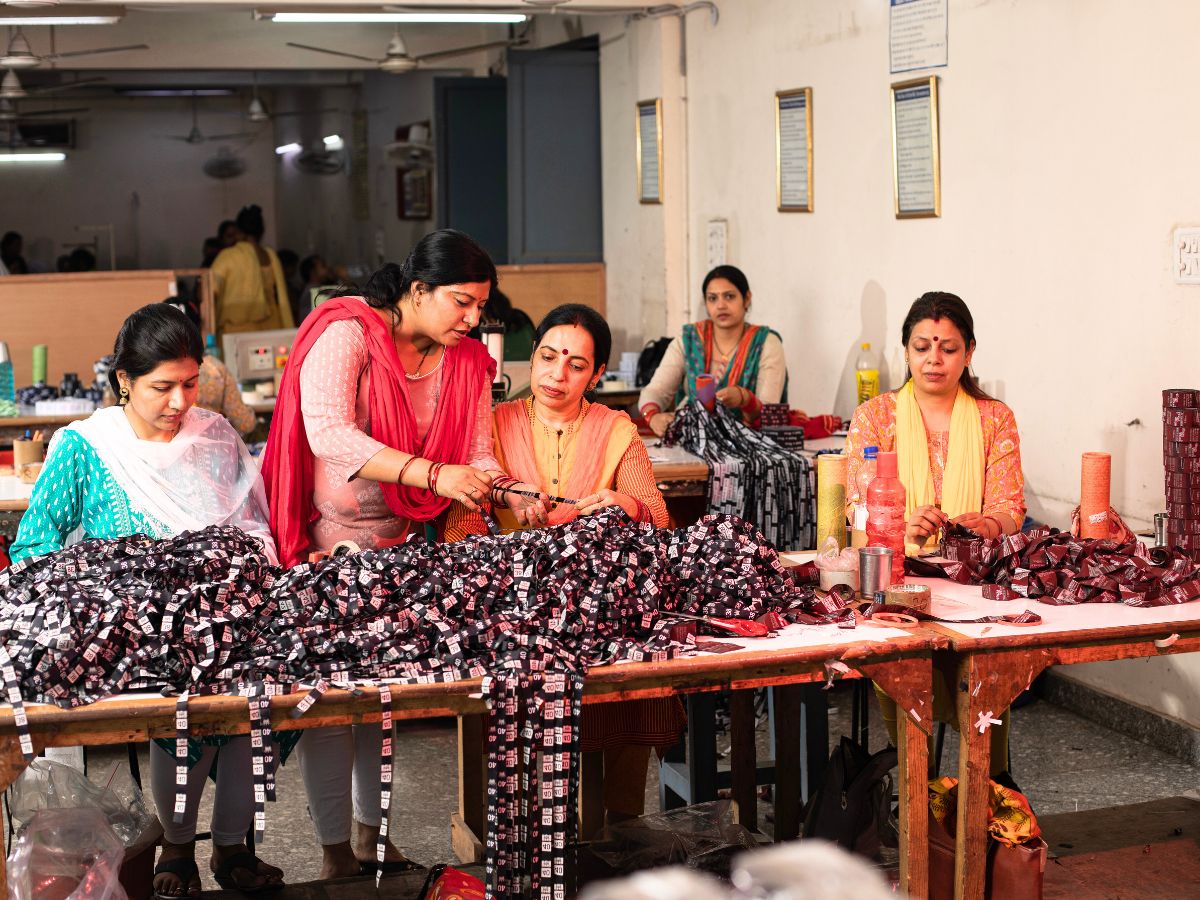
Labour codes can boost women’s workforce participation by improving safety. (Photo: Canva)
The four labour Codes, notified with effect from November 21, 2025, could play a crucial role in increasing women’s participation in India’s workforce by making jobs safer, more secure and more accessible, a white paper by the All India Organisation of Employers (AIOE) in collaboration with law firm Shardul Amarchand Mangaldas has said.
Titled Breaking the Glass Ceiling: How the Labour Codes Boost Women’s Participation in India’s Workforce, the paper highlights how India’s legal framework has evolved alongside social change, pointing to a steady rise in the female labour force participation rate from 23.3 per cent in 2017–18 to 41.7 per cent in 2023–24, indicating growing opportunities and improved conditions for working women.
This progress, according to the white paper, has been supported by women-centric laws such as the Maternity Benefit Act, 1961 and the Sexual Harassment of Women at Workplace Act, 2013, as well as government initiatives including Mission Shakti, NAVYA and WISE-KIRAN.
The white paper further argued that the labour Codes modernise India’s employment law framework by consolidating multiple legacy laws into a simpler and more coherent structure.
This, it noted, is particularly significant for women, as the reforms aim to make workplaces safer, social security broader and compliance more predictable. One of the key outcomes of the Codes is their potential to expand women’s participation across sectors by making work more sustainable and secure, rather than merely creating new opportunities.
Under the Social Security Code, 2020, maternity protections remain robust, with 26 weeks of paid leave continuing for eligible employees and 12 weeks for adoptive and commissioning mothers.
The white paper also highlighted that measures such as nursing breaks, medical support and simplified proof requirements for pregnancy and delivery are critical in reducing the economic and health disruptions that often force women to permanently exit the workforce.
The white paper also drew attention to the expansion of Employees’ State Insurance coverage across all industries and districts, including plantations, which employ a large number of women workers.
The inclusion of gig and platform workers within the social security framework is described as a forward-looking shift, particularly for women who rely on flexible work arrangements to balance caregiving responsibilities.
Further, the Occupational Safety, Health and Working Conditions Code allows women to work in all establishments, including traditionally restricted sectors and night shifts, subject to consent and adequate safety arrangements. This is seen as a transformative provision for sectors such as IT, healthcare, aviation and logistics, removing an “invisible ceiling” on women’s earnings and advancement.
While emphasising the promise of the reforms, the white paper cautioned that legislation alone will not deliver change. Real impact, it argued, will depend on implementation by employers, responsiveness of markets and the effectiveness of supporting institutions.
(With ANI Inputs)
ALSO READ: Delhi AQI: GRAP-3 Restrictions Imposed Again – Here Is What’s Allowed, What’s Banned
Sofia Babu Chacko is a journalist with over five years of experience reporting on Indian politics, crime, human rights, gender issues, and stories about marginalized communities. She believes journalism plays a crucial role in amplifying unheard voices and bringing attention to issues that truly matter. Sofia has contributed articles to The New Indian Express, Youth Ki Awaaz, and Maktoob Media. She is also a recipient of the 2025 Laadli Media Awards for gender sensitivity. Beyond the newsroom, she is a music enthusiast who enjoys singing. Connect with Sofia on X: https://x.com/SBCism
The sudden departure took investors by surprise, more so since HDFC Bank Chairman Atanu Chakraborty…
Brahmacharini Mata Ki Aarti: The second day of Chaitra Navratri is dedicated to Maa Brahmacharini,…
New Zealand vs South Africa 3rd T20I: Check Predicted Playing XI, Weather Forecast And Pitch Report
As the five-match series is levelled at 1-1, New Zealand and South Africa lock horns…
