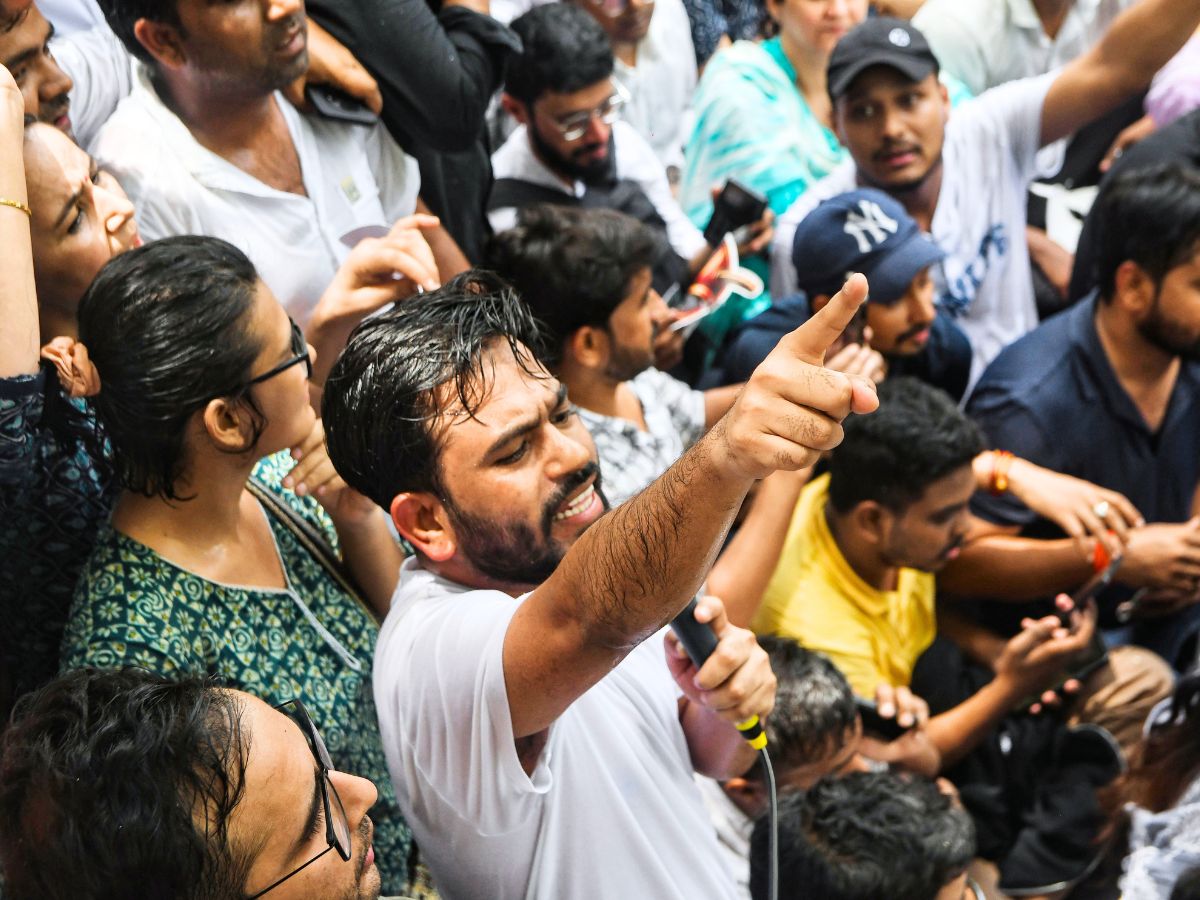
CJP is struggling to build a clear and consistent political identity. (Photo: ANI)
A politically upset guy, Abhijeet Dipke while sitting in an AC room in US started a so-called movement so suddenly, against CJI Surya Kant’s cockroach comment on Indian Youth. He manages to get over 2 crore followers on social media, leaving behind one of the oldest political parties. Entire social media goes gaga and they announce protests. Now the US guy comes to India and heads straight to Jantar Mantar for protest. Of over 2 crore followers, only 1,000 turn up. Some old men, some clueless youngsters and some with usual communal weapons. It seemed like a crowd, not a community. Before 5 pm, all leaders left the site. It was too hot for them in Delhi. The cockroaches were exposed and India wasn’t impressed.
It all followed after a May 2026 court hearing when oral observations he made were widely interpreted as referring to some unemployed youth and activists as “parasites” and “cockroaches”. The remarks were delivered while the Supreme Court was hearing a plea regarding the designation of senior advocates and addressing growing concerns over individuals practicing law with dubious or fake degrees.
CJI criticized people without employment who “don’t have any place in the profession” who then become media, social media, or RTI activists to “attack the system”. This triggered some youth and opposition party leaders in India to grant full support to this unknown movement. Why all of a sudden?
What began as online outrage has now morphed into a self-proclaimed political experiment called, the new political star Cockroach Janata Party (CJP). But beneath the noise, the movement appears less like a structured political force and more like a digital performance struggling to survive real-world scrutiny. And ironically, it does not need a “kaala hit” from outside; its working says it is already weakening itself from within.
Even though CJP got support of India’s opposition party leaders, CJP’s emergence can’t even compare to a political party level. It’s a collapsed movement, which is trying to project itself as a saviour of students and youth.
Initially, many compared CJP to the early days of AAP, but the similarity fades on closer look. Unlike AAP, which grew out of Anna Hazare’s grassroots anti-corruption movement and had strong ground-level activists, CJP lacks a real common-man base. Its politics appears driven more by virality than street-level mobilisation and in politics, social media buzz alone rarely lasts.
One of the biggest debates around CJP is how quickly it has grown online and how fast its messages are being shared across platforms. The movement suddenly gained visibility in a very short time, which naturally raises questions about whether this growth is fully organic or helped by coordinated online networks. Will there a western interference here?
These are not proven claims, but they are being discussed widely because the movement has not clearly explained how it is funded or how its digital reach is being managed.
India’s strongest social and political movements were never built overnight or driven by satire and online outrage. They came from deep social struggles and long-term commitment to change. Reformers like Raja Ram Mohan Roy, Jyotiba Phule, and Ishwar Chandra Vidyasagar fought against serious social evils such as sati, child marriage, and caste discrimination with clear purpose and courage.
In 1828, Raja Ram Mohan Roy started the Brahmo Samaj to promote rational thinking and social reform. Later, in 1873, Jyotiba Phule founded the Satyashodhak Samaj to challenge caste oppression and give dignity to marginalized communities. These movements were not about attention or trends they were about real issues affecting people’s lives.
This tradition continued during the freedom struggle, one of the largest mass movements in history. Between the 1920s and 1947, Mahatma Gandhi’s movements like the Non-Cooperation Movement, Civil Disobedience Movement, and Quit India Movement brought millions together against British rule with sacrifice and discipline.
After independence in 1947, social movements focused on land reforms, tribal rights, and women’s empowerment. All these movements had clarity of purpose and long-term vision. In contrast, CJP appears to be driven more by trending outrage and digital visibility rather than structured ideology or grassroots work. Without that foundation, it becomes difficult for any movement to grow beyond social media attention.
These movements had clarity of purpose, sacrifice, and long-term vision. In contrast, CJP appears to be built on trending outrage rather than structural change. That difference is crucial.
Abhijeet Dipke, the face of this movement, is being framed online as a “Gen Z voice.” However, he is a millennial. Having previously worked in communication spaces and later pursuing studies abroad, his sudden re-entry into activist politics has raised questions about intent, timing, and political direction. Even Dipke himself has clarified that the movement is not aligned with external Gen Z protests seen in other countries, but comparisons continue to circulate. It is clearly evident that CJP is not just trying to reform education in India. But something else.
CJP does not really need any outside force to bring it down; its biggest problems seem to come from within. When Abhijit Dipke landed in Delhi and faced chants of “Kaala hit,” it reflected the growing criticism around the movement. But beyond that, CJP is struggling to build a clear and consistent political identity.
Its messaging often changes with social media trends, its demands lack long-term policy direction, and its positions keep shifting, making it difficult for people to trust its seriousness.
More importantly, unlike movements that grew from the ground up, CJP has failed to create a strong base of common people working at the grassroots.
At its core, CJP looks more like a viral internet phenomenon than a durable political force. And in politics, virality may create attention, but without organisation and ground-level activism, it rarely lasts.
ALSO READ: Who Were 5 IAF Personnel Killed in Assam’s Johrat An-32 Crash?
Sofia Babu Chacko is a journalist with over five years of experience reporting on Indian politics, crime, human rights, gender issues, and stories about marginalized communities. She believes journalism plays a crucial role in amplifying unheard voices and bringing attention to issues that truly matter. Sofia has contributed articles to The New Indian Express, Youth Ki Awaaz, and Maktoob Media. She is also a recipient of the 2025 Laadli Media Awards for gender sensitivity. Beyond the newsroom, she is a music enthusiast who enjoys singing. Connect with Sofia on X: https://x.com/SBCism
FIFA Orders Egypt To Remove Seven AFCON Icons From FIFA World Cup 2026 Jersey — Here’s Why
The governing body has stepped in with a strict wardrobe ruling that forces the Pharaohs…
Woman Attacked Multiple Times By Shark At Sydney’s Coogee Beach | Watch
A 35-year-old woman suffered serious arm and leg injuries after a shark attack at Sydney's…
Trump Makes Big Claim: Iran Could Sign Peace Agreement Within 24 Hours
Trump and Pakistan say a framework for a US-Iran peace deal is ready for signing,…
