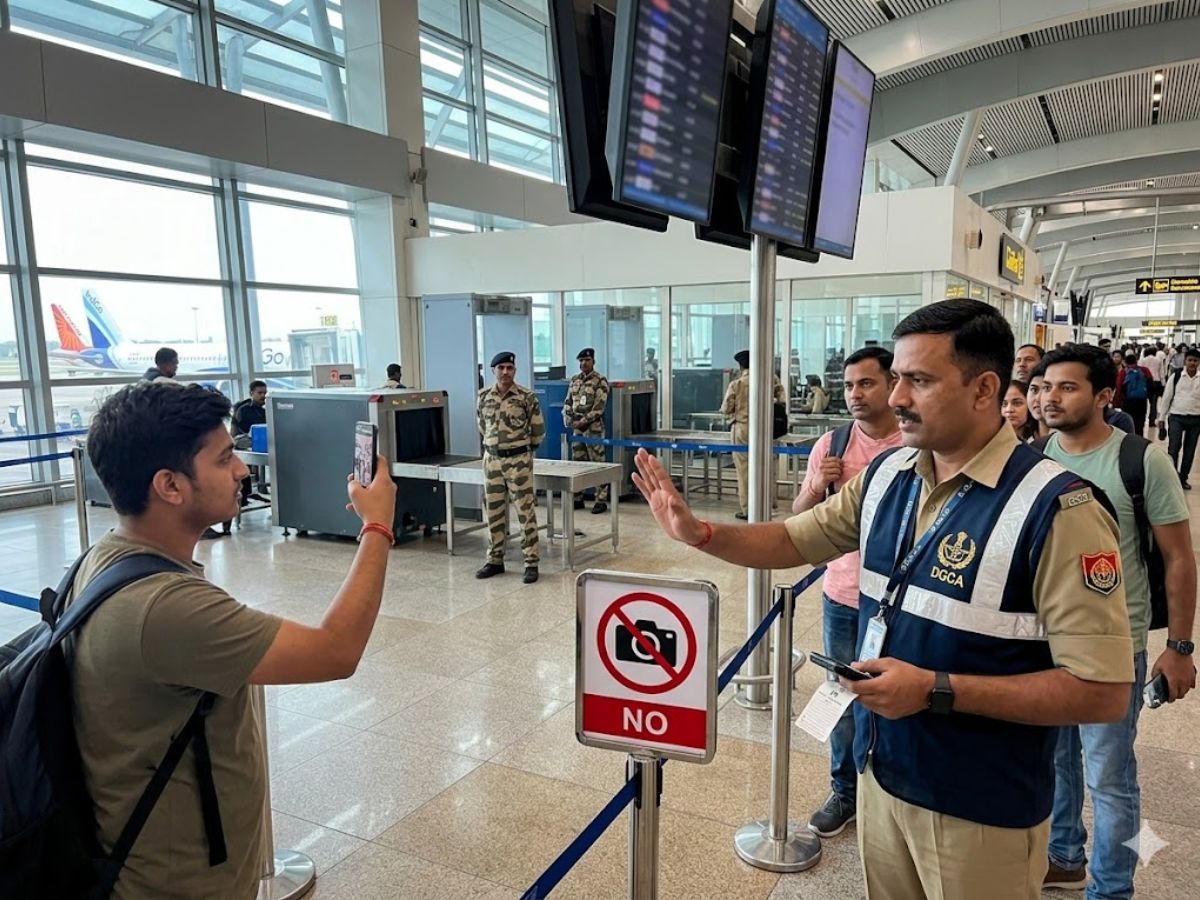
Photography could lead travellers in trouble, DGCA issues new rules (Image: AI-generated)
In the UAE, the Directorate General of Civil Aviation (DGCA) recently imposed restrictions on taking photographs and making videos in the country’s airports. The DGCA issued these warnings against unauthorised shooting at Indian airports at a time when people have become so addicted to posting on social media about their experiences at the airport. While this is happening, people are unaware that by taking pictures at the airport, they could be inadvertently putting out some sensitive information related to its security and operations. In the new restrictions, passengers could be subject to different types of sanctions for breaching the set policies including fines, confiscation of cameras and devices, and being blacklisted from flying to the country in case of security-related infringements.
As per reports, the latest DGCA guidelines prohibit photography and videography in several sensitive sections of airports unless prior permission has been obtained. These restricted locations include security checkpoints, boarding gates, runway buses, aircraft parking and handling zones, also known as aprons, and other operational areas that are not meant for public recording.
Authorities say the purpose of these restrictions is to prevent the accidental capture of surveillance systems, airport security arrangements, staff procedures and other operational details. While many travellers may record content without any harmful intent, officials believe such footage can still expose information that should remain protected.
According to reports, passengers who ignore the restrictions may be asked to immediately delete the content they have recorded. Depending on the seriousness of the violation, authorities can also confiscate mobile phones, cameras or other recording equipment. Financial penalties may also be imposed under the revised enforcement measures.
In more severe cases, it might even be possible to inspect the devices as part of an investigation. Additionally, the DGCA has said that in cases of multiple or serious violations, it is recommended to put the individual’s name on the no-fly list.
As per reports, under existing civil aviation regulations, passengers can face different levels of flying restrictions. Level 1 violations can result in a ban of up to three months. Level 2 violations can attract a suspension of up to six months. Level 3 violations carry a minimum ban of two years and can extend even further depending on the circumstances.
The DGCA has emphasised that security-related offences fall into a serious category. Officials say the growing volume of airport content on platforms such as Instagram and YouTube has raised concerns because some videos have captured surveillance camera locations, staff movement patterns, airport layouts and security systems.
According to reports, the regulations also place strict conditions on photography involving foreign nationals. No foreign crew shall be engaged in photography. However, if foreign nationals are involved, authorities must ensure they have received security clearance from the relevant agencies before undertaking photography at any aerodrome.
In addition, records of all photography activities must be maintained for three years and made available to the Directorate General of Civil Aviation whenever requested. Commercial shoots, including brand campaigns, documentaries and professional influencer content, will continue to require prior approval from airport authorities and security agencies. While filming remains allowed in public spaces such as check-in halls, food courts and arrival or departure concourses outside restricted zones, travellers must continue to follow all signage and instructions issued by airport staff.
Khalid Qasid is a media enthusiast with a strong interest in documentary filmmaking. He holds a Master’s degree in Convergent Journalism from AJK MCRC. He has also written extensively on esports at Sportsdunia. Currently, he covers world and general news at NewsX Digital.
Diagnoses, Tips and Care for Dengue amid Monsoon Surge
New Delhi [India], June 01: At the peak of this monsoon season, health experts are…
EBITDA in FY26 stood at Rs. 22.93 crore, reflecting stable performance. Surat (Gujarat) [India], June…
TMC Expels 2 MLAs Amid Signature Forgery Case
The alleged MLA signature forgery case in West Bengal has escalated after TMC expelled MLAs…
