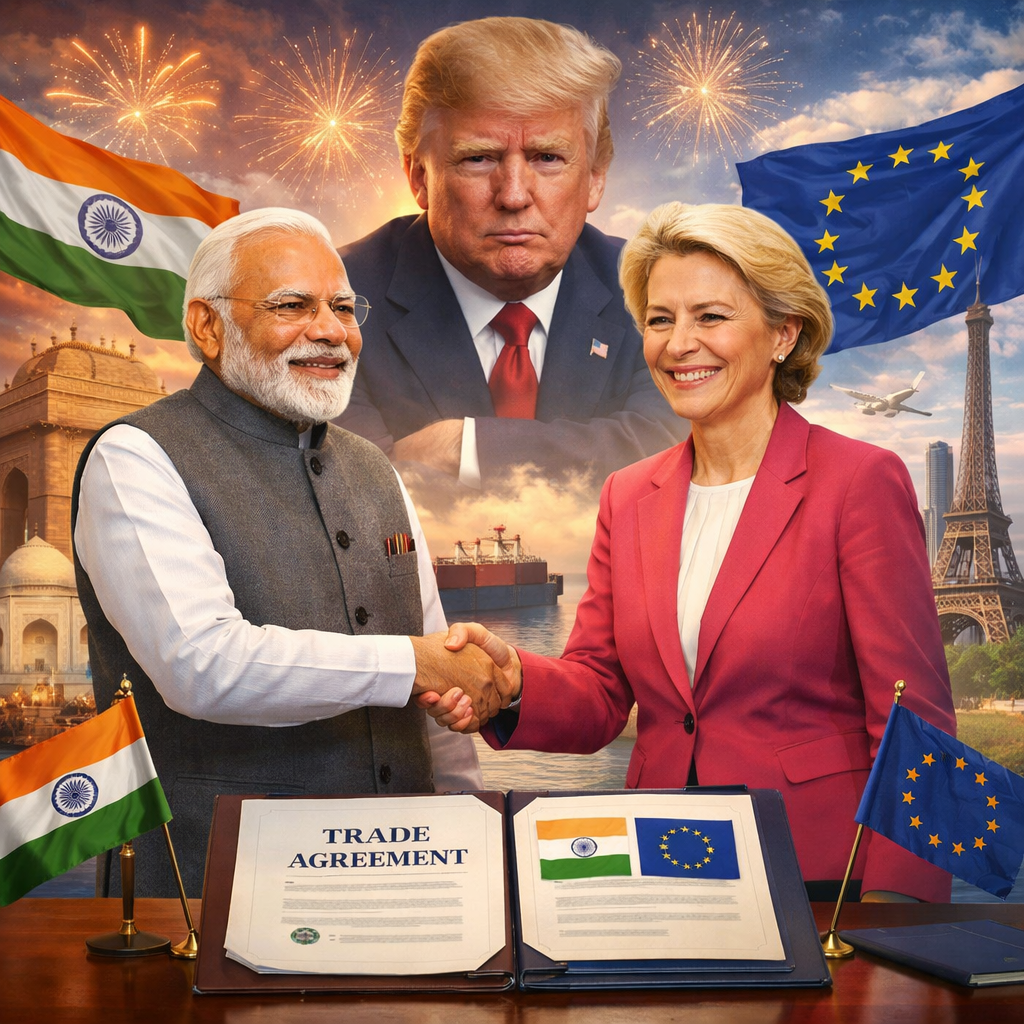
India has been slapped with 50% tariffs (25% reciprocal and 25% for Russian oil) amid rocky ties with the US (AI-Generated Image)
India and the European Union just pulled off what they’re calling the ‘mother of all trade deals’ and let’s be honest, it’s the kind of move that’s sure to get under Trump’s skin.
Trump isn’t exactly known for letting things slide. For him, this probably feels like a slap in the face, especially since the US-India trade deal is still stuck.
That ‘Daddy’ nickname, courtesy of the NATO chief last year, has stuck to Trump like glue. It’s become a way to sum up how he acts: this overbearing figure who wants to call the shots, whether you’re a friend or an enemy.
Just the other day, his Treasury Secretary, Scott Bessent, went on TV and accused Europe of funding the Russia-Ukraine war by buying energy through India.
“We slapped 25% tariffs on India for buying Russian oil,” Bessent told ABC News. “And what happened? Europe signs a trade deal with India.” You could almost hear the frustration.
But here’s the twist: Trump kind of helped make this deal happen. The talks dragged on for twenty years, but his tough-guy tactics on those tariffs, the constant needling of allies, actually pushed India and the EU closer together. Without all that drama, maybe they wouldn’t have sealed the deal.
When Modi announced the agreement, he couldn’t resist a subtle jab at Trump. “There’s upheaval in the global order. This deal will stabilise the turmoil,” he said. The message was clear: sometimes, chaos brings people together—just not always in the way you expect.
In bad relations with the US, India has received 50% tariffs (25% reciprocal and 25% on the Russian oil). Throughout most of the previous year, Trump and his supporters indulged in madmen’s criticisms of India, not only describing it as the orifice of the Kremlin, but also terming the conflict in Ukraine, the war of Modi. All this to coerce India into making a one-sided trade agreement to benefit the US.
However, India has managed to hold its own against Trump when threatened and bully tactics but has never made any direct attacks against the US President.
Europe, on the other hand, has angered Trump over supporting his bid to take over Greenland. Europe has suffered as well as the target of an unpredictable Trump since it was labelled as weak, and threats of further tariffs were also made.
It has reacted by freezing the EU-US trade agreement, and some countries have shunned bids to be part of the Gaza Board of Peace that Trump is leading.
In this context, therefore, the India-EU agreement appears as a tactic to diversify their trade relations not only with the US and China, which have employed export restrictions as a means of safeguarding vital technologies.
In the case of India, the trade agreement will be an indication to the US that it is not ready to bow down to the threats of Trump. India has been making rapid steps in recent months to sign vital trade deals with the UK, New Zealand and Oman.
India is fully aware that Trump admires power, and it has survived through the upheaval because PM Modi has not lost his methods of pressure.
The EU, on the other hand, has been mindful of the Indian red lines with reference to agriculture and dairy. In this way, the trade deal does not cover these sensitive industries, which can be regarded as a long-term practice of India to support domestic farmers.
The US, in its turn, is obsessed with gaining wider access to these spheres.
For the EU, India’s a big deal now, it’s the fourth-largest economy, and the market just keeps growing. Sure, New Delhi and Brussels have their disagreements, but India hasn’t tried to push Europe around or embarrass it.
The trade deal kicking in next year is a win for both sides.
India gets a break from the tariffs Trump slapped on things like textiles, chemicals, gems, and jewellery, industries that rely heavily on workers. This free trade agreement gives them better, sometimes duty-free, access to European markets.
Europe already buys more from India than anyone else. Now, with duties dropping on over 90% of traded goods and fewer barriers for services like telecom and accounting, India’s exports are set to grow even more.
The EU isn’t left out, either. India’s slashing tariffs on European cars from a jaw-dropping 110% down to 40%. That’s a serious opening for Volkswagen, Mercedes, BMW, and others to get a bigger piece of the world’s third-largest car market.
So, without threats or arm-twisting, just through solid negotiation, India and the EU have managed to reach a practical trade deal that works for both.
For over six decades, Metformin has remained the go-to treatment for Type 2 Diabetes, valued…
Petrol Price Today: Petrol prices have risen sharply by over ₹5 per litre in several…
Boman Irani humorously questioned Donald Trump’s delayed concern for Iranians, asking “Where were you when…
