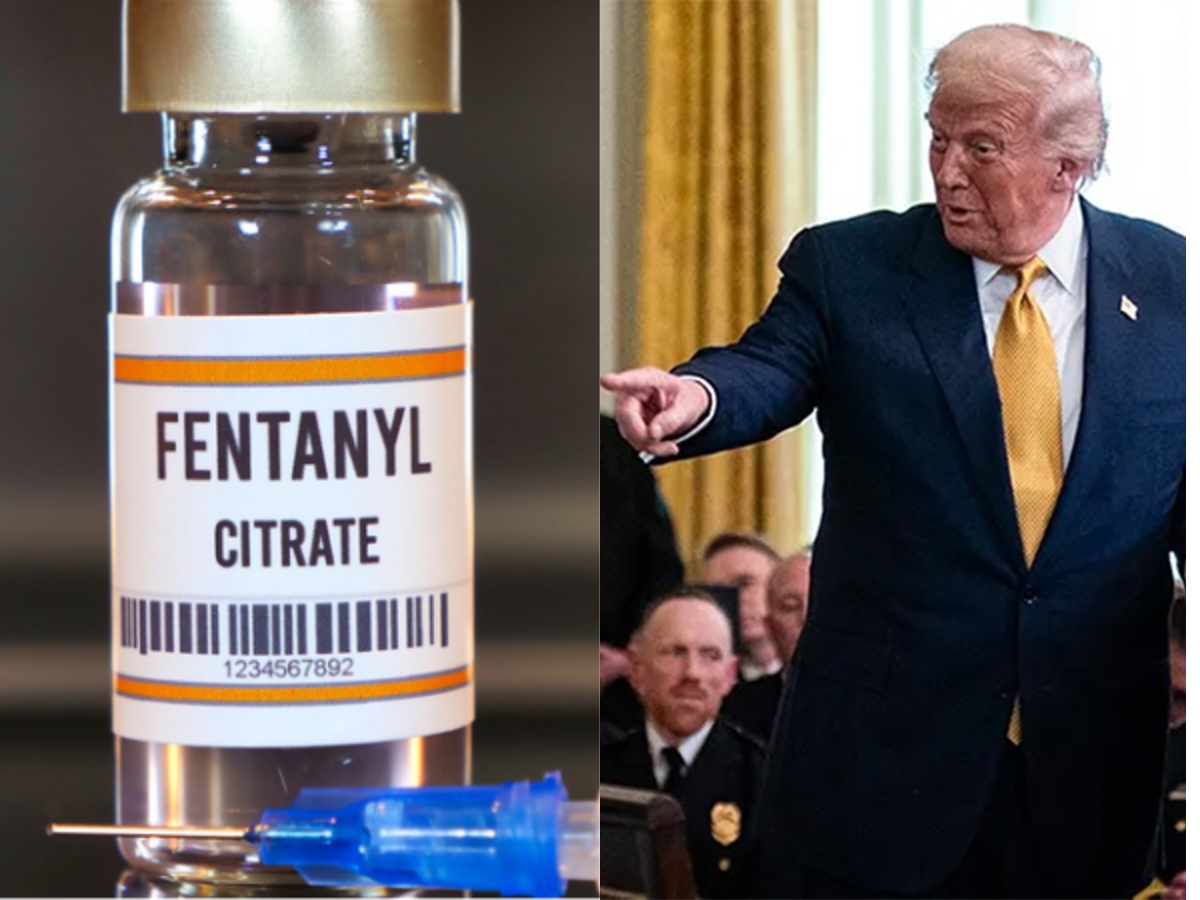
Donald Trump signs executive order declaring illicit fentanyl a Weapon of Mass Destruction, citing national security and terror threats. Photos: X.
President Donald Trump on Monday signed an executive order formally designating illicit fentanyl and its core precursor chemicals as Weapons of Mass Destruction (WMD), warning that the synthetic opioid poses a threat comparable to a chemical weapon rather than a conventional narcotic.
Speaking from the Oval Office, Trump said the move was aimed at confronting what his administration views as one of the gravest dangers facing the United States.
“Today, I’m taking another step to protect Americans from the scourge of deadly fentanyl flooding into our country,” Trump said. “With this historic executive order I’m signing today, we are formally classifying fentanyl as a weapon of mass destruction, because that’s what it is.”
The executive order argues that illicit fentanyl is “closer to a chemical weapon than a narcotic,” citing its extreme lethality. According to the document, as little as two milligrams, described as “an almost undetectable trace amount equivalent to 10 to 15 grains of table salt,” can be fatal.
The order notes that hundreds of thousands of Americans have died from fentanyl overdoses and asserts that the drug’s mass production and distribution by organized criminal networks now constitute a serious national security threat.
It further states that fentanyl trafficking fuels widespread lawlessness across the Western Hemisphere and helps finance assassinations, terrorist acts, and insurgencies abroad.
According to the order, the two dominant cartels responsible for fentanyl trafficking into the United States “engage in armed conflict over territory,” generating violence that extends far beyond the drug crisis itself.
The directive also raises concerns about the potential for fentanyl to be weaponized in “concentrated, large-scale terror attacks” by hostile actors, one of the central justifications for invoking authorities traditionally reserved for nuclear, chemical, and biological threats.
“As President of the United States, my highest duty is the defense of the country and its citizens,” the order states. “Accordingly, I hereby designate illicit fentanyl and its core precursor chemicals as Weapons of Mass Destruction.”
The executive order lays out a broad, coordinated federal strategy to combat fentanyl trafficking using tools typically applied to WMD threats.
It directs the Justice Department, State Department, Treasury Department, Department of War, and the Department of Homeland Security to take “appropriate action” to eliminate the threat posed by illicit fentanyl and its precursor chemicals.
Under Section 2 of the order, The Justice Department is instructed to immediately intensify investigations and prosecutions related to fentanyl trafficking.
The State and Treasury Departments are tasked with targeting traffickers through sanctions and financial penalties.
The Departments of War and Justice will assess whether military resources should support enforcement efforts.
Fentanyl is a heavily regulated legal medication, prescribed primarily for pain relief in cancer patients, post-surgical care, and for individuals with chronic pain who have developed tolerance to other opioids.
When prescribed by a physician, fentanyl can be administered in several forms, including injections, skin patches, lozenges, or films placed between the cheek and gum. It can also be delivered via nasal spray or under the tongue, according to the American Society of Health-System Pharmacists Inc.
The illicit version of fentanyl, typically a powder mixed into other drugs, has overtaken much of the US drug market. It is manufactured in clandestine laboratories in Mexico using easily sourced chemicals.
Fentanyl affects areas of the brain that control pain and emotions, according to the National Institute on Drug Abuse. The US Drug Enforcement Administration lists its effects as including euphoria, relaxation, pain relief, drowsiness, and sedation.
With repeated use, the brain adapts to the drug, making it difficult to experience pleasure without it. Abruptly stopping fentanyl use leads to withdrawal, often referred to as “dope sickness,” which can include extreme anxiety, vomiting, muscle pain, chills, rapid heartbeat, and profuse sweating. Many long-term users report that they no longer experience euphoria and continue using the drug primarily to avoid becoming sick.
Zubair Amin is a Senior Journalist at NewsX with over seven years of experience in reporting and editorial work. He has written for leading national and international publications, including Foreign Policy Magazine, Al Jazeera, The Economic Times, The Indian Express, The Wire, Article 14, Mongabay, News9, among others. His primary focus is on international affairs, with a strong interest in US politics and policy. He also writes on West Asia, Indian polity, and constitutional issues. Zubair tweets at zubaiyr.amin
The newly released Epstein Files have put powerful names, including Donald Trump, Bill Gates and…
Freshly released Epstein Files have triggered controversy after an email allegedly written by Jeffrey Epstein…
Catherine O’Hara, the legendary actor known for Home Alone, Beetlejuice and Schitt’s Creek, has died…
