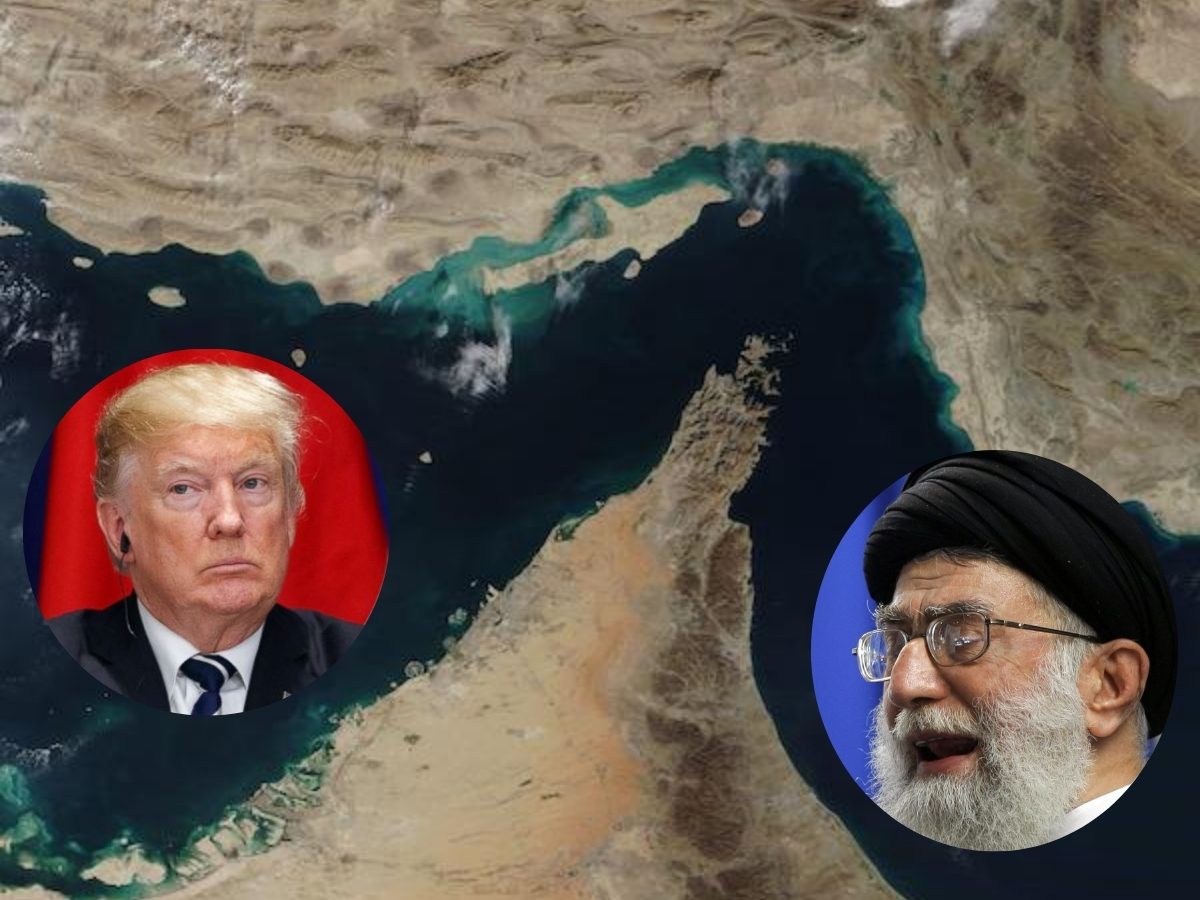
Iran plans live-fire drills in the Strait of Hormuz, raising concerns over global oil trade and fresh warnings from the US. Photos: X.
Iran is preparing to conduct a live-fire military drill in the Strait of Hormuz, a narrow but strategically critical maritime corridor through which nearly a fifth of the world’s oil trade passes. The exercise is scheduled for Sunday and Monday, according to maritime warnings issued this week.
Tehran has cautioned commercial shipping about the drill. The US, in response, has warned Iran against any actions that could endanger international navigation or escalate tensions in the region.
A notice to mariners broadcast by radio on Thursday stated that Iran plans to carry out “naval shooting” exercises in the Strait of Hormuz over the two-day period. The coordinates included in the advisory suggest that the drill could extend into the Traffic Separation Scheme (TSS), a critical maritime system that regulates ship movements through the narrow passage.
The TSS consists of two lanes, each approximately 3.2 kilometers (2 miles) wide. Vessels entering the Persian Gulf travel north through one lane, while ships exiting toward the Gulf of Oman move south through the other. The northern lane, used by inbound traffic, falls within the coordinates identified for the Iranian exercise.
Iran has not released further public details about the scope or scale of the drill. However, it is widely expected to involve the country’s paramilitary Islamic Revolutionary Guard Corps (IRGC), which maintains a fleet of small, fast-attack boats in the strait. These vessels have frequently been involved in tense encounters with US naval forces operating in the region.
The military drill comes days after Mohammad Akbarzadeh, political deputy of the IRGC naval forces, raised the prospect of closing the Strait of Hormuz, a long-standing threat that Iran has periodically used during times of heightened regional tension.
Akbarzadeh said Iran maintains real-time intelligence coverage across the strait, both above and below the water’s surface, and emphasized that the security of the passage ultimately rests with Tehran.
“We do not want the world economy to suffer,” he said, “but the Americans and their supporters will not benefit from a war they start.”
Iran has issued similar warnings in the past but has never followed through with an actual closure of the waterway.
Viewed from space, the Strait of Hormuz resembles a narrow bend connecting the Persian Gulf to the Gulf of Oman. At its narrowest point, the strait is just 33 kilometers (21 miles) wide.
The waterway flows from the Persian Gulf into the Gulf of Oman and onward to the Arabian Sea, providing a vital maritime route for global trade. While Iran and Oman control territorial waters along the strait, it is considered an international waterway open to all vessels. The United Arab Emirates also lies close to the route.
Historically, the strait has been central to trade, serving as a conduit for goods such as ceramics, ivory, silk, and textiles moving from China through the region. In the modern era, its depth and width have proven sufficient for the world’s largest oil tankers.
According toreports, about 20 percent of global oil consumption moves through the Strait of Hormuz. More than 20 million barrels per day of crude oil, condensate, and refined fuels passed through the strait on average last year.
Major oil producers including Saudi Arabia, Iran, the United Arab Emirates, Kuwait, and Iraq export most of their crude via the strait, primarily to Asian markets. Qatar, one of the world’s largest liquefied natural gas exporters, ships almost all of its LNG through the same route.
While Saudi Arabia and the UAE have developed pipeline infrastructure to bypass the strait, the EIA says “most volumes that transit the strait have no alternative means of exiting the region.”
Threats to the strait have previously triggered spikes in global energy prices.
Zubair Amin is a Senior Journalist at NewsX with over seven years of experience in reporting and editorial work. He has written for leading national and international publications, including Foreign Policy Magazine, Al Jazeera, The Economic Times, The Indian Express, The Wire, Article 14, Mongabay, News9, among others. His primary focus is on international affairs, with a strong interest in US politics and policy. He also writes on West Asia, Indian polity, and constitutional issues. Zubair tweets at zubaiyr.amin
WWE's one of the most-anticipated event, Royal Rumble will take place pm 31 January in…
Ex-Prince Andrew faces renewed scrutiny as Epstein files show him kneeling over a woman, hand…
Finance Minister Nirmala Sitharaman will present the Union Budget 2026-27 on Sunday, February 1. Here’s…
