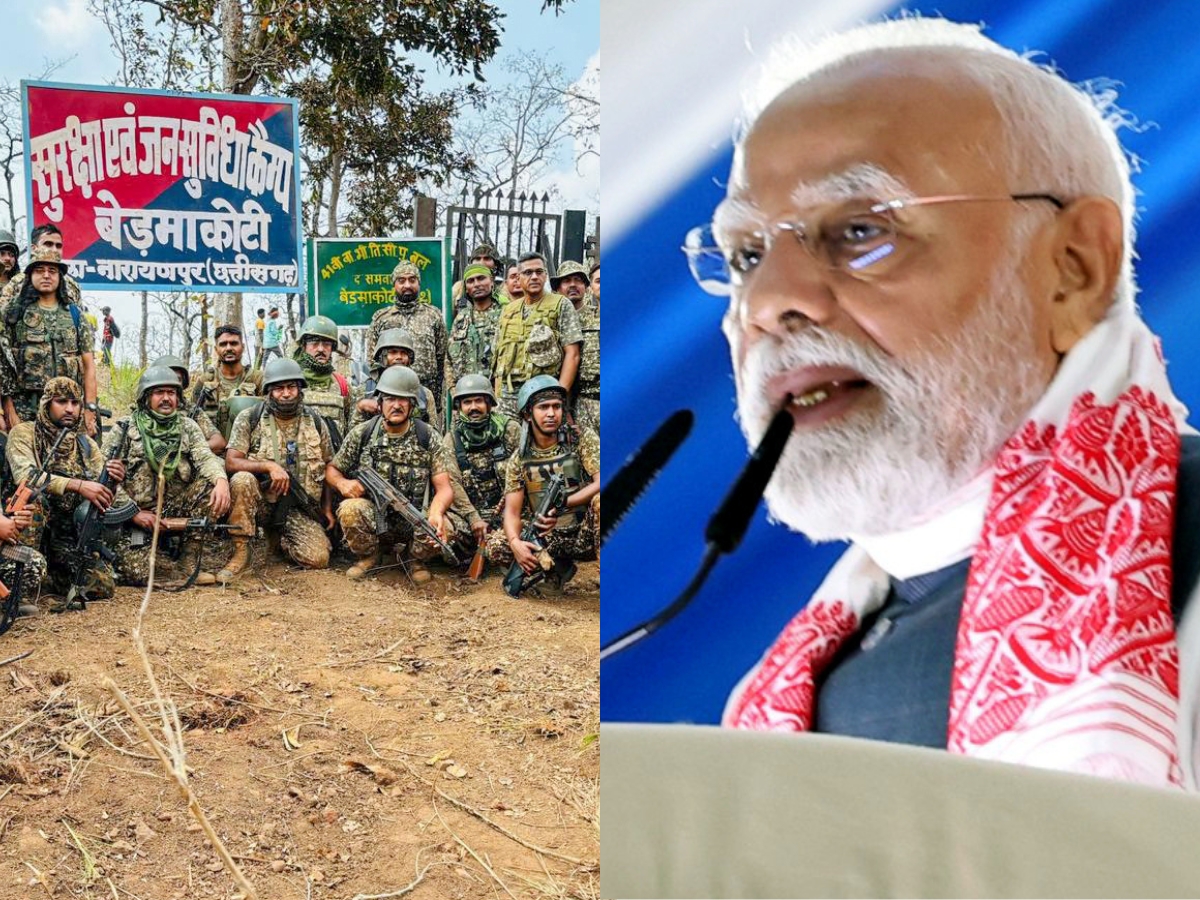
PM Modi’s security and development push slashes Naxal violence 81%, driving India closer to a Naxal-free future. Photos: ANI.
India has been the victim of terrorism for decades, particularly in Jammu & Kashmir and various North Eastern states. While Kashmir has witnessed Pakistan-sponsored terrorism, Left Wing Extremism (LWE), commonly known as Naxalism, has long been one of India’s serious internal security challenges. Rooted in the Maoist ideology, it started from the 1967 Naxalbari uprising in West Bengal and expanded across the “Red Corridor.” States like Chhattisgarh, Jharkhand, Odisha, Maharashtra, Kerala, Madhya Pradesh, West Bengal, Andhra Pradesh, and Telangana have been the victims of this ideology that claims to fight for soc called socio-economic disparities.
Naxalites have employed violent means, claiming they are defending the marginalized communities, particularly tribals. These groups have used means, as armed rebellion, extortion, infrastructure sabotage, and child recruitment.
Over the past decade, under the leadership of PM Modi, India has adopted a multidimensional counterinsurgency strategy. This includes going hard against terrorists with security operations while also focusing on inclusive development and community outreach in the affected states. These efforts have delivered results.
The number of LWE-affected districts in states with the presence of Naxalites reduced from 126 to 90 in 2018, 70 in 2021, and further to 38 in 2024.
The most severely impacted districts are now only six: Bijapur, Kanker, Narayanpur and Sukma (Chhattisgarh), West Singhbhum (Jharkhand), and Gadchiroli (Maharashtra).
Violence has also fallen sharply after employing the two-pronged strategy of rehabilitation and security measures.
2010 saw the peak of 1,936 incidents, and this has been reduced to only 374 in 2024. This accounts for an 81% drop. Civilian and security forces used to die in large numbers. However, these deaths declined by 85%, from 1,005 in 2010 to 150 in 2024. More than 8,000 insurgents have given up the violence in the last ten years after PM Modi took office. There are only 20 districts that are now affected by Naxalism.
The Central Government, under the leadership of PM Modi, has adopted a zero-tolerance policy. The National Policy and Action Plan (2015), focuses on law enforcement, rapid compensation for underdevelopment, and complete saturation of government schemes.
Under the special Central Assistance (SCA) the most-affected districts, each year, receive 30 crore, while “Districts of Concern” receive Rs. 10 crore.
During the last decade, between 2014-15 and 2024-25, Rs. 3,260.37 crore has been disbursed under the Security Related Expenditure (SRE) Scheme.
Since 2017, Rs. 3,563 crore has been released under SCA. Additionally, Rs. 1,741 crore was sanctioned for Special Infrastructure Scheme (SIS).
With these funds, 221 police stations were fortified. In the past decade, 612 fortified police stations have been built compared to only 66 in 2014.
The Modi government has also launched other measures to tackle left-wing terrorism in the country. These include Civic Action Programme (Rs. 196.23 crore since 2014), assistance to central agencies (Rs. 1,120.32 crore), and a Media Plan (Rs. 52.52 crore since 2017-18) to counter Maoist propaganda.
While PM Modi allowed security forces to go hard on the Naxalite terrorism, the government also made massive investments in the affected regions. Huge funding was allocated for connectivity and welfare initiatives in the affected areas.
Road projects (RRP-I and RCPLWE) have sanctioned 17,589 km of roads, of which 14,618 km are completed. By December 2025, 10,505 telecom towers will bring full mobile coverage to these regions, with 7,768 already commissioned.
The affected areas have also witnessed financial inclusion at a swift rate. 1,007 new bank branches, 937 ATMs, 5,731 post offices, and 37,850 banking correspondents were allocated in affected districts since 2015.
In terms of skill initiatives, 8 ITIs, 61 Skill Development Centres, and 178 Eklavya schools were opened. Over 1,143 tribal youth have joined security forces.
To augment the security in the affected areas, 280 new camps and 15 Joint Task Forces have been created since 2019, alongside six CRPF battalions.
Naxal finances have been tracked and targeted by the NIA and the Enforcement Directorate. The agencies have filed PMLA cases and seized crores of rupees. In December 2023 alone, 380 insurgents were killed, 1,194 arrested, and 1,045 surrendered.
Major breakthroughs were achieved in 2025. On March 30, fifty insurgents surrendered in Bijapur, a day after security forces neutralized 16 in Sukma.
Earlier that month, 22 were killed in operations across Bijapur and Kanker. Home Minister noted that 2022 saw fewer than 100 casualties from LWE violence — the lowest in three decades.
In October 2024, Prime Minister Narendra Modi launched the “Dharti Aaba Janjatiya Gram Utkarsh Abhiyan” from Jharkhand. The program was launched with an aim to provide amenities across 15,000 villages, benefiting 1.5 crore people.
The scheme focuses on “3C” – road, mobile, and financial connectivity. Once spread over 18,000 sq km, LWE is now limited to only 4,200 sq km.
Between 2014-2024, 53% fewer violent incidents were witnessed in comparison to the previous decade. Modi government has set March 31, 2026, as the deadline to eliminate Naxalism from the country. With declining violence, sustained development, and community integration, India appears closer than ever to achieving a “Naxal-free Bharat.”
Must Read: From 2014 To 2025: Here’s How PM Modi Celebrated His Birthday, Check What’s Special This Year
Zubair Amin is a Senior Journalist at NewsX with over seven years of experience in reporting and editorial work. He has written for leading national and international publications, including Foreign Policy Magazine, Al Jazeera, The Economic Times, The Indian Express, The Wire, Article 14, Mongabay, News9, among others. His primary focus is on international affairs, with a strong interest in US politics and policy. He also writes on West Asia, Indian polity, and constitutional issues. Zubair tweets at zubaiyr.amin
Finance Minister Nirmala Sitharaman’s Union Budget 2026–27 brought major compliance reforms and relief measures for…
On the whole, the Union Budget 2026 was aimed to balance between development and social…
Union Budget 2026: FM Sitharaman Unveils Initiative For High-Quality Sports Manufacturing
During the Union Budget 2026, the Finance Minister underscored the importance of the sports sector,…
