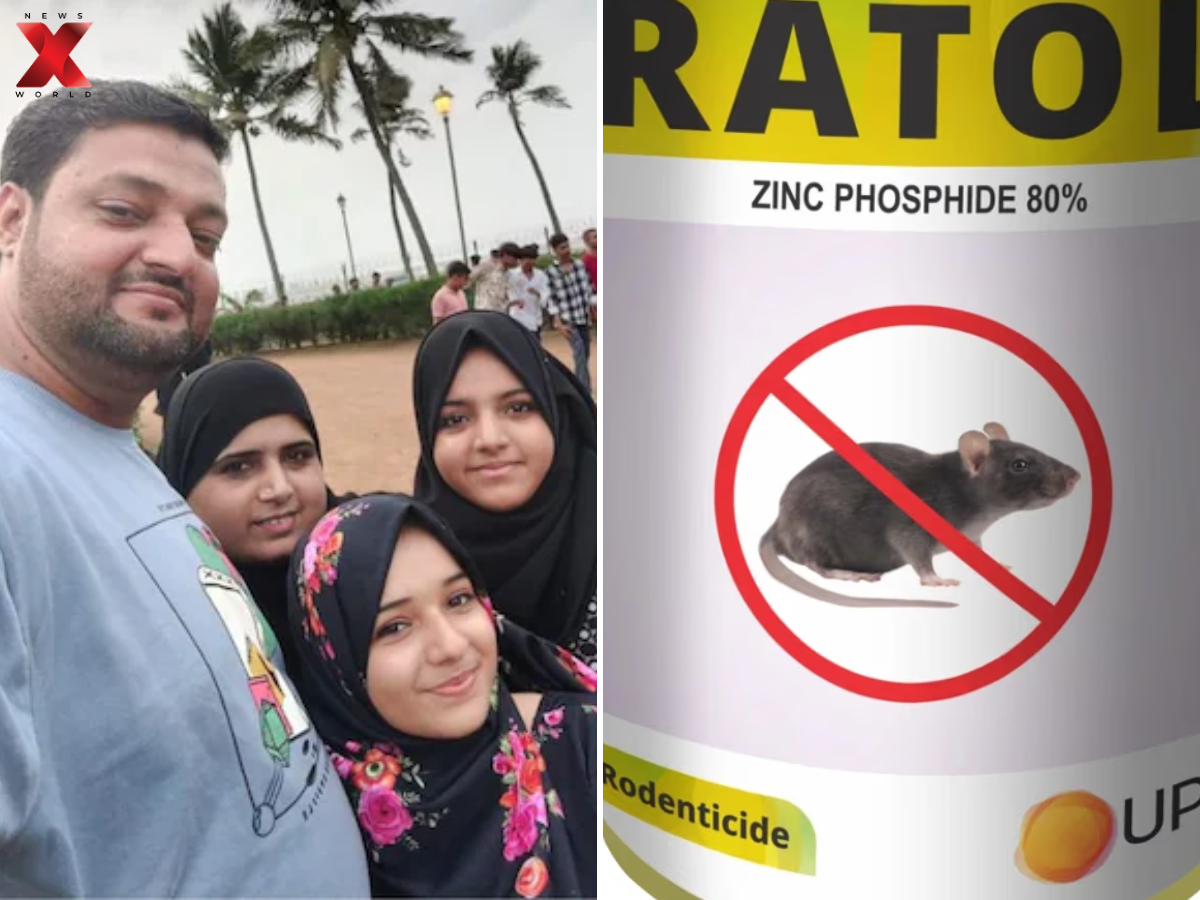
Doctors have found traces of Zinc Phosphite in their bodies (IMAGE: X)
MUMBAI FAMILY DEATH: A family of four from Mumbai’s Pydhonie area died on the early morning of April 26. Initially, watermelon was cited as the cause, but there was more to the case. Abdullah Dokadia, aged 45 years, Nasreen, his wife, aged 35 years, and their two daughters, Zainab aged 13 years and Ayesha aged 16 years organized dinner for their families where they served mutton pulao. At around 1 am, after their guests had left, the family ate watermelon, and by 5 am, all of them got severe diarrhea and vomiting and subsequently succumbed to death.
In a report released on May 7, forensic experts proved that traces of zinc phosphide which is an extremely poisonous rat killer were detected in the viscera of the victims as well as the watermelons consumed by them. The police claim that there is not enough evidence showing that the watermelon per se was the cause. An investigation is being carried out by detectives on how the toxic substance came into contact with the victims.
The victims who succumbed to death include Abdullah Dokadia, his wife Nasreen, and their two daughters Ayesha and Zaineb. There is no remedy for zinc phosphide.
Last week, preliminary forensic reports showed that the organs of the deceased, such as their brain, heart, and intestines, were green in color as they had been poisoned. The preliminary tests on the body of Abdullah Dokadia also indicated the presence of morphine, a strong painkiller, which is normally used in controlled environments.
Zinc phosphide (Zn3P2) is a chemical compound used as a rodenticide in rat poison in India. In its pure form, the substance is quite stable. However, things become dangerous when zinc phosphide is ingested into the human body. The human body is equipped with hydrochloric acid, which aids in digesting food consumed by individuals. When zinc phosphide interacts with this acid, a chain reaction starts, resulting in the production of phosphine gas. This gas is invisible and highly lethal.
Unfortunately, there is no antidote for zinc phosphide poisoning anywhere in the world. It would be impossible to inject a medication into a patient to neutralise the toxic substance. But what can be done is to try to delay the formation of phosphine gas and shield the vital organs from shutting down. One such treatment includes the stomach lavage method with coconut oil. Zinc phosphide does not react with coconut oil. This creates a physical barrier to prevent the chemical reactions from taking place.
With 13 years on the line, Ashish Kumar Singh loves everything when it comes to movies, music, travel and pop culture. Formerly employed at ANI, Pinkvilla, India Today and HT, Ashish has interviewed some of the top celebrities of India, including Shah Rukh Khan, Aamir Khan, Ranveer Singh, Ranbir Kapoor and Hrithik Roshan, among others. Breaking news excites him and deadlines are what he chases. Interviewing comes naturally to him. Hit him up at ashish.kumar02singh@gmail.com.
Take a look at the IPL 2026 points table as of May 13. Here's a…
Virat Kohli back in form! The King slams a hundred against KKR in IPL 2026.…
Is Virat Kohli heading to the FIFA World Cup 2026? A viral social media post…
