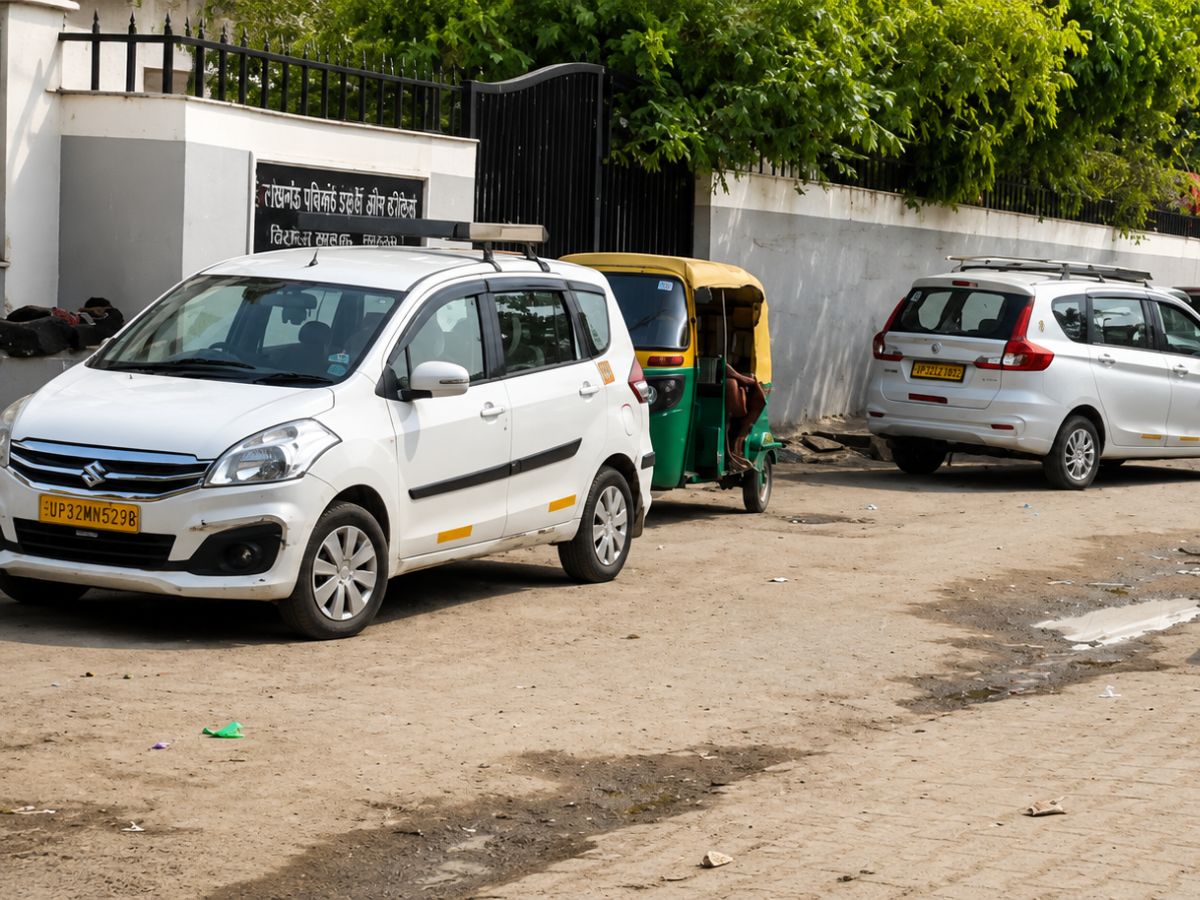
Delhi-NCR Chakka Jam from May 21-23 may disrupt cab, taxi and auto services amid drivers’ protest over fares. Photo: ANI.
Chakka Jam Today: Commuters across Delhi-NCR may face transport disruptions, longer waiting times and overcrowded public transport services over the next three days as commercial vehicle drivers’ unions have announced a strike from May 21 to May 23. The protest has been called over rising fuel prices – petrol & diesel – unrevised fares and new regulatory measures affecting transport operators. The protest has been announced by multiple commercial vehicle unions, including the “Chalak Shakti Union”, which informed the Delhi Lieutenant Governor, Chief Minister, Transport Minister and Police Commissioner about the planned strike through an official letter. According to the union, the protest is being organised “in solidarity with a nationwide agitation announced by the All India Motor Transport Congress”.
Transport bodies have argued that fares for taxis and commercial vehicles in Delhi-NCR have remained unchanged for nearly 15 years despite continuous increases in the prices of CNG, petrol and diesel.
The unions said repeated fuel price hikes have sharply increased operating expenses, making it difficult for drivers to sustain earnings and manage daily costs.
Apart from fare revision demands, the strike is also aimed at protesting recent policy measures introduced by the Delhi government and the Commission for Air Quality Management (CAQM), which transporters claim will negatively impact operators and supply chains.
More than 68 transport unions from across Delhi-NCR are participating in the agitation.
One of the biggest reasons behind the strike is the recent increase in Environment Compensation Cess (ECC) charges, which came into effect on April 19.
Under the revised rates
ECC on light commercial vehicles and two-axle trucks was increased from ₹1,400 to ₹2,000.
Charges for three-axle and heavier vehicles were raised from ₹2,600 to ₹4,000.
Transport unions have also objected to the government’s decision to increase the ECC by 5 per cent every year.
According to transporters, the cess is being imposed on all goods vehicles entering Delhi, including empty trucks arriving for loading as well as vehicles carrying essential commodities.
Another major issue raised by transport bodies is the CAQM proposal to ban BS-4 and older commercial vehicles from entering Delhi-NCR starting November 1, 2026, as part of anti-pollution measures.
The All India Motor Transport Congress (AIMTC) has criticised the proposed restrictions, arguing t
The strike is expected to impact several modes of transport and last-mile connectivity across Delhi-NCR.
Services likely to face disruption include:
App-based cab services such as Ola, Uber and Rapido
Auto-rickshaw services across Delhi-NCR
Commercial taxi operations
Peak-hour local transport connectivity
Last-mile connectivity to metro stations, railway stations and office areas
Cab availability and waiting times during office rush hours
Despite the strike, some major public transport services are expected to operate without disruption:
Delhi Metro services
DTC bus services
Cab and auto unions supporting the strike have separately highlighted the financial strain on drivers caused by rising petrol, diesel and CNG prices.
Drivers say increasing fuel costs, vehicle maintenance expenses, app-based aggregator commissions and loan EMIs have made survival increasingly difficult.
Ahead of the strike, AIMTC wrote to Delhi Lieutenant Governor Taranjit Singh Sandhu and Chief Minister Rekha Gupta seeking an immediate revision in taxi fares and stronger protections for commercial drivers.
The Chalak Shakti Union also accused app-based cab aggregators such as Ola, Uber and Rapido of exploiting drivers financially.
“App-based companies like Ola, Uber and Rapido are operating arbitrarily, and drivers in Delhi-NCR are becoming victims of serious economic exploitation,” the union alleged, according to ANI.
The union said rising fuel costs were affecting the livelihoods of middle-class drivers and their families.
“Due to the continuously increasing prices of CNG, petrol and diesel, middle-class drivers are struggling to support their families,” said Anuj Kumar Rathore, vice-president of the union, while announcing the “Chakka Jam” from May 21 to 23, according to PTI.
Zubair Amin is a Senior Journalist at NewsX with over seven years of experience in reporting and editorial work. He has written for leading national and international publications, including Foreign Policy Magazine, Al Jazeera, The Economic Times, The Indian Express, The Wire, Article 14, Mongabay, News9, among others. His primary focus is on international affairs, with a strong interest in US politics and policy. He also writes on West Asia, Indian polity, and constitutional issues. Zubair tweets at zubaiyr.amin
PM Narendra Modi Inaugurates Sardardham in Vadodara, Meets Trustees Including Dr. Parul Patel
Vadodara (Gujarat) [India], May 20: Vadodara witnessed a historic day in the sphere of knowledge…
SpaceX IPO: Wall Street may be preparing for one of the biggest stock market debuts…
Banda in Uttar Pradesh remained the hottest city in India for the fourth consecutive day…
