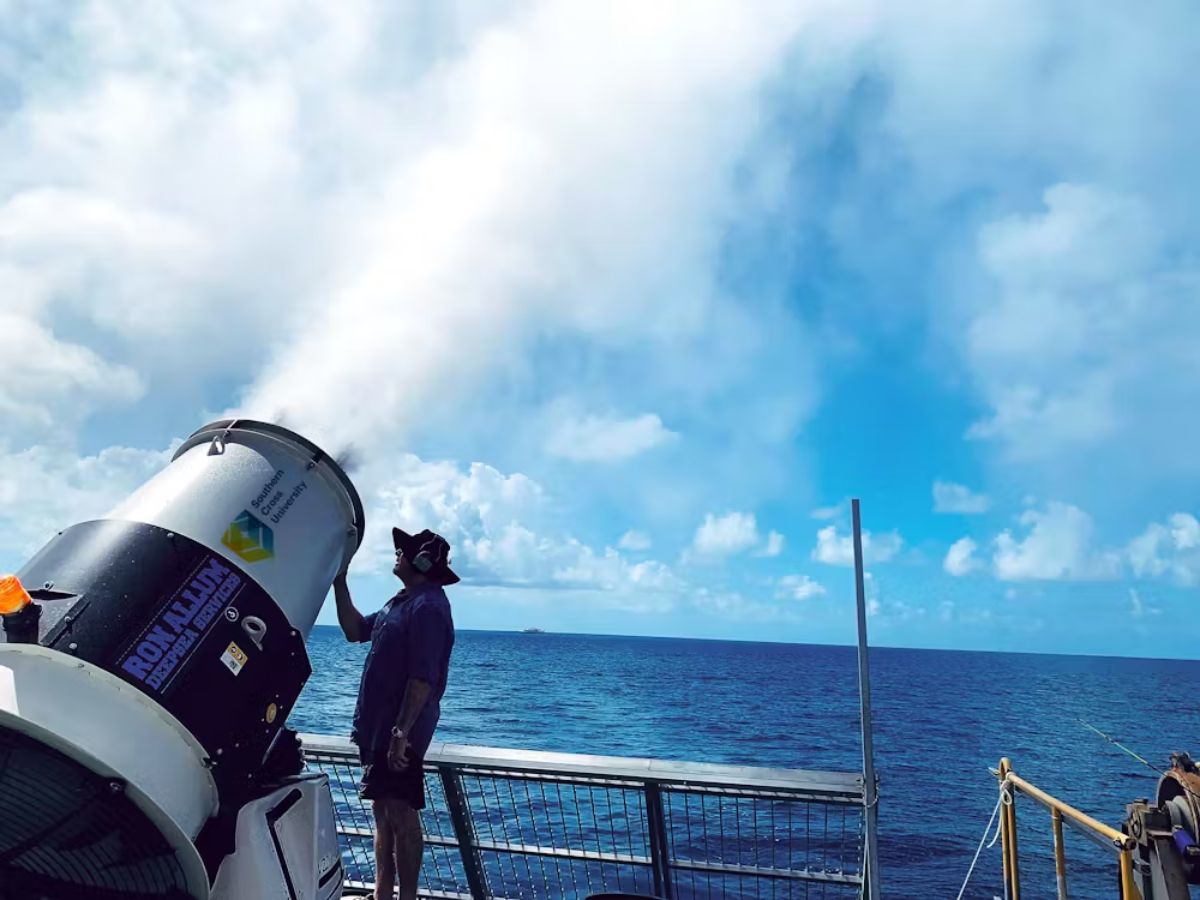
California scientists planned a secret cloud-brightening trial over the ocean, raising fresh debate over geoengineering risks. Photo/X.
A team of researchers in California had been secretly preparing an ambitious and potentially contentious study to create clouds over an oceanic area larger than Puerto Rico. The group had last year also tried cloud-making experiment aboard a retired aircraft carrier.
POLITICO has recieved documents of the study showing that the ultimately cancelled test in the San Francisco Bay was merely a precursor to a multimillion-dollar undertaking involving large-scale marine cloud brightening.
The research group was trying a 3,900-square-mile trial by employing saltwater-spraying technology, proposed test sites were off the west coast of North America, Chile, or south-central Africa, according to more than 400 internal documents received through an open records request by the University of Washington.
Also Read: What Is The Tea App? The Latest Controversy Around The Most Downloaded App Explained
A 2023 research proposal from the university’s Marine Cloud Brightening Program acknowledged that at such a scale, “meaningful changes in clouds will be readily detectable from space.” The planned large-scale test, though, relied upon the success of the smaller Alameda pilot, which lasted just 20 minutes before city officials terminated it due to lack of advance notice.
SilverLining Executive Director Kelly Wanser told E&W news that the Marine Cloud Brightening Program had been aimed at collecting data to assess if such technologies are “safe and effective.”
Sarah Doherty, the program director and University of Washington professor of atmospheric and climate science, explained to POLITICO that the program does not “recommend, support or develop plans for the use of marine cloud brightening to alter weather or climate.” She said there are no intentions for “large-scale studies that would alter weather or climate.”
Solar geoengineering is speculative technology which tries to send sunlight back into space with an ai, to cool down the world. Thus is achived by various means like by releasing sulfate particles into the stratosphere, spraying saltwater aerosols above oceans to whiten clouds and putting a reflective material in space.
Some scientists say technologies like these would give us a temporary shield against global warming, but others caution about danger it entails and the absence of regulation.
Over 575 experts have signed a petition that calls an international prohibition on the development of geoengineering. The signatories of the petition are worried about the inability to regulate the technology “in a fair, inclusive, and effective way.”
Even, Florida Governor Ron DeSantis signed a legislation in June, calling for the prohibition of the deliberate release of chemicals into the air for climate engineering.
Also Read: OpenAI CEO Sam Altman Warns ChatGPT Users: No Legal Protection For Sensitive Conversations
Zubair Amin is a Senior Journalist at NewsX with over seven years of experience in reporting and editorial work. He has written for leading national and international publications, including Foreign Policy Magazine, Al Jazeera, The Economic Times, The Indian Express, The Wire, Article 14, Mongabay, News9, among others. His primary focus is on international affairs, with a strong interest in US politics and policy. He also writes on West Asia, Indian polity, and constitutional issues. Zubair tweets at zubaiyr.amin
The ICC has reacted to Pakistan’s refusal to play India in the ICC Men’s T20…
Merchant Navy Officer Rikshit Chauhan Returns Home Safely After Russian Tanker Seizure by US
A second woman has accused Prince Andrew of a sexual encounter linked to Jeffrey Epstein,…
