
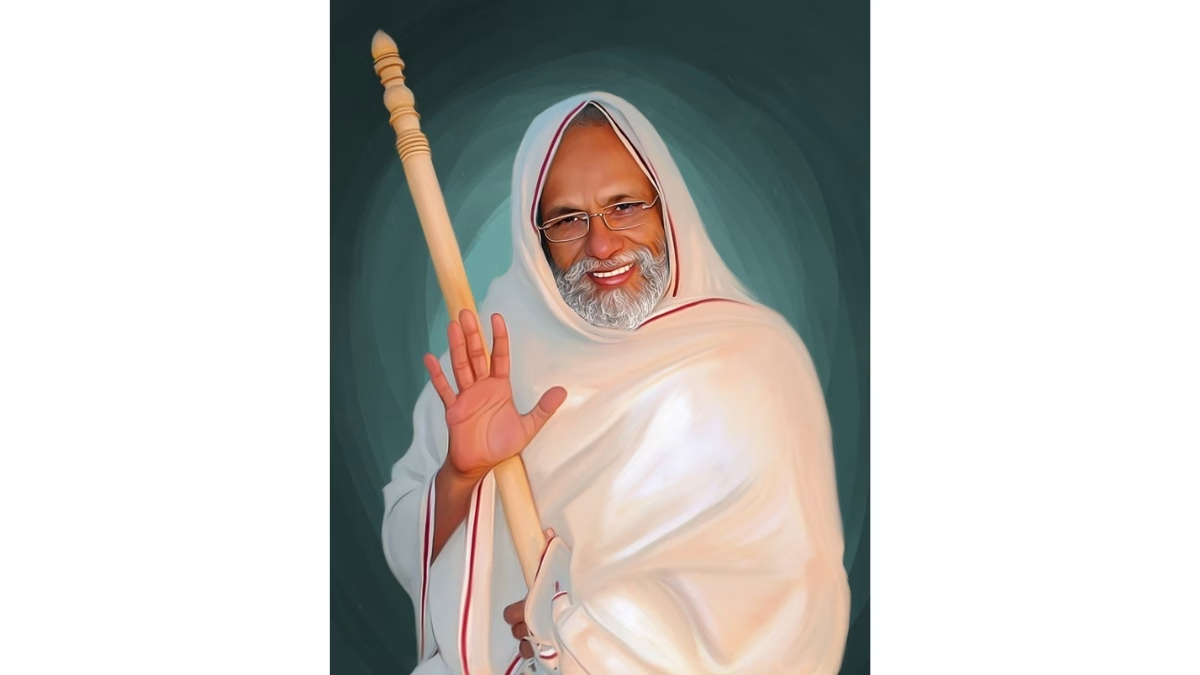

Mumbai (Maharashtra) [India], January 3: At Borivali, the three-day international conference “Rishabhayan-2: Forerunner and Architect of Indian Culture”, dedicated to the life and values of Bhagwan Rishabhdev—the pioneer of human civilisation—concluded successfully in a truly historic manner. Scholars, saints, thinkers, educationists, and students participated in the conference, which was witnessed by an audience of over one lakh people.
The programme commenced on Friday, 19 December, with a grand procession. The inspirer of the Rishabhayan Conference, Jain Gachchhadhipati Acharya Yashovarmasurishwarji Maharaj, bestowed blessings. In the august presence of saints from all four Jain traditions, more than 15 Acharyas and over 400 sadhus and sadhvis, the conference was inaugurated by Maharashtra Chief Minister Devendra Fadnavis. While releasing the book “Rishabhayan”, the Chief Minister stated that the text is highly relevant to modern society. On this occasion, saints such as Vijay Somtirth, Dandi Swami Jitendra Saraswatiji, and Shantigiri Maharaj provided profound guidance on the universal philosophy of Rishabhdev. Saints from Sikh, Buddhist, Hindu, and Jain traditions marked their presence, collectively acknowledging King Rishabhdev’s contributions and existence, and celebrating the day as a reaffirmation of his status as the pioneer and architect of Indian culture. During the inauguration, Dr N. P. Singh, Executive Chairman of the Indian Education Board, expressed keen interest in integrating values with modern education.
An initiative was launched to distribute the booklet “Rishabh Jeevan”, which presents the life of Rishabhdev, to every school and educational institution across India. This publication was prepared under the guidance of Gachchhadhipati Acharya Yashovarmasurishwarji and Acharya Bhagyayashasurishwarji.
Sessions focusing on the origins of civilisation and the pride behind the name “Bharat” presented historical and archaeological evidence establishing Bhagwan Rishabhdev as the actual initiator of Indian civilisation. Scholars explained, with precise references, that modern concepts such as entrepreneurship, skill development, and sustainable living were embedded thousands of years ago in the arts of Asi, Masi, and Kasi, imparted by Rishabhdev. Citing the Shrimad Bhagavata Purana, it was reaffirmed that the country’s name “Bharat” is derived from the name of Chakravarti Emperor Bharat, the eldest son of Rishabhdev. In the startup-focused session, industry leaders including Niranjan Hiranandani (Hiranandani Group), Hitesh Doshi (Wari Group), Uttam Jain (Neon Laboratories Group), and Krishna Rana (Platinum Group) interacted with students.
On the second day, national and international researchers presented papers on the Brahmi script, mathematics, the 72 masculine arts, and the 64 feminine skills from the era of Rishabhdev. With the cooperation of 1,111 Jain Sanghs under the Mumbai Jain Sangh Organisation, trustees from Vihar Dham, and support from regions spanning Navi Mumbai to Virar and Surat, a historic public unveiling of manuscripts dating from 200–500 years ago and 1,111 rare texts was held. Union Minister Piyush Goyal and Maharashtra Education Minister Chandrakant Dada Patil were present in person. One of the conference’s most outstanding academic achievements was the signing of memoranda of understanding with universities across Mumbai and India, including Nalanda University, SAU University, and the Archaeological Survey of India. Gujarat Deputy Chief Minister Harsh Sanghavi also extended an invitation to host Rishabhayan-3 in Gujarat in 2026.
Eminent scholars from India and abroad deliberated intensely on Bhagwan Rishabhdev’s contributions to civilisation. Padma Shri Kumarpal Desai highlighted Rishabhdev’s role in the rise of human civilisation and presented a creative, thought-provoking monologue by King Rishabh. Advocate Vishnu Shankar Jain presented legal and historical perspectives on “King Rishabhdev’s System of Justice.”
Scholars Dr Rajmal Jain and Dr Bipin Doshi described Rishabhdev as the founder of a cultured human society, discussing both historical contexts and contemporary relevance. Prof. Jitendra Shah and Dr Dharamchand Jain elaborated on Rishabhdev’s teachings and his contributions to nation-building. Dr Bhagchandra Jain ‘Bhaskar’ explained the roots of civilisation through archaeological and historical evidence. Architect Mayank Barjatya presented insights into the science of energy in the Bhaktamar Stotra and Rishabhdev. Young astrologer Vishwa Vora, a recipient of the President’s Award, captivated the audience with his profound knowledge. At the same time, Rahul Kapoor from Bengaluru delivered an hour-long presentation on a paper authored by a revered sadhviji.
As part of the conference, large sets and advanced digital models vividly showcased the 72 vocational arts, 64 fine arts, and ancient historical heritage. Stalls featuring ancient handicrafts, women-led home industries, and art-based startups by hundreds of youth and schoolchildren attracted massive crowds.
On the final day, Maharashtra Cultural Affairs Minister Ashish Shelar stated that “Rishabhayan” is not merely a festival but a mission to connect future generations with their roots. The Labdhi Vikram Janseva Trust organised the event in cooperation with Naginadas Khandwala College. Legislators Sanjay Upadhyay and Pravin Darekar, along with several Jain organisations, youth groups from Borivali, Kandivali, Malad, Bhayandar, Mira Road, and RSS leaders, were present.
More than 100 research papers were presented during the conference, discussed by scholars from across India, forming the foundation for the forthcoming “Rishabhayan-2” volume. During the programme, the Labdhi Vikram Janseva Trust inaugurated research initiatives under the Rishabh Swadhyay Peeth. Sejal Shah and Ramzan Hasniya skilfully anchored the three-day event.
The tireless efforts of motivational trainer and BJP leader Sunil Lodha of Mumbai, Mukeshbhai of Multi Graphics, Lalit Gandhi, Girish Shah, trustees of LVGST, Ketanbhai, Jineshbhai, Ashokbhai, and many others bore fruit. Above all, the dedicated efforts of Gachchhadhipati Acharya Yashovarmasurishwarji Maharaj, Acharya Bhagyayash Maharaj, Acharya Hrinkaryash Maharaj, Muni Tirthyash Maharaj, Sadhviji Vipulmalashriji, and accompanying sadhvis ensured the grand success of the event. With over one lakh people in attendance, Rishabhayan-2 emphatically proved that India’s ancient culture is the foundation of a bright future for the nation.
The three-day conference featured two main halls: the primary hall hosted scholarly lectures, saintly discourses, and political dignitaries, while the adjoining smaller hall—Rishabh Swadhyay Peeth—witnessed the presentation of over 100 research papers over three days. These discussions by scholars from across India will culminate in the publication of Rishabhayan-2. Sejal Shah and Ramzan Hasniya efficiently conducted the programme.
The efforts of motivational trainer and Mumbai BJP leader Sunil Lodha, along with Mukeshbhai of Multi Graphics, Lalit Gandhi, Girish Shah, and the trustees of LVGST — Ketanbhai, Jineshbhai, Ashokbhai, and other eminent personalities — bore fruitful results. In the overall organisation, the dedicated efforts of Gachchhadhipati Acharya Yashovarmasurishwarji Maharaj, Acharya Bhagyayash Maharaj, Acharya Hrinkaryash Maharaj, and Muni Tirthayash Maharaj, as well as Sadhviji Vipul Mala Shriji and her fellow Sadhvi Bhagwants, played a significant role in its success.
(The article has been published through a syndicated feed. Except for the headline, the content has been published verbatim. Liability lies with original publisher.)




