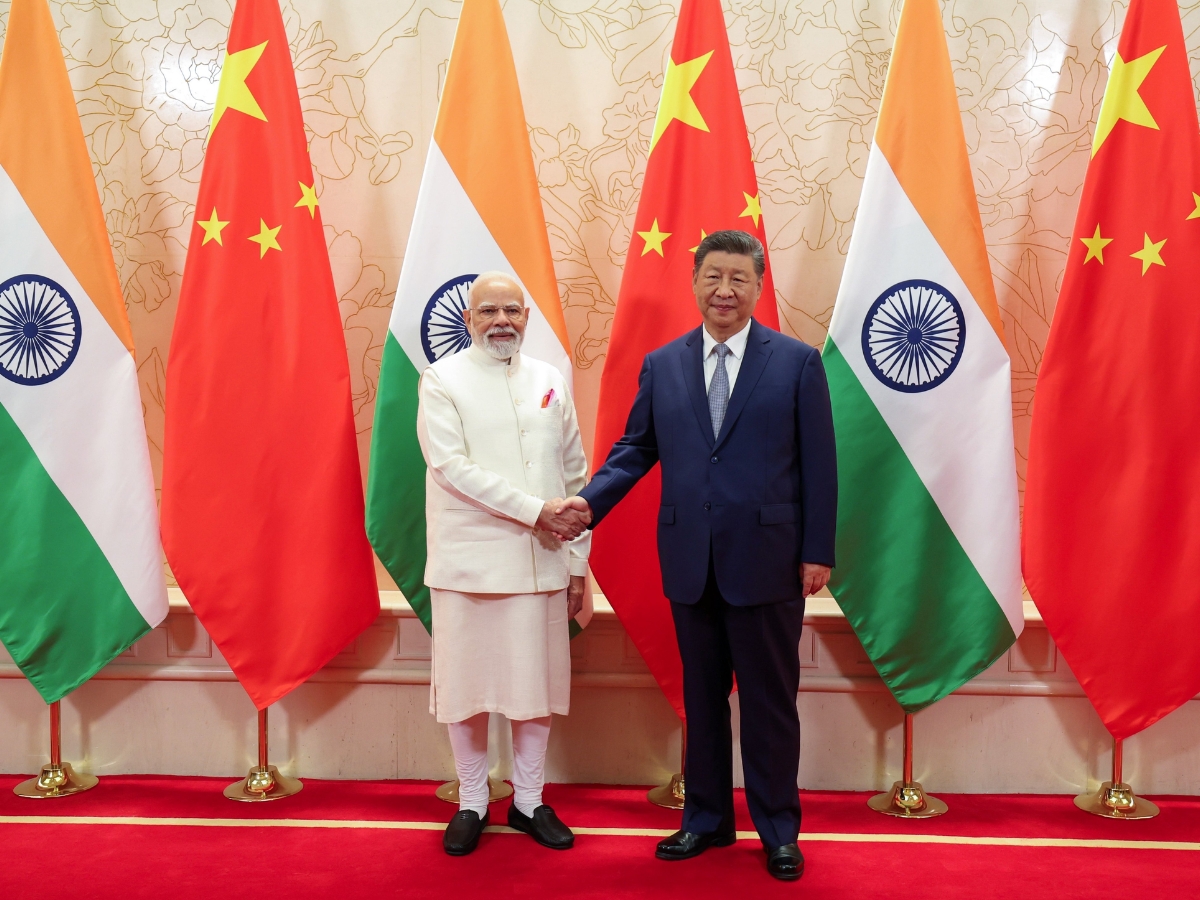
PM Modi invites Xi Jinping to 2026 BRICS Summit; leaders discuss China-India ties, border peace, and global cooperation.
Prime Minister Narendra Modi on Sunday invited Chinese President Xi Jinping to the BRICS Summit that India will host in 2026, the Ministry of External Affairs said. President Xi thanked Prime Minister Modi for the invitation and offered China’s support to India’s BRICS Presidency. India is preparing to take over the leadership of BRICS from the current president, Brazil.
PM Modi also expressed support for China’s Presidency of the Shanghai Cooperation Organisation and the Summit in Tianjin, the Ministry of External Affairs said in a statement today.
The two leaders met on the sidelines of the Summit of the leaders of the Shanghai Cooperation Organisation (SCO) in Tianjin today. The two leaders had previously met in Russia’s Kazan in 2024 on the sidelines of the BRICS Summit.
In July this year, Prime Minister Modi, in his intervention at the BRICS grouping’s summit in Rio De Janeiro, said that India will attempt to give a “new form” to the BRICS next year.
PM Modi said BRICS will mean Building Resilience and Innovation for Cooperation and Sustainability, and just as during the G-20 chairmanship, India had given priority to the issues of the Global South in the agenda, similarly, during India’s chairmanship of BRICS, it will take the forum forward in the spirit of people-centricity and humanity first.
The 17th BRICS Summit held under the theme: “Strengthening Global South Cooperation for a More Inclusive and Sustainable Governance”. Xi Jinping had participated in the summit virtually.
Commitments were adopted across strategic areas, including global governance, finance, health, AI, climate change, peace and security.
In addition to the main declaration, BRICS leaders endorsed three supplementary frameworks- The BRICS Leaders’ Framework Declaration on Climate Finance, The BRICS Leaders’ Declaration on Global Governance of Artificial Intelligence and the BRICS Partnership for the Elimination of Socially Determined Diseases.
The Leaders’ Framework Declaration on Climate Finance is a first-of-its-kind collective BRICS commitment under the United Nations Framework Convention on Climate Change (UNFCCC) and the Paris Agreement. The declaration proposed mobilising USD 300 billion annually by 2035 for climate-related investments, with an explicit emphasis on ensuring that such finance is “accessible, timely and concessional.”
The Rio-de-Janerio summit announced the establishment of a BRICS Climate Research Platform to harmonise data, share best practices, and advance joint modelling.
The BRICS Leaders’ Statement on the Global Governance of Artificial Intelligence emphasised that AI must serve as a tool to advance inclusive development, reduce digital inequalities, and empower the Global South through multilateral, UN-led frameworks.
The BRICS grouping is formed by eleven countries: Brasil, Russia, India, China, South Africa, Saudi Arabia, Egypt, United Arab Emirates, Ethiopia, Indonesia, and Iran. It serves as a political and diplomatic coordination forum for countries from the Global South, facilitating coordination in a wide range of areas.
Meanwhile, during his bilateral meeting with Chinese President in Tianjin on the sidelines of the SCO summit, Prime Minister Modi underlined the importance of peace and tranquility on the border areas for continued development of bilateral relations.
The two leaders noted with satisfaction the successful disengagement last year and the maintenance of peace and tranquility along the border areas since then, the MEA said in a statement.
They expressed commitment to a fair, reasonable, and mutually acceptable resolution of the boundary question proceeding from the political perspective of their overall bilateral relations and the long-term interests of the two peoples. They recognized the important decisions taken by the two Special Representatives in their Talks earlier this month, and agreed to further support their efforts.
Both leaders welcomed the positive momentum and steady progress in bilateral relations since their last meeting in Kazan in October 2024. They reaffirmed that the two countries were development partners and not rivals, and that their differences should not turn into disputes.
A stable relationship and cooperation between India and China and their 2.8 billion peoples on the basis of mutual respect, mutual interest and mutual sensitivity are necessary for the growth and development of the two countries, as well as for a multipolar world and a multi-polar Asia befitting the trends of the 21st century.
Prime Minister Modi underlined the importance of peace and tranquility on the border areas for continued development of bilateral relations. The two leaders noted with satisfaction the successful disengagement last year and the maintenance of peace and tranquility along the border areas since then.
They expressed commitment to a fair, reasonable, and mutually acceptable resolution of the boundary question proceeding from the political perspective of their overall bilateral relations and the long-term interests of the two peoples. They recognized the important decisions taken by the two Special Representatives in their Talks earlier this month, and agreed to further support their efforts, the MEA said in a statement.
The two leaders noted the need to strengthen people-to-people ties through direct flights and visa facilitation, building on the resumption of Kailash Manasarovar Yatra and tourist visa. On economic and trade relations, they recognized the role of their two economies to stabilize world trade. They underlined the need to proceed from a political and strategic direction to expand bilateral trade and investment ties and reduce trade deficit.
The Prime Minister noted that India and China both pursue strategic autonomy, and their relations should not be seen through a third country lens. The two leaders deemed it necessary to expand common ground on bilateral, regional, and global issues and challenges, like terrorism and fair trade in multilateral platforms.
Prime Minister also had a meeting with Cai Qi, Member of the Standing Committee of the Politburo of the Communist Party of China. Prime Minister Modi shared with Cai his vision for bilateral relations and sought his support to realize the vision of the two leaders, the MEA said.
Cai reiterated the Chinese side’s desire to expand bilateral exchanges and further improve relations in line with the consensus reached between the two leaders.
(With inputs from ANI)
Must Read: Why Is China The Dragon, India The Elephant And Russia The Bear? Know The Reasons
Zubair Amin is a Senior Journalist at NewsX with over seven years of experience in reporting and editorial work. He has written for leading national and international publications, including Foreign Policy Magazine, Al Jazeera, The Economic Times, The Indian Express, The Wire, Article 14, Mongabay, News9, among others. His primary focus is on international affairs, with a strong interest in US politics and policy. He also writes on West Asia, Indian polity, and constitutional issues. Zubair tweets at zubaiyr.amin
AO 2026: Carlos Alcaraz bounced back from a set down to defeat Novak Djokovic and…
India on Sunday rejected Pakistan’s claims linking it to violence in Balochistan, calling the allegations…
FM Nirmala Sitharaman says 21st century driven by tech will benefit common man; hits back…
