
Iran–US-Israel War LIVE and Latest Updates: rump-Xi Jinping Summit To End Today. POTUS Warns Iran, ‘Not Going To Be Much More Patient’
✍️ Written by: Zubair Amin
Iran–US-Israel War LIVE and Latest Updates: Trump-Xi Jinping Summit Overshadowed By Iran War, Strait Of Hormuz Tensions Escalate
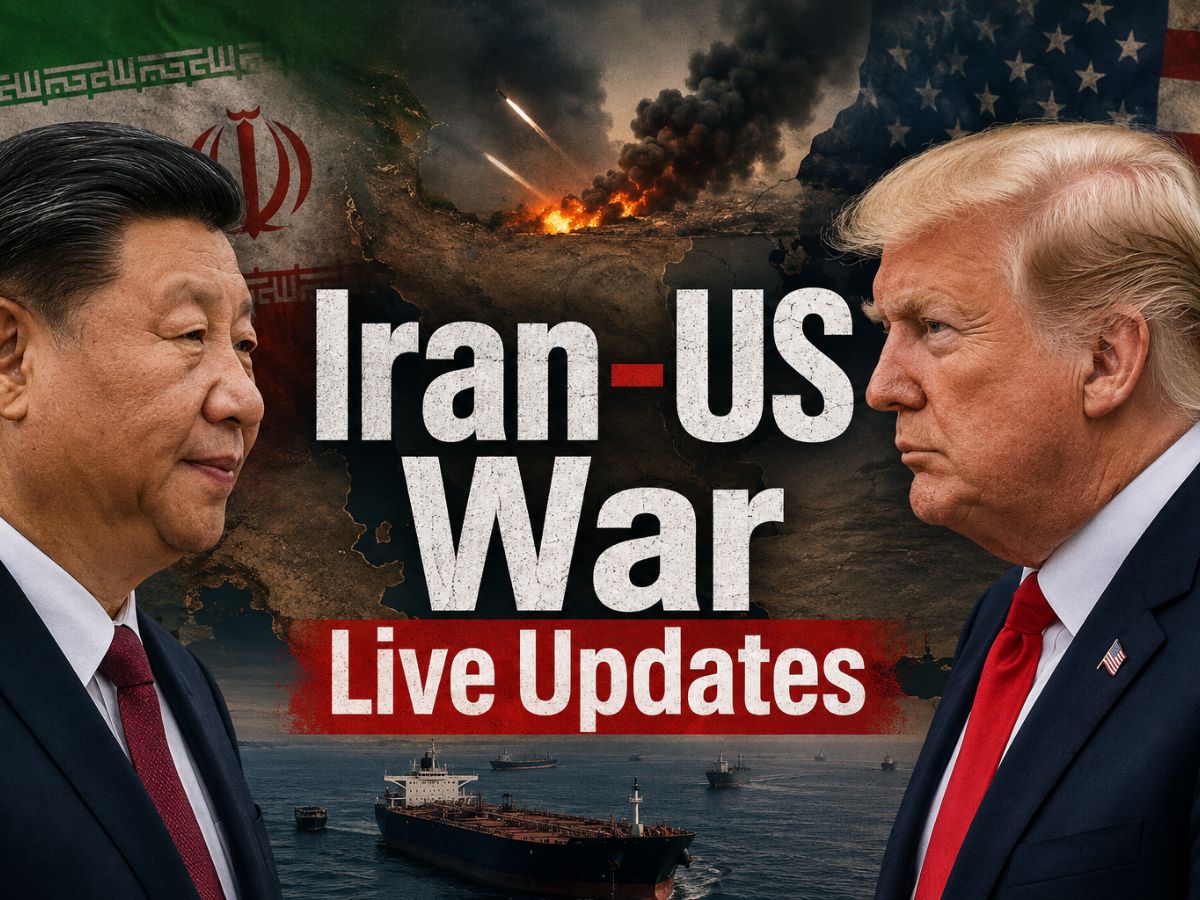
US President Donald Trump and Chinese President Xi Jinping are set to meet on Friday to conclude a two-day state summit, with discussions taking place against the backdrop of war in West Asia and growing concerns over global energy supplies. Trump is on his first visit to China since 2017. According to the schedule released ahead of the final day of the visit, the two leaders are expected to have tea together, followed by lunch before Trump departs for the United States.
Vessel Seized Near UAE Waters
Iran has seized a commercial vessel off the coast of the United Arab Emirates on Thursday and redirected it toward Iranian waters.
The developments unfolded as the White House stated that Trump and Xi had agreed on the importance of keeping the Strait of Hormuz open for international shipping.
China remains one of Iran’s closest partners and is also the primary buyer of Iranian oil. The Strait of Hormuz has become a focal point of the ongoing regional conflict after Iran largely restricted shipping movement through the route following the outbreak of the US-Israeli war on Iran on February 28.
Iran has reportedly allowed only its own vessels to move freely through the strait since the war began.
While the United States paused its attacks on Iran last month, Washington subsequently imposed a blockade on Iranian ports.
Iran Allows Chinese Vessels Through Strait
Iran’s Revolutionary Guards said on Thursday that nearly 30 vessels had transited through the Strait of Hormuz since Wednesday evening after receiving permission from Tehran, Reuters reported citing Iranian state media.
Separately, Iran has also started permitting some Chinese vessels to move through the strategically crucial waterway after both sides reportedly reached an understanding on Iranian management protocols governing the strait.
The semi-official Fars news agency, citing an informed source, reported that the arrangement specifically applies to certain Chinese ships.
0s Helsinki Process, which helped ease tensions across Europe in the aftermath of World War II.
Obama Defends 2015 Iran Nuclear Deal
Former US President Barack Obama has meanwhile defended the 2015 nuclear agreement with Iran, arguing that the deal successfully curbed Tehran’s nuclear programme without triggering a broader regional war.
In an interview with CBS, Obama said the agreement had resulted in the removal of a significant portion of Iran’s enriched uranium stockpile and noted that both US and Israeli intelligence agencies had supported the deal’s effectiveness at the time.
“We pulled it off without firing a missile,” Obama said. “We got 97 percent of their enriched uranium out.”
“There’s no dispute that it worked. And we didn’t have to kill a whole bunch of people or shut down the Strait of Hormuz,” he added.
Live Updates
- 09:45 (IST) 15 May 2026
Iran–US-Israel War LIVE and Latest Updates: Trump says Xi is 'all business' as talks resume after Taiwan warning
President Donald Trump and China’s Xi Jinping are set to meet on Friday to wrap up a two-day state visit that has featured pomp and business deals but also a warning from Xi that mishandling the Taiwan issue could send relations spiraling.Trump is on the first visit by a U.S. president to China, America’s main strategic and economic rival, since his last in 2017, and has been seeking tangible results to beef up his dented approval ratings ahead of crucial midterm elections.“Hopefully our relationship with China will be stronger and better than ever before!” Trump wrote in a post on...
- 09:09 (IST) 15 May 2026
Iran–US-Israel War LIVE and Latest Updates: Oil rises more than 1% after Trump flags China's interest in US supplies
Oil prices gained more than 1% after President Donald Trump said China wants to buy oil from the United States and as concerns persisted over ship attacks and seizures despite Iran saying about 30 vessels had passed through the Strait of Hormuz.
Brent crude oil futures LCOc1 rose $1.17, or 1.11%, to $106.89 a barrel by 0252 GMT, while U.S. West Texas Intermediate futures CLc1 were up $1.10, or 1.09%, to $102.27.
Trump also said in an interview with Fox News he would not be much more patient with Iran as he urged Tehran to reach a deal with Washington.
(Reuters)
- 08:21 (IST) 15 May 2026
Iran–US-Israel War LIVE and Latest Updates: Trump on Iran: 'I am not going to be much more patient'
U.S. President Donald Trump said he would not be much more patient with Iran as he urged Tehran to reach a deal with Washington.
“I am not going to be much more patient,” Trump said in an interview aired on Thursday night on Fox News’ “Hannity” program. “They should make a deal.”
(Reuters)
- 07:59 (IST) 15 May 2026
Iran–US-Israel War LIVE and Latest Updates: India hikes petrol and diesel prices by about 3 rupees/litre
India has raised petrol and diesel prices for the first time in four years by about 3 rupees ($0.03) per litre, according to retailers in Delhi on Friday, as the country aims to recoup some of the losses incurred due to higher global oil prices.Global oil prices spiked at more than $120 per barrel, before pulling back to around $100 to $105 a barrel following the near-closure and severe disruption of the Strait of Hormuz, triggered by the U.S.-Israeli conflict with Iran.India is among the last major economies to raise retail fuel prices. A litre of diesel in Delhi will...
- 07:18 (IST) 15 May 2026
Iran–US-Israel War LIVE and Latest Updates: Saudi Arabia Discussing Regional Non-Aggression Pact
According to reports, Saudi Arabia is engaged in discussions over a regional non-aggression pact aimed at reducing tensions across West Asia.
The Financial Times, citing diplomats, reported that the proposed framework is intended to prevent the broader region from continuing to bear the consequences of the ongoing war even after the conflict eventually ends.
Diplomats told the publication that Saudi Arabia is attempting to advance a model similar to the 197




