
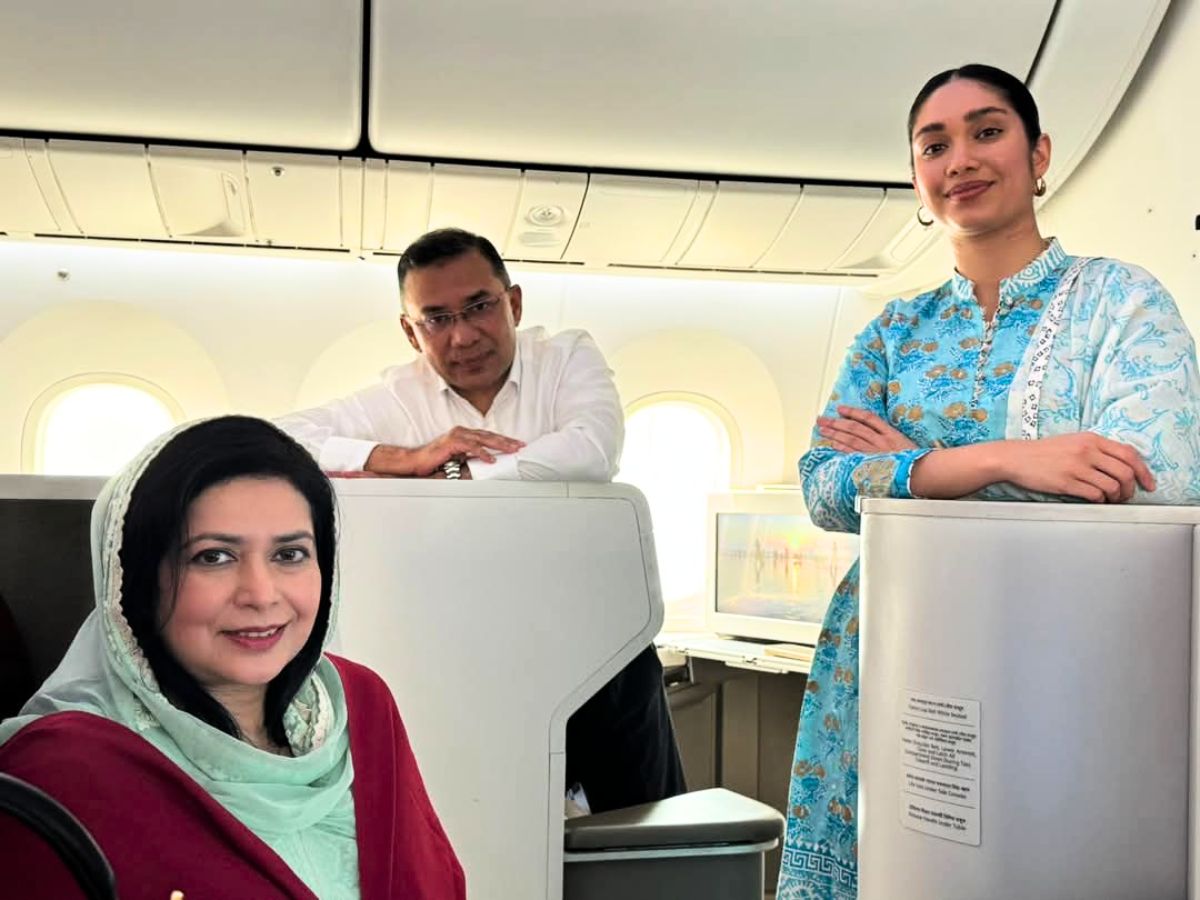

Bangladesh Nationalist Party (BNP) acting chairman Tarique Rahman returned to Bangladesh after over 17 years in self-exile, completing his national voters registration and obtaining a National ID (NID) card in Dhaka.
Accompanying him was his wife Dr Zubaida Rahman and their daughter Zaima Rahman, whose presence is now fueling speculation about her potential role in the country’s political arena.
Who is Zaima Rahman? The New Face of BNP
Zaima Rahman, 32, is the sole daughter of the BNP Chairperson, Tarique Rahman, as well as the granddaughter of former Prime Minister Khaleda Zia, in addition to late President Ziaur Rahman. Being a trained barrister from London, she has maintained a distance from politics for the last 17 years.
Unlike other political inheritors in Bangladesh, she has not occupied any official position in a political party or run in elections. She maintained a relatively low profile, but her recent return to Dhaka and her appearances alongside her father indicate the start of a new era in BNP politics.
First Steps into Bangladeshi Politics
Zaima’s return to Bangladesh has come at a very important time as the country is moving towards holding national elections in February 2026. She began making political appearances by representing her father in important events such as the National Prayer Breakfast in Washington, DC, and BNP meetings with representatives from Europe.
On the 27th of December, Faria visited Tarique Rahman at Dhaka University, where she visited the graves of slain student leader Osman Hadi and national poet Kazi Nazrul Islam. Such instances reveal the deliberate manner in which Faria has been allowed to mingle with the world outside her private boundaries.
A Symbol of Youth and Renewal for BNP?
Political observers believe that Zaima Rahman could be a new symbol of youth and change for BNP, and that this could help her father reach out to young voters in Bangladesh’s divided political atmosphere. With Tarique Rahman trying to change his image that has been tarnished by scandals of corruption and an alternative power center called Hawa Bhaban, Zaima seems to have a fresher and more modern image to bring to her party.
Personal Connections & Early Media Attention
Zaima first appeared before the public eye aged six-years-old when she accompanied her grandmother, Khaleda Zia, to the polling station during the national election in 2001. Recently in 2021, national attention focused on her as an Awami League minister made derogatory comments about her. This sparked the resignation of the said minister.
She has also described her return to Bangladesh as an opportunity for her to “rediscover her homeland through lived experiences,” which reveals that she has a desire to be more than a symbolic figure in BNP politics.
What This Means For Dhaka’s Power Play
Zaima Rahman’s rising popularity brings a fresh factor to the country’s political equation. Though Zaima Rahman does not have any political ambitions or plans to run for an election yet, her participation in events along with her father raises curiosity about what might lie in store in the future.
As national elections are pending and tensions are high in the political arena, Zaima Rahman might play an important role in the BNP’s plans to engage young voters and change their image before the elections in February 2026.
ALSO READ: Not London, Not New York: Why Are Thousands Of Indian Workers Flocking To Moscow? Explained
Sofia Babu Chacko is a journalist with over five years of experience covering Indian politics, crime, human rights, gender issues, and stories about marginalized communities. She believes that every voice matters, and journalism has a vital role to play in amplifying those voices. Sofia is committed to creating impact and shedding light on stories that truly matter. Beyond her work in the newsroom, she is also a music enthusiast who enjoys singing.




