
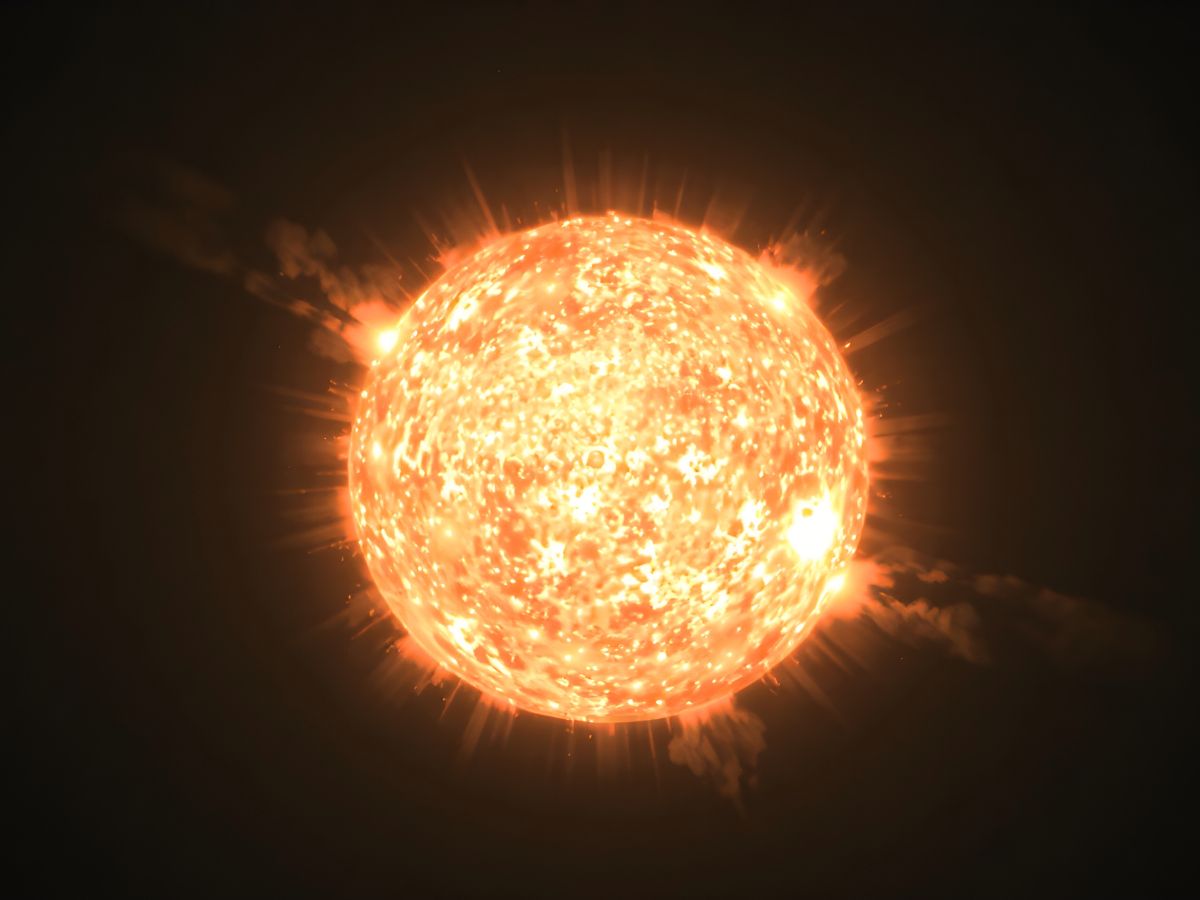

The Sun has entered a difficult phase once again, unleashing a string of powerful solar flares that have prompted space agencies across the world to issue alerts.
In India, the Indian Space Research Organisation (ISRO) is on high alert after scientists warned of a strong possibility of radio blackouts that could disrupt communication networks, navigation systems, television broadcasts, and radar operations.
More than 50 operational Indian satellites are currently under constant monitoring as heightened solar activity threatens to interfere with critical space-based infrastructure.
Anil Kumar, Director of ISRO’s Telemetry, Tracking and Command Network (ISTRAC), said there is a real possibility of radio communication loss, but assured that all satellites are being watched very closely and any disruption will be addressed immediately.
Ground stations have already alerted mission control centres and contingency measures are in place to handle anomalies.
Why is Sun ‘Angry’?
The current solar unrest began with the sudden intensification of a magnetically complex sunspot cluster known as Active Region 14366.
Over the past few days, this region has erupted repeatedly, producing several intense solar flares, including an X8.1-class flare the most powerful solar flare recorded so far in 2026.
The Sun emitted a strong solar flare on Feb. 3, peaking at 9:08 a.m. ET. NASA’s Solar Dynamics Observatory captured images of the event, which was classified as X1.5. https://t.co/gHptBKDzqk pic.twitter.com/prkVqTWE8O
— NASA Space Alerts (@NASASpaceAlerts) February 3, 2026
NASA confirmed that the flares peaked between February 1 and February 2, with the strongest eruption occurring on February 1.
Scientists described it as the brightest solar flare since October 2024 and one of the top 20 most powerful flares observed since modern satellite monitoring began in 1996. These eruptions are part of the Solar Maximum phase, the peak period of the Sun’s 11-year activity cycle when such violent outbursts become more frequent.
How Solar Flares Affect Earth and India
Solar flares release enormous bursts of electromagnetic radiation that reach Earth within minutes. Although they do not harm people directly on the ground, they severely disturb the ionosphere, the electrically charged layer of Earth’s upper atmosphere.
When this layer is disturbed, high-frequency radio signals can fail, GPS navigation can become inaccurate, television signals can be disrupted, and radar systems can face interference.
For a country like India that relies heavily on satellites for communication, weather forecasting, navigation, disaster management, defence surveillance, and broadcasting, such disturbances are a serious concern.
Increased radiation exposure during such events also poses risks to satellites orbiting the Earth.
Scientists Say This Was Anticipated
Professor Dibyendu Nandi, a solar astrophysicist at CESSI, IISER Kolkata, said the unusual activity of Active Region 14366 had been observed in advance.
According to him, the region had become hyperactive and was repeatedly firing solar storms throughout the week. Indian scientists had analysed the region earlier and issued space-weather alerts anticipating elevated solar activity.
Why the Situation Is Being Watched Closely
Despite the extreme flaring, scientists point out that Earth has so far avoided the worst-case scenario a strong Earth-directed Coronal Mass Ejection (CME), which can trigger geomagnetic storms capable of damaging satellites and even power grids.
A weaker CME is currently on its way, but experts warn that because the active region lies close to the Sun–Earth line, the possibility of a stronger impact in the coming days cannot be ruled out.
Aditya-L1: India’s Watchtower in Space
India’s first dedicated solar observatory, Aditya-L1, is playing a crucial role in tracking the unfolding solar storm.
Positioned at the L1 Lagrange point about 1.5 million kilometres from Earth, Aditya-L1 provides an uninterrupted view of the Sun and helps scientists measure solar radiation, magnetic fields, and energetic particles in real time. This data allows ISRO to issue early warnings and take steps to safeguard satellites.
India’s Plan to Study the Angry Sun
On February 1, Finance Minister Nirmala Sitharaman announced the plan to establish the National Large Solar Telescope (NLST) near Pangong Lake in Ladakh at a cost of around ₹1000 crore.
This advanced ground-based telescope will study the origin and behaviour of solar magnetic fields that drive flares and coronal mass ejections.
The telescope will complement data from Aditya-L1 and strengthen India’s ability to predict when the Sun may turn volatile.
No Immediate Catastrophe, But Vigilance Continues
Scientists have clarified that there is no immediate threat of catastrophic damage. However, as Active Region 14366 continues to rotate across the Sun’s surface, India and the world remain on alert.
The Sun, which sustains life on Earth, can also disrupt the technology that modern societies depend on. For now, ISRO’s close monitoring and India’s growing solar observation capability are ensuring preparedness for the next solar outburst.
Sofia Babu Chacko is a journalist with over five years of experience covering Indian politics, crime, human rights, gender issues, and stories about marginalized communities. She believes that every voice matters, and journalism has a vital role to play in amplifying those voices. Sofia is committed to creating impact and shedding light on stories that truly matter. Beyond her work in the newsroom, she is also a music enthusiast who enjoys singing.




