
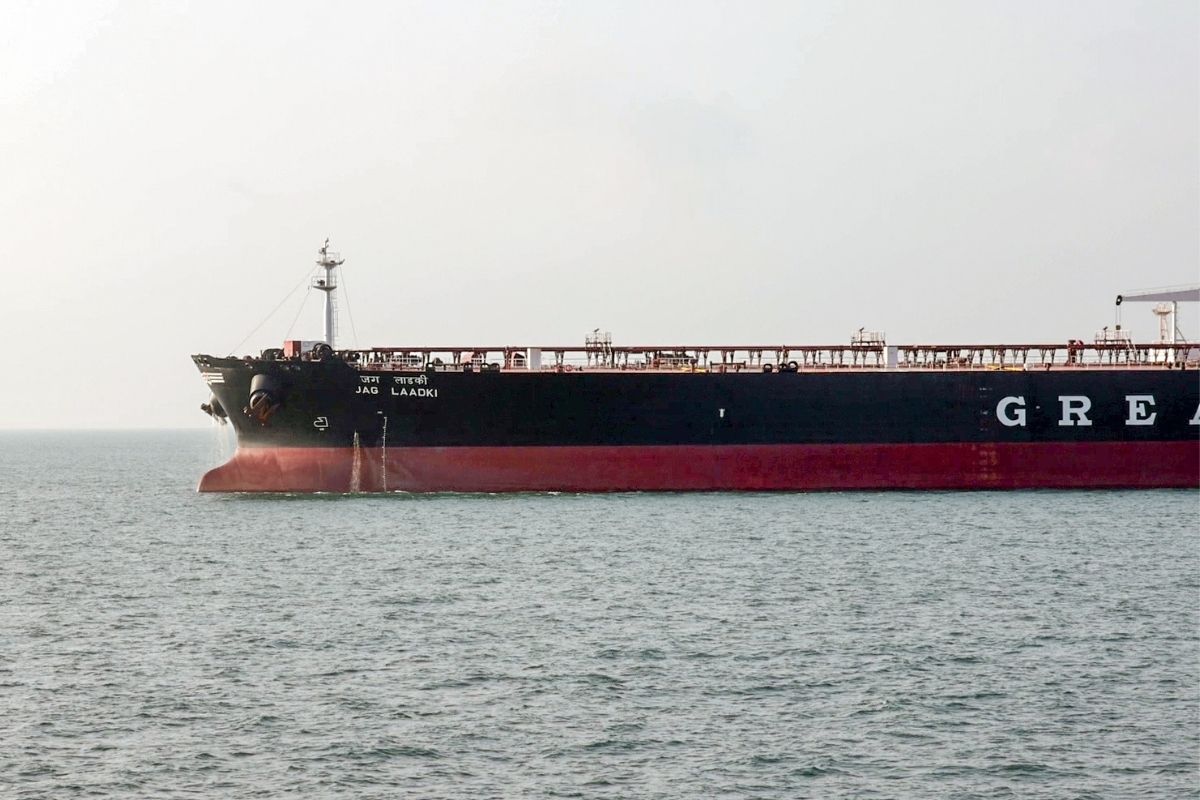

With Iran allowing movement of vessels belonging to only friendly nations via the Strait of Hormuz which has become an flashpoint for confrontation between Iran and the US-Israel, the country has allowed two more India-flagged LPG tankers that are together set to bring around 90000 metric tonnes of LPG to the world’s second largest LPG consumer.
The smooth departure of these two vessels reinforces that the bilateral energy partnership between India and Iran continues to grow stronger even as India strikes a balance between Iran, the US and Israel.
With the Indian LPG tankers BW ELM and BW TYR clearing the Ras Al Kuh South TSS Exit on Saturday evening, both managed a safe exit from the high-risk area where Iran remains engaged in a major confrontation with US and Israeli blocking ships it perceives as linked to the war effort of the latter, but letting through a trickle of others.
Both the vessels are scheduled to arrive at Indian coasts by Thursday.
“While the BW TYR is scheduled to arrive at Mumbai by 20.00 hours on March 31, BW ELM is bound to reach the New Mangalore port 1200 hours on April 1,” a senior government official told The Sunday Guardian.
Once the two vessels arrive at Indian ports, a total of six Indian LPG vessels would have received a safe passage from the Strait of Hormuz with Shivalik, Jag Vasant, Pine Gas and Nanda Devi, being the ones to have got a safe passage earlier.
The Iran crisis has sparked the worst gas crisis in decades in India where consumers are resorting to panic booking of gas cylinders and queuing up outside gas agencies.
In 2025, India consumed about 33.15 million metric tonnes of LPG, of which, imports accounted for about 60 per cent of demand. About 90 per cent of these imports arrived from the Middle East.
While several tankers remained stranded in the Strait of Hormuz (SOH) during the initial period of intense confrontation between Iran and the US/Israel, Iran has now softened its stand towards friendly nations by granting special clearances for vessels destined for friendly nations including China, India, Iraq, Russia and Pakistan.
Significantly, at least three more India-flagged LPG vessels, namely, Jag Vikram, Green Asha, and Green Sanvi are currently anchored off the Mina Saqr, awaiting instructions from the Indian Navy for transit through / north of the Strait of Hormuz.
The Mina Saqr is a major deep water sea port in UAE’s Ras Al Khaimah near the Strait of Hormuz.
While Iran has not directly targeted an Indian-flagged ship in the SOH ever since the war started, it has targeted some vessels which had Indian crew, resulting in casualties of Indian seafarers including three deaths of Indian nationals, one of them continuing to be missing and four others suffering injured.
Under Operation Sankalp and Operation Urja Suraksha, the Indian Navy has been ensuring that India-bound vessels get a safe passage against threats, including potential, underwater mines which have been planted by Iran to target vessels associated with its rivals or their allies.
“As of Saturday, 18 Indian vessels are in the Persian Gulf on the west of Strait of Hormuz, six are in the Gulf of Oman on the east of the SOH, and two are in the Gulf of Aden,” the official mentioned above said.
Approximately 21,000 Indian seafarers continue to be in the wider gulf region, out of whom 644 are onboard Indian-flagged vessels.
Of the 644 Indian seafarers, as many as 485 are in the Persian Gulf region while 159 are in the Gulf of Oman region.
Syed Ziyauddin is a media and international relations enthusiast with a strong academic and professional foundation. He holds a Bachelor’s degree in Mass Media from Jamia Millia Islamia and a Master’s in International Relations (West Asia) from the same institution.
He has work with organizations like ANN Media, TV9 Bharatvarsh, NDTV and Centre for Discourse, Fusion, and Analysis (CDFA) his core interest includes Tech, Auto and global affairs.
Tweets @ZiyaIbnHameed




