

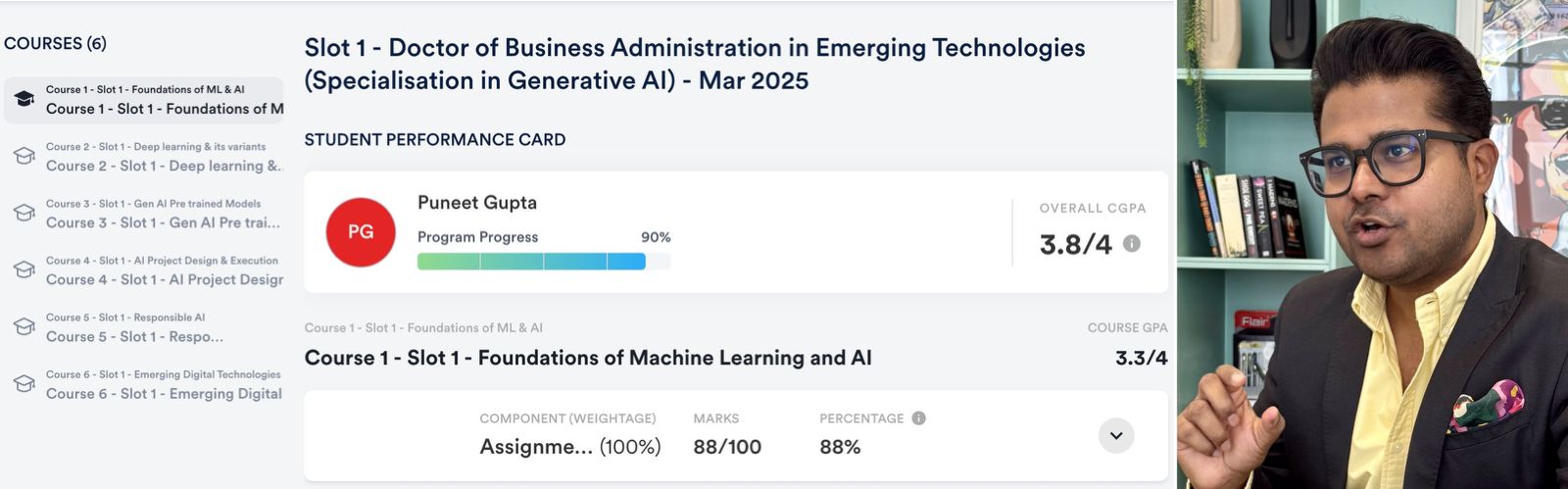
HARYANA, 4 JUNE: Puneet Gupta, a serial entrepreneur and National Awardee widely known as the “Waterless Man of India,” has shared the performance card from his ongoing doctoral programme in Generative AI, offering a rare public look at why an established founder chose to sit assignments, case studies and examinations again at a stage in life when most people consider their formal learning behind them.
The card tells a simple story. His first course was assessed at 3.3 out of 4. His overall now stands at 3.8 out of 4. For Gupta, the distance between those two numbers, rather than either number on its own, is the point.
“Began at 3.3 CGPA, ended at 3.8,” Gupta said. “The journey meant more than the score. There is a difference between knowing something and being able to prove you know it. I built companies for years on instinct and execution, and it worked. But I was about to place my next big bet in artificial intelligence, and I refused to build in a field I only understood from the outside.”
The decision to return to the classroom followed a turning point in Gupta’s career. Following the acquisition of the waterless hygiene brand he had built, and his own exit from the company, he found himself at a rare pause between chapters. Rather than rush into the next venture, he chose to treat the gap as a deliberate sabbatical and use it to learn.
“This was the best possible way to take a sabbatical,” Gupta said. “After an exit, the easy thing is to jump straight into the next thing. I wanted the opposite. I wanted room to step back, to think clearly, and to plan my next bet with depth rather than haste. Going back to study gave me exactly that.”
Gupta is enrolled in the Doctor of Business Administration in Emerging Technologies, with a concentration in Generative AI, at Golden Gate University in San Francisco, California. A first-of-its-kind, STEM-designated professional doctorate offered by an institution with a 120-year history, the programme sits in the heart of the San Francisco Bay Area, the global epicentre of artificial intelligence and the wider technology economy. Its faculty include practitioners active in building AI companies, and the university is expanding its focus on emerging technology as the field reshapes industry worldwide.
That Silicon Valley grounding is built into the structure of the degree itself. The programme is designed around a sequence of global immersion residencies that take doctoral candidates from India to Singapore and culminate in San Francisco, placing them directly inside the ecosystem where much of the world’s frontier AI is being built. For Gupta, studying in proximity to that ecosystem was part of the appeal.
“I went back not for the title, but for the discipline of being examined, and for the arc that takes you across an entire field instead of only the parts you find comfortable,” he said. “Being connected to San Francisco and the Bay Area, where so much of this technology is actually being built, changes how you think about what is possible and what is real.”
The coursework was structured to build expertise across the full stack of modern artificial intelligence rather than any single layer of it, and Gupta’s scores rose steadily as he moved through it. The programme opened with the Foundations of Machine Learning and AI, establishing the core concepts and algorithms that underpin the field. It moved into Deep Learning and its Variants, covering the neural network architectures behind today’s most capable systems, and then into Generative AI and Pre-trained Models, the study of the large foundation models now driving the current wave of AI.
From there the programme turned from theory to application. AI Project Design and Execution focused on taking artificial intelligence from concept through to real deployment, the discipline of making systems work outside the laboratory. Responsible AI addressed the ethics, governance and safety questions that increasingly determine whether AI can be trusted at scale. The final course, Emerging Digital Technologies, widened the lens to the broader landscape of technologies reshaping business and society. Taken together, the six courses trace a deliberate path from foundations, to architectures, to generative models, to execution, to responsibility, and finally to the wider horizon, the same end-to-end view Gupta says he wanted before committing to his next venture.
“Somewhere across those late nights, artificial intelligence stopped being a headline for me and became something I understood from the inside,” Gupta said. “How the models are built, where they break, and what it actually takes to build on top of them in Indian conditions, for Indian realities. I set myself one private rule at the start. Not simply to pass, but to beat my own score in every course that followed.”
Beyond the taught courses, the doctorate is a multi-year research degree that requires candidates to clear a qualifying examination testing their mastery of AI foundations before progressing to a substantial body of original dissertation work. Having completed the coursework component and the examinations that accompany it, Gupta has now entered the dissertation and business plan stage of the programme, a phase he says he had been working toward from the beginning.
He frames the doctorate not as an end in itself but as preparation for what he intends to build next. “The goal was never the degree,” he said. “The goal is to build something for India. Something sovereign. Built from the layer up.” Gupta has declined to name the venture at this stage, saying only that work on it has already begun and that he will “let it speak when it is ready.”
The return to structured study marks a deliberate turn for a founder whose earlier work centred on solving everyday constraints through product. Gupta first drew national attention for building a waterless hygiene category, work that earned him recognition as the “Waterless Man of India” and that he traces back to a long-standing interest in building for real-world conditions, including the demands of defence environments where reliability and resource constraints are unforgiving.
“Real-world exposure changes how you build,” Gupta said. “Going back to study was a way of pairing that instinct with depth, so the next thing I build stands on both.” He says he intends to share more about the direction of his work in the coming months, with updates to be posted at puneetgupta.org.
About Puneet Gupta
Puneet Gupta is a serial entrepreneur and National Awardee widely known as the “Waterless Man of India” for his work building a waterless hygiene category. He is currently pursuing doctoral research in Generative AI and Emerging Technologies at Golden Gate University, San Francisco, and works at the intersection of artificial intelligence, emerging technology and venture building. More information is available at puneetgupta.org.





