
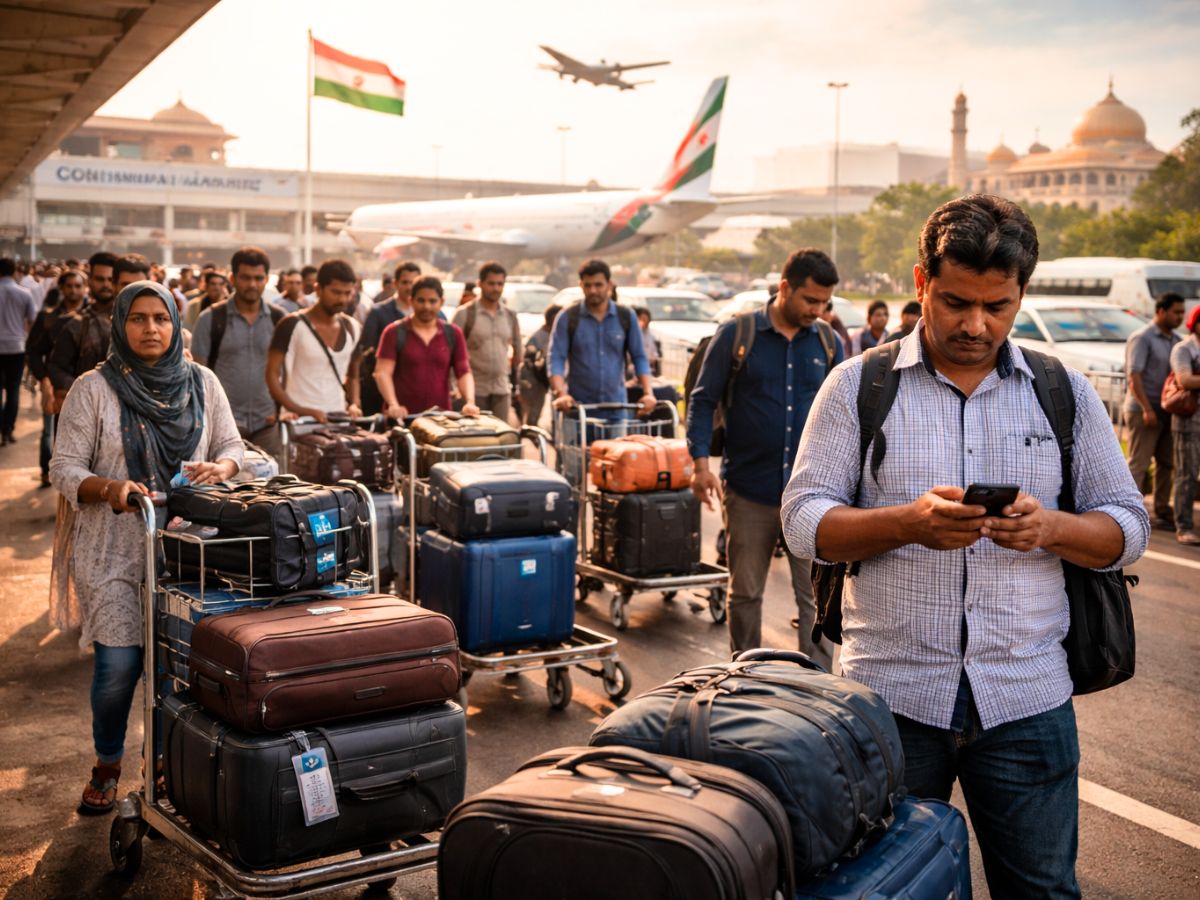

Less than a week before the Kerala Assembly polls scheduled on April 9th, the state is witnessing a major challenge that the possible mass absenteeism of Gulf-based Non-Resident Keralites (NRIs), a historically decisive voter bloc.
Growing tensions in West Asia have caused disruption in transport services and increased airfares four-fold to ₹60,000 compared to ₹8,000-13,000 earlier. This development forces the political parties to revise their poll strategies accordingly.
How Pravasi Voter Turnout Faces Historic Drop
Kerala has approximately 2.25 lakh registered pravasi voters, many of whom reside in Gulf Cooperation Council (GCC) countries.
Experts estimate that turnout this year could drop drastically, from the usual 60% to as low as 10%. Political analysts warn that even a partial absence of these voters could swing tightly contested constituencies in North Kerala.
In the 2021 Assembly elections, razor-thin margins decided several seats. For example, Perinthalmanna in Malappuram was won by just 38 votes, Kuttiadi by 333, and constituencies like Tanur and Palakkad recorded victory margins under 5,000. Kuttiadi alone has over 16,000 registered overseas voters, meaning even a modest drop in turnout could significantly alter the electoral arithmetic.
Is West Asia Conflict Disrupting Travel And Campaigns?
The ongoing conflict in West Asia has disrupted more than a thousand flights, directly affecting voter mobility. Rising airfares have further discouraged expatriates from returning. “Ticket prices have surged beyond ₹61,000 during the election period,” said Noorudheen, a travel agency representative in Dammam, Saudi Arabia.
Political campaigns targeting expatriates have also been curtailed. Unlike the 2024 Lok Sabha elections, when Congress MP Shafi Parambil led high-profile overseas campaigns, this year’s contests have shifted to grassroots mobilisation and virtual outreach. Expatriate networks are now relying on digital engagement to influence votes from abroad.
What are the High-voltage Constituencies in Malabar?
Kuttiadi, with the highest number of registered overseas voters in Kerala (16,002), exemplifies the impact of pravasi absenteeism. Other constituencies with significant expatriate presence include Nadapuram (12,424), Tirur (8,601), and Kalliasseri (8,097).
“The absence of NRIs could redefine outcomes in constituencies that were traditionally considered UDF strongholds,” said KTA Muneer, Middle East convener of the Overseas Indian Cultural Congress (OICC). He added that 30% of active UDF workers and 60% of supporters in the Gulf might not be able to return due to travel restrictions and soaring airfares.
Parties Recalibrate Strategies
Political fronts remain publicly optimistic. The Indian Union Muslim League (IUML) is focusing on local-level mobilisation in constituencies like Perinthalmanna and Kuttiadi, while urging expatriates to influence family votes remotely.
The Left Democratic Front (LDF) continues to project itself as a “stability shield,” highlighting welfare measures for returning migrants, including the Rs 7,000 pension and pravasi health insurance schemes. Meanwhile, the NDA is emphasising the Union government’s readiness to protect Indian citizens abroad, hoping to win over middle-class families concerned about relatives in conflict zones.
The Economic Fallout and Voter Concerns
The West Asia conflict has created a “pocketbook crisis” in Kerala. Remittances, which constitute over 23% of the state’s Net State Domestic Product (NSDP), are projected to drop by 20% this year, impacting household finances.
Expatriates cite logistical constraints, high airfare, and fears of losing employment as key deterrents. Ajitha Aneesh, chairperson of the Dubai Malayali Association, warned that voter turnout could plummet to just 10%.
With fewer NRIs physically returning, political parties have increasingly relied on digital campaigns targeting Gulf-based voters. Analysts estimate that one expatriate worker can influence the voting decisions of 4-8 family members back home. WhatsApp groups, video calls, and online content are now playing a decisive role in shaping electoral outcomes.
Kerala’s Political Future and Gulf NRIs
Approximately 1.7-2 million Keralites live in the GCC, contributing nearly ₹2 lakh crore in remittances annually. Their votes have historically played a kingmaker role in tightly contested constituencies. This year, however, the twin challenges of travel disruption and skyrocketing costs threaten to sideline a crucial voter base, potentially reshaping Kerala’s political map.
As April 9 approaches, the 2026 Kerala Assembly elections are becoming a test of how local politics adapts to global crises. While NRIs may be grounded, their influence now digital remains a decisive factor in the state’s closely fought Malabar constituencies.
Sofia Babu Chacko is a journalist with over five years of experience reporting on Indian politics, crime, human rights, gender issues, and stories about marginalized communities. She believes journalism plays a crucial role in amplifying unheard voices and bringing attention to issues that truly matter. Sofia has contributed articles to The New Indian Express, Youth Ki Awaaz, and Maktoob Media. She is also a recipient of the 2025 Laadli Media Awards for gender sensitivity. Beyond the newsroom, she is a music enthusiast who enjoys singing. Connect with Sofia on X: https://x.com/SBCism




