
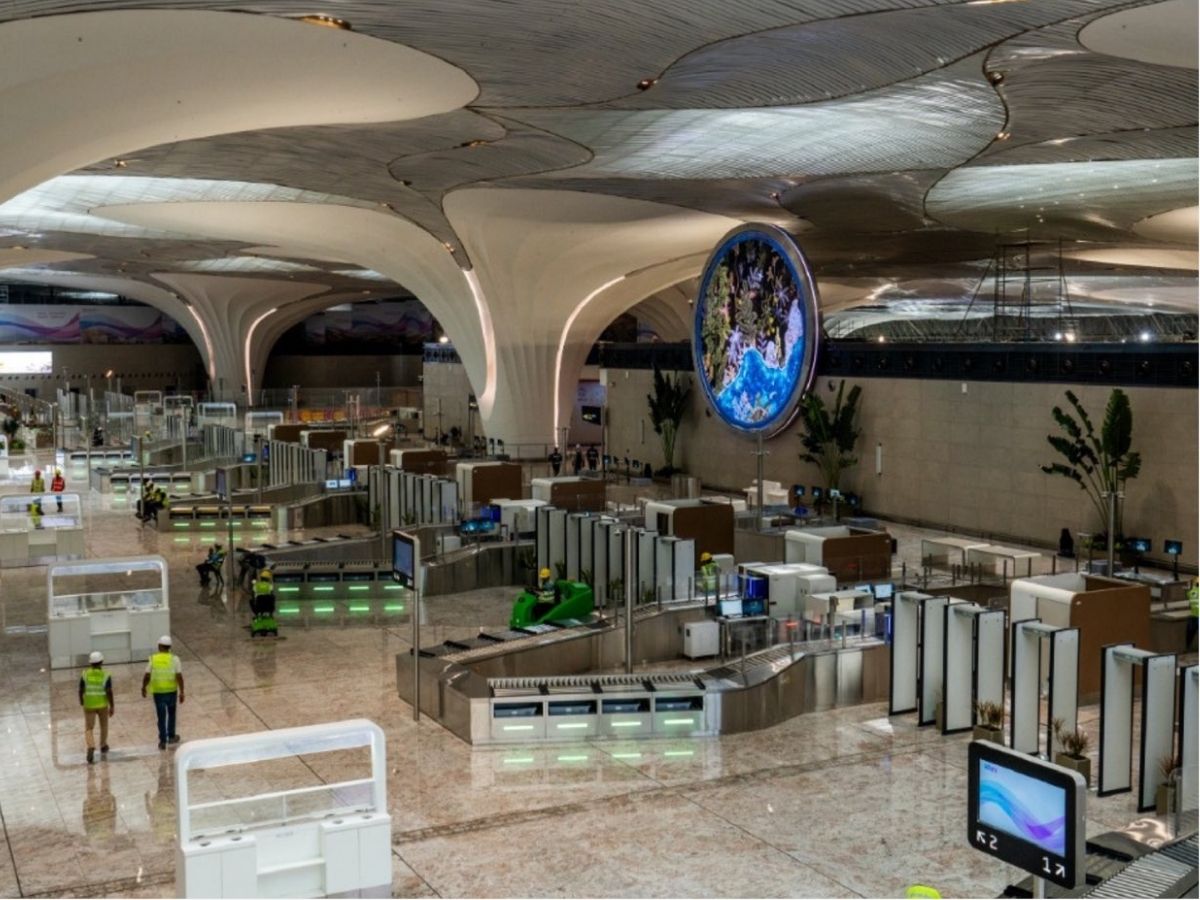

Navi Mumbai International Airport (NMIA), inaugurated today, October 8, 2025, has been formally declared India’s first fully digital air hub. Established through a public-private partnership (PPP) model between Adani Airport Holdings and CIDCO, NMIA added advanced digital infrastructure to offer a seamless, paperless experience for the passengers.
The airport features AI-powered terminals, self-baggage drop facilities, facial recognition systems, and app-based vehicle parking. All airport services right from check-in to boarding are well designed to be retrieved digitally, making NMIA a model for smart aviation infrastructure in India.
This digital-first approach in the development aligns with global trends in airport transformation, parallel to initiatives at major hubs in Tokyo, New York, and London.
Multi-Modal Connectivity and Sustainability
NMIA is also India’s first major aviation project with combined multi-modal connectivity. It links the Airport to expressways, metro lines, suburban rail, and waterways, providing an overall unified transport experience to the passengers. The airport is likely to significantly reduce the total travel time for millions of travellers in the Mumbai Metropolitan Region.
The project was designed by keeping sustainability in focus, hence, NMIA includes solar energy systems, rainwater harvesting plant, and advanced noise-reduction technologies. Primarily, it will function with one terminal and runway to serve around 20 million passengers per year, with long-term capacity planned for 155 million passengers.
NMIA is projected to generate more than 200,000 jobs across sectors including aviation, IT, hospitality, and real estate. Airlines like IndiGo, Air India Express, and Akasa Air have declared their operations starting from NMIA by December 2025.
Ankur Mishra is a journalist who covers an extensive range of news, from business, stock markets, IPOs to geopolitics, world affairs, international crises, and general news. With over a decade of experience in the business domain, Ankur has been associated with some of the reputed media brands. Through a sharp eye on global marketplaces along with deep insights and analysis of business strategies, Ankur brings simplicity to the complex economic matrix to decode market trends and empower people.
He is committed to entrenched data, facts, research, solutions, and a dedication to value-based journalism. He has covered trade tariff wars, international alliances, corporate policies, government initiatives, regulatory developments, along with micro- and macroeconomic shifts impacting global fiscal dynamics.




