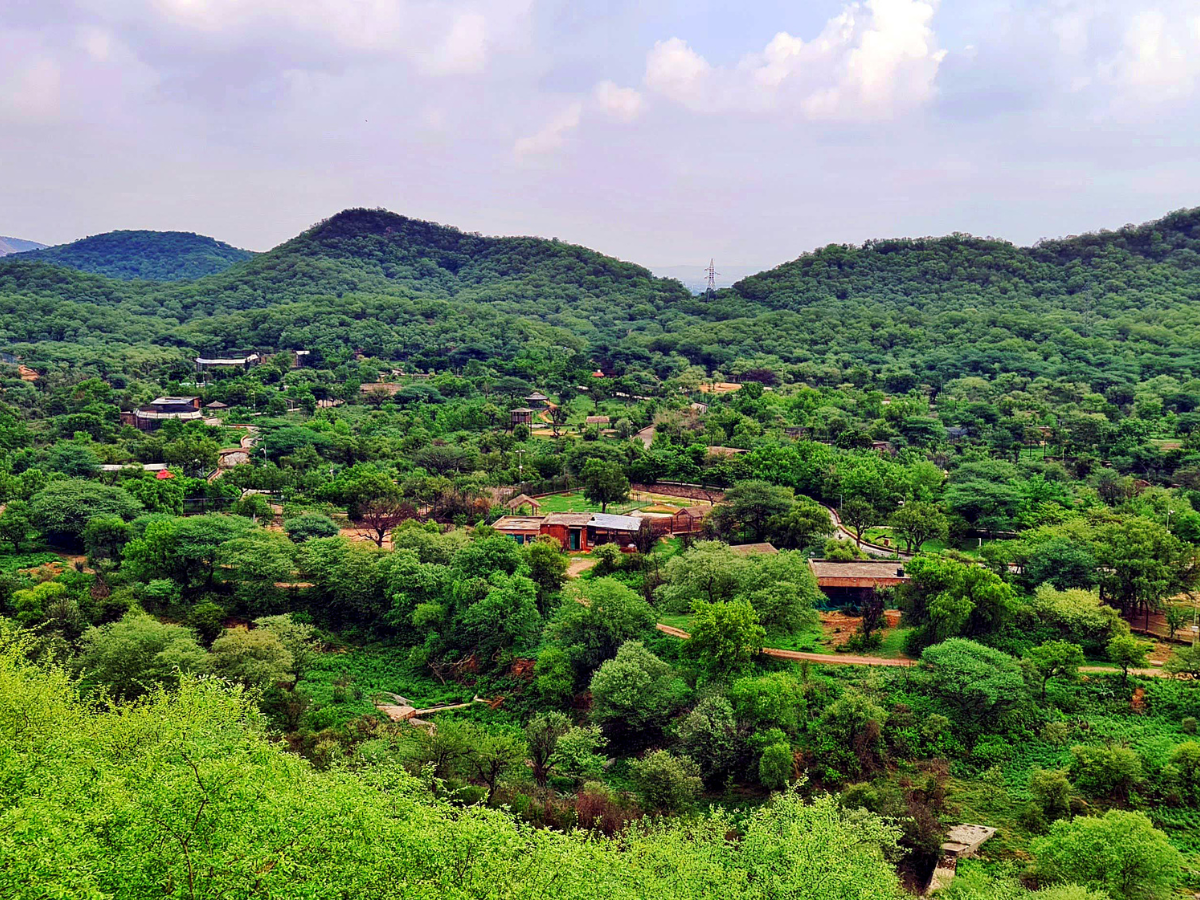

The Supreme Court accepted a new definition of the Aravalli Hills and Ranges based on the elevation, which has sparked a new controversy and protests in Haryana and Rajasthan. Activists say that the changed definition could prove detrimental and have serious environmental and ecological consequences. The Aravalli is one of India’s oldest mountain ranges and spreads across Rajasthan, Haryana, Delhi, and Gujarat. It plays a crucial role regarding the region’s environmental balance and has been called the “green lungs” of Delhi-NCR
The new definition describes an “Aravalli Hill” as “any landform in designated Aravalli districts with an elevation of 100 metres or more above its local relief,” and an “Aravalli Range” is defined as “a collection of two or more such hills within 500 metres of each other.” Critics argue that the new definition has left much of the lower ridges and small hills outside the protection, which are ecologically significant.
Aravalli redefinition sparks protests
Environmental activists and local residents peacefully protested in Gurugram outside the residence of Haryana cabinet minister Rao Narbir Singh. The protesters held placards that said “No Aravalli, No Life” and chanted slogans like “Save Aravalli, Save the Future.”
Lawyers in Udaipur also conducted a protest and marched from the court premises to the district collectorate in order to submit a memorandum addressed to the President and district officials.
According to reports, one of the protestors said that “This decision could encourage mining, construction and commercial activities, increasing the risk of destruction of the natural beauty of the Aravalli Range. We believe this decision could be detrimental to its ecological balance.”
Environment Minister talks about the issue
Bhupender Yadav addressed the concerns about the conservation of the Aravalli Hills and said that, “Aravalli spans four states and a total of 39 districts. The Aravalli is not just forest land. It includes forts, lakes, protected forest areas, temples, and cities. It is also home to critical minerals that are essential for the country’s needs. As for the operative part of the Supreme Court judgment, it directs the Environment Ministry to prepare a management plan for sustainable mining. At present, the court has only asked for the preparation of a plan; it has not permitted mining yet.” He pointed out that conservation of the Aravalli hills is necessary and mining should not be indiscriminate.
Opposition leader in Rajasthan, Tika Ram Jully warned about allowing mining in areas that do not fall under the new definition, adding that such action could lead to damage and desertification. While speaking to ANI, he said that, “On one hand, you are running a campaign called ‘Ek Ped Maa Ke Naam’ while on the other, you are cutting down lakhs of trees for your friends. This is wrong….The Aravali is the lifeline of Rajasthan. It is the Aravali that stops the desert… Scientists have also acknowledged that if there were no Aravali mountain range, the entire area up to Delhi would have turned into a desert.”
The new definitions have raised public concern and protests across several states.