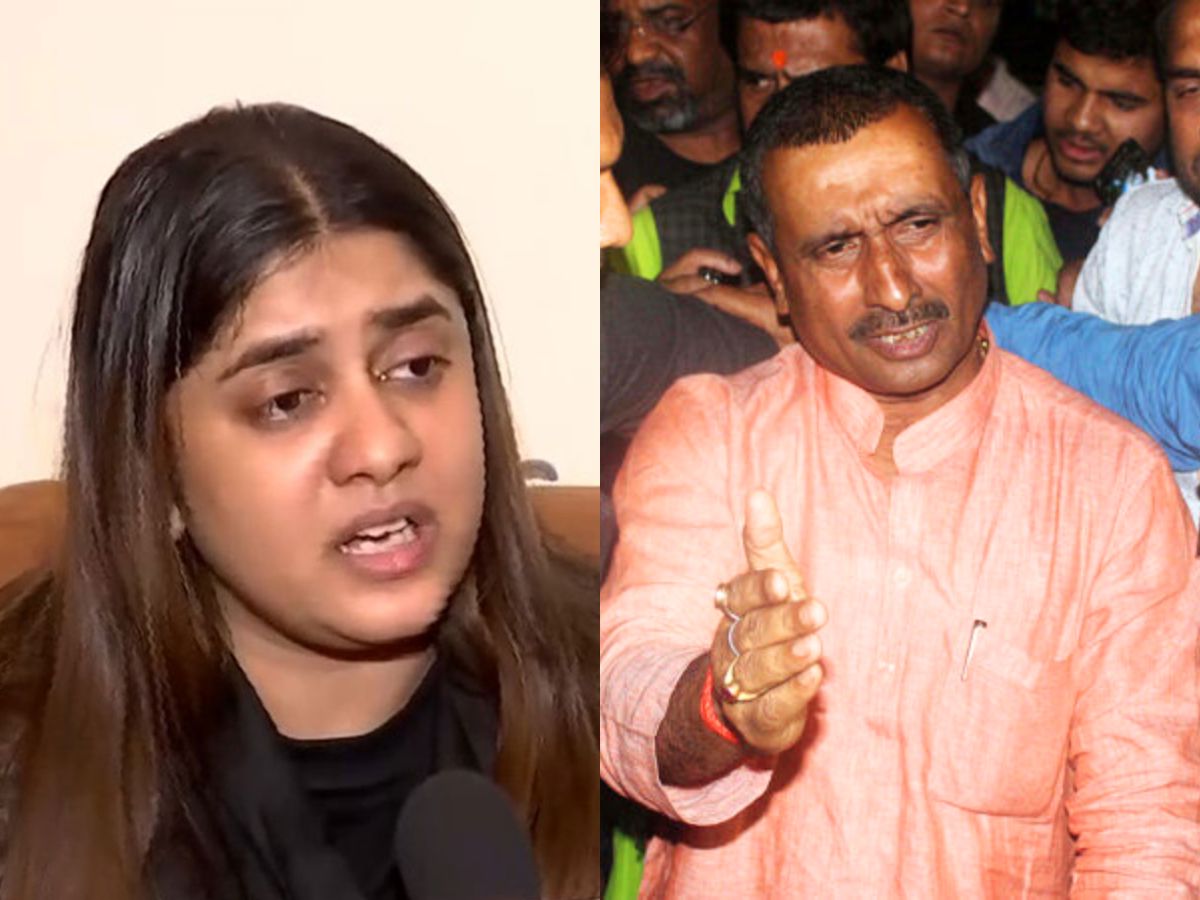

Aishwarya Senger, daughter of expelled BJP leader Kuldeep Singh Sengar, on Monday expressed anguish after the Supreme Court stayed the operation of the Delhi High Court order that had suspended her father’s life sentence in the 2017 Unnao rape case, claiming the defence was not even allowed to argue on merits.
In a statement issued shortly after the order, she said the hearing kept getting postponed, with the timing changed from 2 pm to 6 pm and finally to 8 pm, leaving no room for substantive arguments.
She further claimed that the AIIMS medical board had found the survivor to be over 18, CDR records showed that her father was not at the alleged location, and that it was also on record that the survivor herself was on a call at the time of the alleged incident.
She added that her family has been battling the case for years. “I’ve been fighting for justice for the past eight years, but maybe the sorrows of me and my family mean nothing. We have been stripped of our dignity, our peace, and even our basic right to be heard. Still, I hope for justice. I request members of the media not to spread any misinformation,” she said.
Earlier in the day, a three-judge vacation bench of the Supreme Court, headed by Justice Surya Kant, along with Justices J.K. Maheshwari and Augustine George Masih, stayed the Delhi High Court’s December 23 order, which had suspended Sengar’s life sentence. The stay was granted while the Central Bureau of Investigation appealed the High Court’s decision.
While issuing a notice to Sengar, the Supreme Court made it clear that the High Court order would remain in force and that Sengar would not be released from prison. The bench noted that although such suspension orders are not ordinarily stayed without hearing the convict, the present case involved “peculiar facts”, including the fact that Sengar remains incarcerated in another case.
“We are conscious of the fact that when a convict or undertrial has been released, such orders are not ordinarily stayed by this Court without hearing such persons. But in view of the peculiar facts, where the convict is convicted for a separate offence, we stay the operation of the Delhi High Court order dated December 23. Thus, the respondent shall not be released pursuant to the said order,” the bench observed.
During the hearing, Solicitor General Tushar Mehta, appearing for the CBI, argued that for the Protection of Children from Sexual Offences (POCSO) Act, a “public servant” includes a person occupying a dominant position over a child. He submitted that Sengar, being a powerful MLA at the relevant time, clearly exercised such dominance, attracting the aggravated offence provisions.
Senior advocates Siddharth Dave and N. Hariharan, appearing for Sengar, opposed the CBI’s plea and contended that an MLA could not be treated as a “public servant” for aggravated offences under the POCSO Act.
The bench, however, expressed concern over the High Court’s interpretation of the term “public servant” under Section 5 of the POCSO Act, observing that such a view could lead to an anomalous situation where elected lawmakers are excluded while lower-level officials are covered.
The Delhi High Court had suspended Sengar’s sentence on the prima facie view that the offence of aggravated penetrative sexual assault under the POCSO Act was not made out against him. Despite that order, Sengar continued to remain in custody as he had not been granted bail in the separate case relating to the custodial death of the victim’s father.
Sengar was convicted in 2019 by a Delhi trial court under the Indian Penal Code and the POCSO Act and sentenced to imprisonment for the remainder of his natural life. The trial court had held that he fell within the definition of a “public servant” under the POCSO Act.
(With ANI Inputs)
Sofia Babu Chacko is a journalist with over five years of experience covering Indian politics, crime, human rights, gender issues, and stories about marginalized communities. She believes that every voice matters, and journalism has a vital role to play in amplifying those voices. Sofia is committed to creating impact and shedding light on stories that truly matter. Beyond her work in the newsroom, she is also a music enthusiast who enjoys singing.