
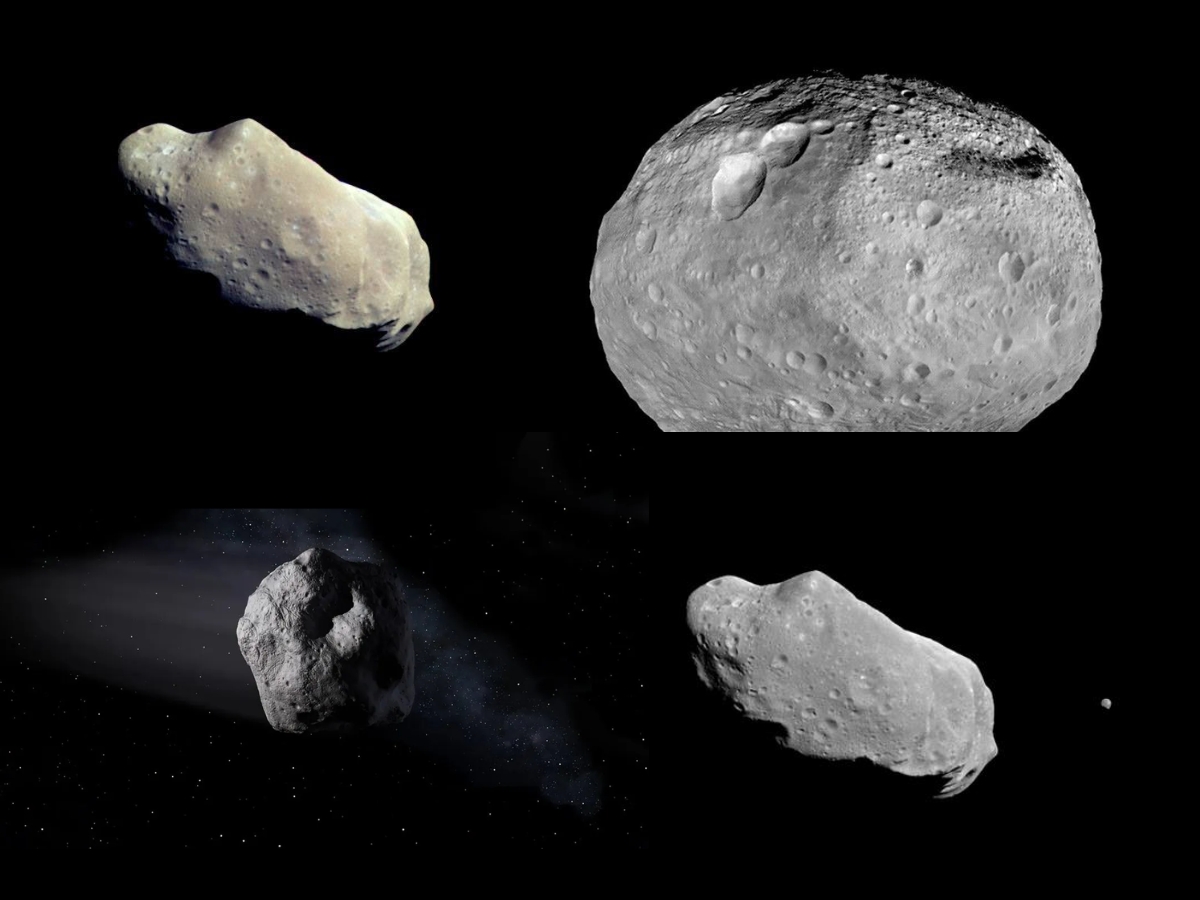

Space agencies are monitoring four near-Earth asteroids set to pass by Earth within a 24-hour window, according to new data released by NASA’s Jet Propulsion Laboratory (JPL). While the cluster of fly-bys has drawn public attention and occasional alarm, scientists stress that none of the objects pose any impact threat.
Next Five Asteroid Approaches List By NASA
The asteroids, classified as near-Earth objects (NEOs), are part of NASA’s continuous surveillance programme, which tracks small bodies passing within several million miles of Earth.
NASA’s “Next Five Asteroid Approaches” list maps NEOs projected to fly past Earth at distances of up to 4.6 million miles (7.5 million kilometres).
Also Read: Hubble Captures 3I/ATLAS Interstellar Comet with Stunning 40,000 km Glowing Halo Around Coma
Although four-asteroid groupings are not always highlighted in public briefings, the database routinely shows multiple NEOs scheduled for close approaches in short time spans. NASA notes that these listings can shift due to differences in asteroid sizes, identities, and orbital paths. What remains consistent, however, is that their so-called “close” distances are still far beyond any collision threshold.
How Close Is ‘Close’? Understanding the Distances
For perspective, the distance between Earth and the Moon averages 239,000 miles (385,000 kilometres).
By comparison, most NEOs in NASA’s current tracking window travel at up to 4.6 million miles from Earth—around 19 times the Earth-Moon distance.
Even smaller, rock-sized objects at such distances remain nowhere near Earth’s atmosphere or gravitational influence. Scientists emphasise that these fly-bys are entirely safe and represent normal, ongoing activity in the solar system.
Why NASA Tracks Safe Fly-bys Too
NASA’s Asteroid Watch division at JPL explains that monitoring close approaches is not solely about identifying potential hazards. Each pass offers an opportunity to refine orbital predictions, study asteroid composition, and build long-term datasets.
Many smaller asteroids are detected only shortly before they pass an object, or before entering Earth’s general vicinity, making their initial orbits uncertain. Continuous tracking helps fill these knowledge gaps and strengthen the accuracy of future risk assessments.
In most cases, what matters is not the threat, but the chance to capture measurements, images, and test detection tools.
Also Read: Hubble Captures 3I/ATLAS Interstellar Comet with Stunning 40,000 km Glowing Halo Around Coma
Threat to Earth:? What the Public Should Know About The Incoming Asteroids
For people following the news, scientists outline that there is no danger as none of the four approaching asteroids are on a collision course. There would not be any visual spectacle as their distance and size mean they will not create any visible streaks or meteor-like events. The event is for scientific value only as observatories may study them, but they are irrelevant to daily life on Earth.
These objects are simply part of the solar system’s natural motion. Earth orbits the Sun through a shifting environment of debris, comets, and minor bodies, most of which pass by unnoticed.
Also Read: Can Humans Really Live On Moon? What Research Says In 2026
Zubair Amin is a Senior Journalist at NewsX with over seven years of experience in reporting and editorial work. He has written for leading national and international publications, including Foreign Policy Magazine, Al Jazeera, The Economic Times, The Indian Express, The Wire, Article 14, Mongabay, News9, among others. His primary focus is on international affairs, with a strong interest in US politics and policy. He also writes on West Asia, Indian polity, and constitutional issues. Zubair tweets at zubaiyr.amin




