
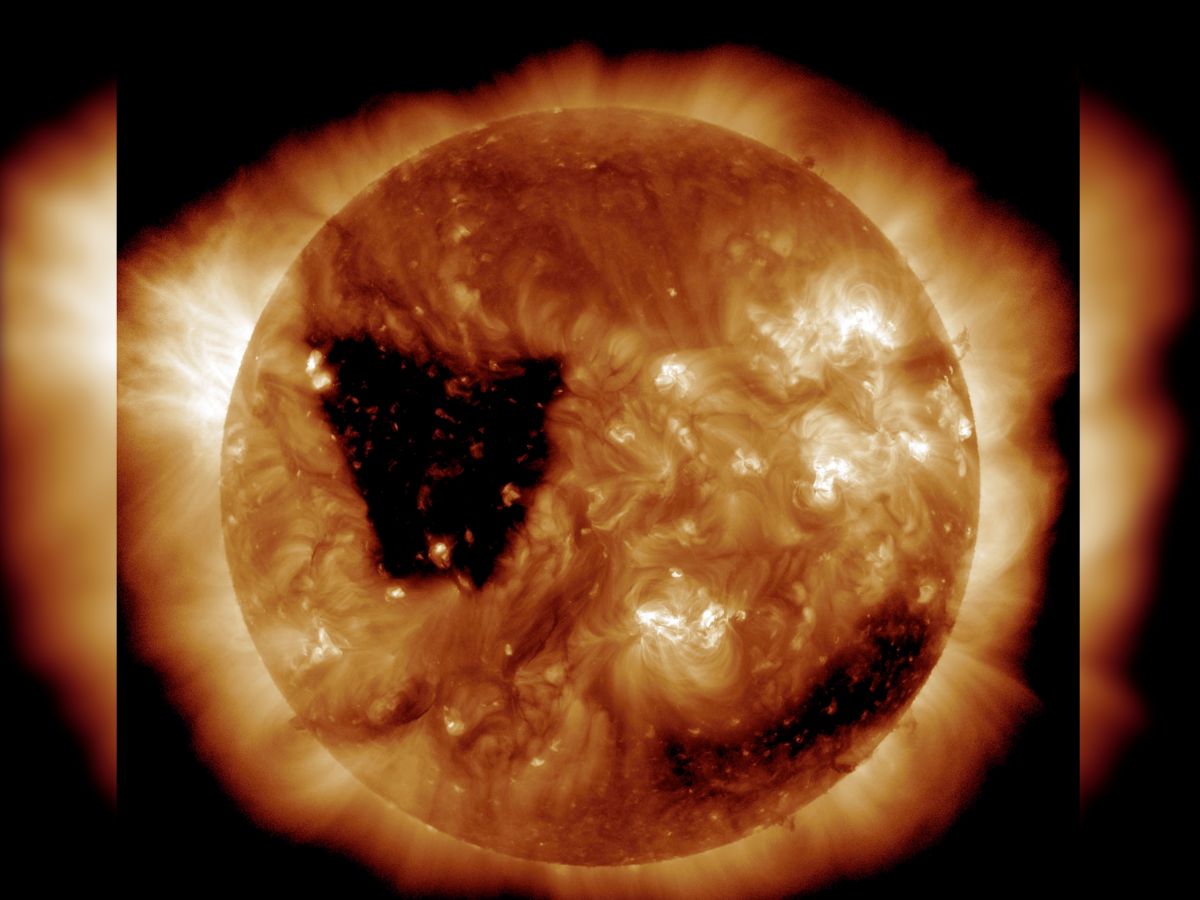

A massive, butterfly-shaped coronal hole has opened up in the sun’s atmosphere, and it’s sending a high-speed stream of solar wind toward Earth, just in time for a potential aurora show this weekend, Space.com reported on Friday.
According to the science news portal, the solar wind is expected to reach Earth around September 14, possibly triggering G1 to G2 geomagnetic storms from September 13 and into the next day, i.e. on the 14th of this month. These storms, reports suggest, have the potential to create dazzling auroras that are usually visible across parts of the Northern and Southern Hemispheres.
What’s Happening on the Sun?
The coronal hole – a cooler and relatively less dense region in the sun’s atmosphere – stretches about 310,000 miles (500,000 kilometers) across, the report said, adding that it’s from this “butterfly wing” formation that solar wind is streaming out at a high speed and heading straight for our planet.
Meanwhile, the UK Met Office has predicted G1 storm levels, with the possibility of them strengthening into the G2 level. The NOAA Space Weather Prediction Center, for its part, has stuck to G1 forecasts, at least for now. However, that could change depending on how the solar wind’s embedded magnetic fields align with Earth’s magnetosphere.
What’s a Geomagnetic Storm?
Geomagnetic storms happen when solar wind slams into Earth’s magnetic field, effectively charging particles that energise gases like oxygen and nitrogen in our upper atmosphere, which, in turn are known to release light – also famously known as the auroras. The stronger the storm, the farther south (or north, in the Southern Hemisphere) the lights can be seen.
These storms are rated on a scale from G1 which is considered minor to G5 (extreme). A G2 storm, the report said, could effectively mean that auroras will be visible as far south as Canada, Alaska, Scandinavia, and parts of the northern UK.
Meanwhile, in the Southern Hemisphere, Antarctica, Tasmania and southern New Zealand might be able to catch a spectacular night light show in the skies, too.
The Russell-McPherron Effect Is in Play
This weekend’s timing adds a twist. Around the autumn equinox (coming September 22), Earth’s orientation will allow solar wind to connect more directly with our magnetic field. This seasonal effect – called the Russell-McPherron effect – makes geomagnetic storms twice as likely compared to solstice months like June or December.
According to Space.com, “Even modest solar wind streams can produce brighter and more widespread auroras than they otherwise might.”
Keep Watching the Skies
Given that even the space weather forecasts come with a bit of uncertainty, the real impact will depend on the precise makeup of the solar wind as it arrives. Still, with a giant coronal hole, favourable seasonal conditions, and potential for G2 activity, this weekend is a seemingly great time to grab your camera and look up.




