
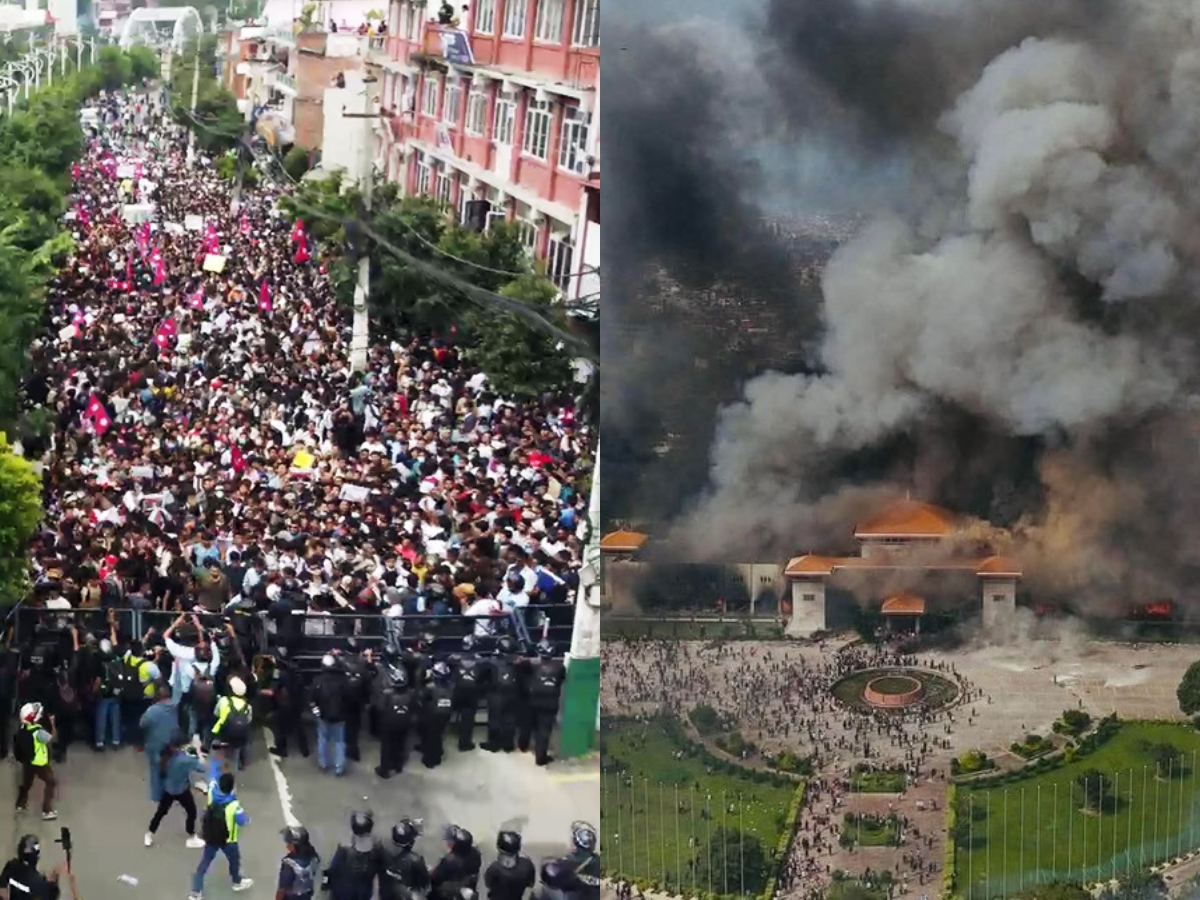

Prime Minister of Nepal, KP Sharma Oli, on Tuesday, resigned after Gen Z protests rocked the country over corruption charges, which were fueled by the ban of 26 social media platforms. The protests turned violent, leading to the deaths of 19 people, while more than 300 were injured. Authorities extended the curfew, but protestors didn’t budge, continuing the demonstrations.
Protestors even vandalized the residences of leaders, including Prime Minister Oli, President of Nepal, and former Prime Minister Pushpa Kamal Dahal ‘Prachanda’ in Khumaltar, Lalitpur. The House of Ram Chandra Paudel, President of Nepal, was also burnt.
Key roads leading to Parliament and other official places were blocked by protestors. Police tried to stop; however, the protestors continued while chanting slogans against the government. Videos of violent clashes between the Gen Z protestors and police in Kathmandu are emerging on social media.
What Led To Violent Nepal Protests?
The protests were actually against the corruption in the government. However, the protest intensified after a recent ban on social media apps across the country.
Protesters demanded the immediate resignation of PM Oli and stated they would continue their demonstrations until their demand was met.
The government lifted the social media ban after an emergency cabinet meeting late Monday. The ban had targeted sites that failed to comply with a registration deadline set by Nepal’s Ministry of Communication and Information Technology.
How Nepal Government Responded
In a statement late Monday, PM Oli announced the lifting of the social media restrictions.
He blamed the violence on “infiltration by various vested interest groups” and pledged that the government would establish a committee to investigate the protests. Financial relief would also be provided to victims, and free treatment would be offered to those injured during the unrest.
#WATCH | Nepal: Protesters dance and celebrate as the private residence of former PM K.P. Sharma Oli, in Bhaktapur, burns. The Nepali PM resigned this afternoon amid demonstrations against the Government over alleged corruption.
(Video Source: TV Today Nepal) pic.twitter.com/d71H1bQ1KJ
— ANI (@ANI) September 9, 2025
Gen Z Protestors Storm Parliament
Despite the lifting of the ban, protests escalated on Tuesday. Minutes before PM Oli resigned, Gen Z protestors stormed Parliament, setting one of the buildings on fire. Demonstrators also torched Oli’s residence in Bhaktapur’s Balkot area, as well as properties of other senior leaders.
Visuals showed thousands of protesters surrounding the Parliament, with thick plumes of grey and black smoke rising from the premises. Even as the fire raged, the protesters continued marching, shouting slogans and raising flags.
No this is some random building, this is nepal’s parliament house.
Nepal youth 🫡🫡 pic.twitter.com/WTZ06k0EVd
— Dr Nimo Yadav 2.0 (@DrNimoYadav) September 9, 2025
Key Developments in the Nepal Protests
Protests erupted on Tuesday following the partial lifting of a social media ban.
The Kathmandu District Administration Office imposed an indefinite curfew within the Ring Road.
Security forces opened fire on demonstrators in Kathmandu and Itahari on Monday, leaving at least 19 dead.
Protesters continued to denounce the government’s authoritarian measures, demanding PM Oli’s resignation.
PM KP Sharma Oli officially stepped down on Tuesday.
A committee will investigate the protests, and victims will receive financial assistance.
Zubair Amin is a Senior Journalist at NewsX with over seven years of experience in reporting and editorial work. He has written for leading national and international publications, including Foreign Policy Magazine, Al Jazeera, The Economic Times, The Indian Express, The Wire, Article 14, Mongabay, News9, among others. His primary focus is on international affairs, with a strong interest in US politics and policy. He also writes on West Asia, Indian polity, and constitutional issues. Zubair tweets at zubaiyr.amin




