
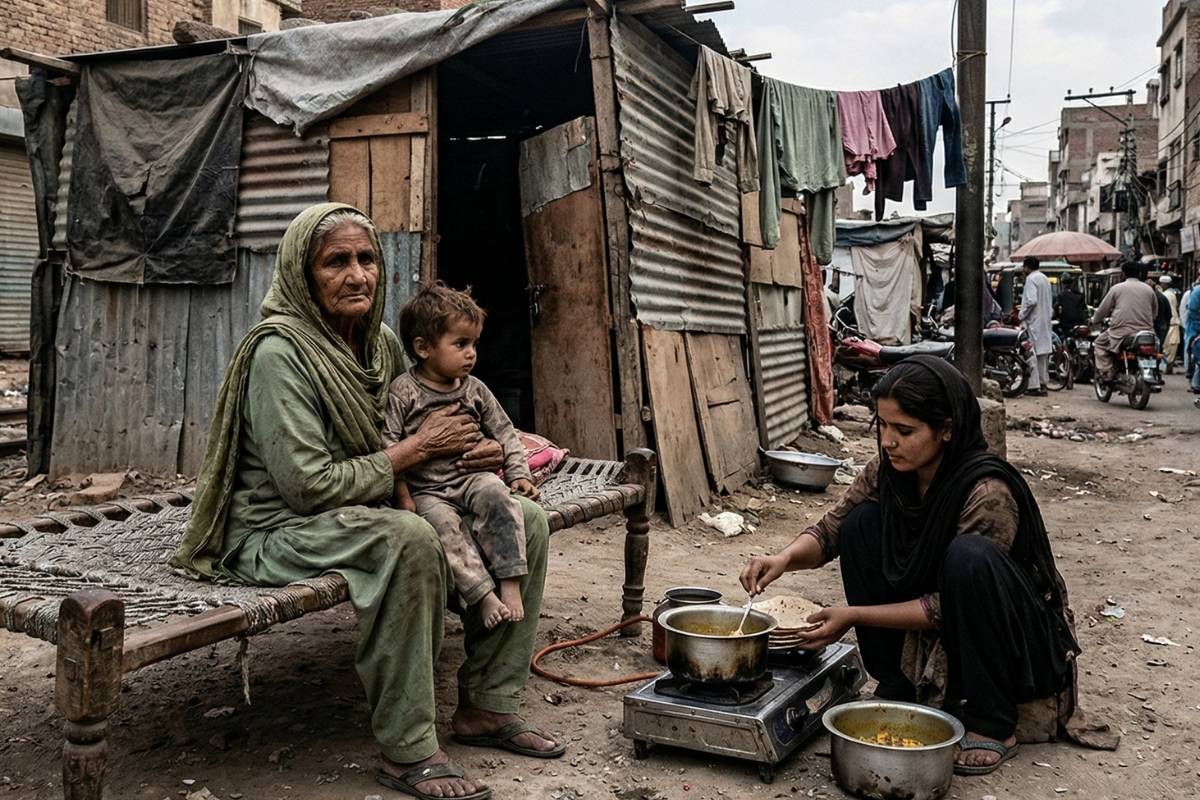

Poverty in Pakistan has increased to 43.5 per cent, significantly higher than official estimates, as per a report released by the country’s Social Policy and Development Centre (SPDC).
According to a report published by The Express Tribune, the SPDC report indicate a 14.6 percentage point gap compared to the 28.9 per cent poverty rate estimated by the Pakistan Bureau of Statistics (PBS) and the Planning Commission.
The report highlights that urban areas have been disproportionately affected, with poverty increasing more rapidly in cities than in rural regions. National poverty rose from 36.6 per cent in 2018-19 to 43.5 per cent in 2024-25, pushing an estimated 27 million more people below the poverty line during this period, The Express Tribune reported.
Urban poverty increased from 32.1 per cent to 42.1 per cent, while rural poverty rose from 39.3 per cent to 44.3 per cent, the report noted.
According to SPDC, the disparity with official figures stems from differences in methodology. The PBS uses the Cost of Basic Needs approach, which adjusts historical poverty lines using the Consumer Price Index (CPI).
However, the report argues that this method often underestimates the cost of living for low-income households and fails to account for essential expenses such as healthcare and access to clean water, The Express Tribune reported.
In contrast, SPDC employs a Food Energy Intake approach, which links household expenditure to minimum caloric requirements for basic subsistence. The institute estimates separate poverty thresholds based on consumption needs, placing the monthly poverty line for 2024-25 at PKR 13,476 in urban areas and PKR 10,283 in rural areas, compared to the official PKR 8,484.
Citing data from the Household Integrated Economic Survey (HIES) 2024-25, the report also pointed to rising income inequality, with wealth increasingly concentrated among higher-income groups, particularly in urban centres.
SPDC Managing Director Muhammad Asif Iqbal stated that the caloric approach provides a more accurate reflection of poverty in developing countries, as it directly accounts for food consumption patterns and noted that low-income households in Pakistan spend more than half of their income on food, making this method more representative of their realities, The Express Tribune reported.
He further criticised the official methodology, saying it often disconnects poverty estimates from actual economic performance, citing historical trends where poverty appeared to decline despite weak economic growth.
The report indicates that living standards are generally declining in Pakistan, especially in urban areas, and it urges policymakers to use more trustworthy measurement methodologies. In order to ensure more equitable economic growth, it also suggests focused measures to combat urban poverty, enhance access to necessary services, and lessen income disparity, according to The Express Tribune.
(ANI)
Syed Ziyauddin is a media and international relations enthusiast with a strong academic and professional foundation. He holds a Bachelor’s degree in Mass Media from Jamia Millia Islamia and a Master’s in International Relations (West Asia) from the same institution.
He has work with organizations like ANN Media, TV9 Bharatvarsh, NDTV and Centre for Discourse, Fusion, and Analysis (CDFA) his core interest includes Tech, Auto and global affairs.
Tweets @ZiyaIbnHameed




