


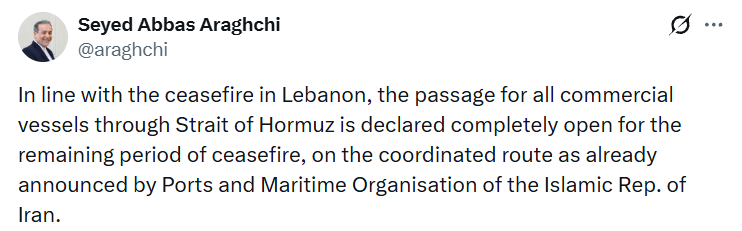
STRAIT OF HORMUZ OPEN: Iran’s foreign minister said Friday that the Strait of Hormuz is fully open to commercial ships during the Lebanon ceasefire. In a post on X, Abbas Araqchi made it clear: all commercial vessels can pass through the strait for as long as the ceasefire lasts. There’s one catch: ships need to stick to the specific route laid out by Iran’s Ports and Maritime Organisation. Iran’s move lines up with the current ceasefire between Israel and Lebanon, giving commercial traffic the green light as long as the peace holds.
When was the Strait of Hormuz shut?
On February 28, 2026, Iran shut down the Strait of Hormuz right after a U.S.-Israeli air offensive hit its missile and drone sites. This wasn’t just a small move; it restricted traffic through the world’s busiest oil chokepoint.
For more than a month, global energy markets felt the shock, with oil and LNG prices climbing as more than 20% of the world’s supplies got caught up in the chaos.
Iran made it clear: the strait was off-limits to the U.S. and its allies. Shippers steered clear, worried about getting caught in the crossfire. When April rolled around, and reports of a ceasefire started surfacing, you’d think things would calm down. But the strait didn’t just snap back to normal; tensions stayed high, with Iran still holding the upper hand over the waterway.
How did the Strait of Hormuz shutdown affect oil prices?
Roughly a fifth of the world’s oil and LNG flows through the strait, so when fighting broke out, global fuel prices shot up. But once news of the ceasefire hit on April 7, 2026, oil prices dropped fast, about 15% almost right away.
ALSO READ: Donald Trump Visiting Pakistan For Iran-US Deal? What US President Said, ‘They Want Me To…’
With 13 years on the line, Ashish Kumar Singh loves everything when it comes to movies, music, travel and pop culture. Formerly employed at ANI, Pinkvilla, India Today and HT, Ashish has interviewed some of the top celebrities of India, including Shah Rukh Khan, Aamir Khan, Ranveer Singh, Ranbir Kapoor and Hrithik Roshan, among others. Breaking news excites him and deadlines are what he chases. Interviewing comes naturally to him. Hit him up at ashish.kumar02singh@gmail.com.





