
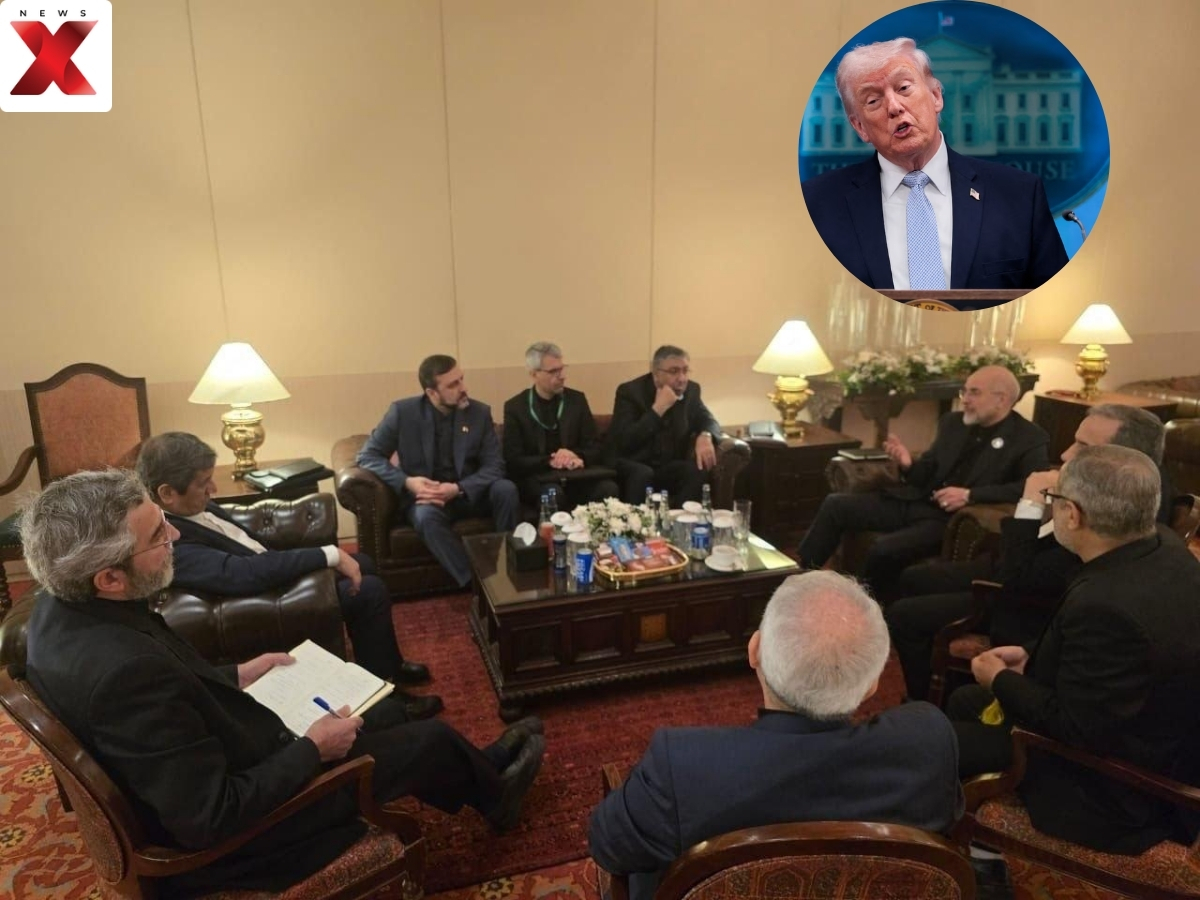

Senior US and Iranian officials met on Saturday in Islamabad for the highest-level talks between Washington and Tehran in half a century as they sought to bring an end to their six-week war. The talks between Vice President JD Vance, special envoy Steve Witkoff and President Donald Trump’s son-in-law Jared Kushner, and Iranian Parliamentary Speaker Mohammad Baqer Qalibaf and Foreign Minister Abbas Araqchi lasted for two hours before the delegations broke for a rest, according to a Pakistani source. Pakistan’s army chief was also present. As the talks began, there were conflicting accounts of what had been agreed.
A U.S. official told Axios that several U.S. Navy ships on Saturday had crossed the Strait of Hormuz, whose blockade by Iran has caused the biggest-ever disruption to global energy supplies. But Iranian state TV and a Pakistani source denied that any U.S. vessel had passed through the waterway.
“We’re now starting the process of clearing out the Strait of Hormuz,” Trump wrote in a social media post, adding that all 28 of Iran’s mine-dropping ships had been sunk.
Trump called Iran as a “failing nation”. He said that US is prepared to “reset” if the peace talks in Pakistan do not proceed as planned.
“We’re ready to go,” he said in an interview with NewsNation.
US Releases Iranian Frozen Assets In Qatar As Peace Talks Beign In Islamabad
In Earlier, a senior Iranian source told Reuters the U.S. had agreed to release frozen assets held in Qatar and other foreign banks, an assertion swiftly denied by a U.S. official.
The senior Iranian source welcomed the purported move as a sign of “seriousness” in the talks.
Qatar’s Foreign Ministry did not immediately respond to a request for comment on the assertion about frozen assets.
The direct talks followed a morning of mediation by Pakistani Prime Minister Shehbaz Sharif as Tehran laid down its red lines that it said Washington must accept before the face-to-face talks could take place.
Among the conditions Tehran laid out to Sharif were the Strait of Hormuz, the release of Iran’s blocked assets, the payment of war reparations, and a ceasefire to be enforced across the region, according to Iranian state TV.
Will US Accept Lebanon As Part of Ceasefire Deal?
Iran is also demanding a ceasefire in Lebanon, where Israeli attacks on Iran-backed Hezbollah militants have killed nearly 2,000 people since the start of fighting in March.
Israel and the U.S. have said the Lebanon campaign is not part of the Iran-U.S. ceasefire.
Tehran’s delegation is expected to continue discussing violations of the ceasefire in Lebanon, an Iranian state TV reporter said.
An unsourced report on Iranian news agencies said the acceptance of the release of Iranian assets and the limitation of attacks on Lebanon by Israel had been sufficient for direct talks to begin.
Iranian government spokesperson Fatemeh Mohajerani had earlier warned there was deep mistrust on the Iranian side.
“We will negotiate with our finger on the trigger,” Mohajerani said on state TV. “While we are open to talks, we are also fully aware of the lack of trust; therefore, Iran’s diplomatic team is entering this process with maximum caution.”
Trump Says US Is Clearing Mines From Strait of Hormuz
Tehran’s agenda includes the acknowledgment of its authority over the narrow Strait of Hormuz, where it aims to collect transit fees and control access. The strait is a chokepoint for about 20% of global oil and liquefied natural gas shipments.
Trump on Saturday posted on social media that the United States military has started to clear the Strait of Hormuz, and that all of Iran’s minelaying ships have been sunk.
“We’re now starting the process of clearing out the Strait of Hormuz,” Trump wrote in a social media post, adding that “all 28” of Iran’s “mine dropper boats are also lying at the bottom of the sea”.
Trump has repeatedly said that American forces have destroyed Iran’s navy and air force while crippling its ballistic missile and nuclear programs. But fear of Iranian attacks on shipping over the past several weeks has effectively closed the Strait of Hormuz, a critical conduit for global oil supplies. Throttling the strait has disrupted global energy markets.
Zubair Amin is a Senior Journalist at NewsX with over seven years of experience in reporting and editorial work. He has written for leading national and international publications, including Foreign Policy Magazine, Al Jazeera, The Economic Times, The Indian Express, The Wire, Article 14, Mongabay, News9, among others. His primary focus is on international affairs, with a strong interest in US politics and policy. He also writes on West Asia, Indian polity, and constitutional issues. Zubair tweets at zubaiyr.amin




