
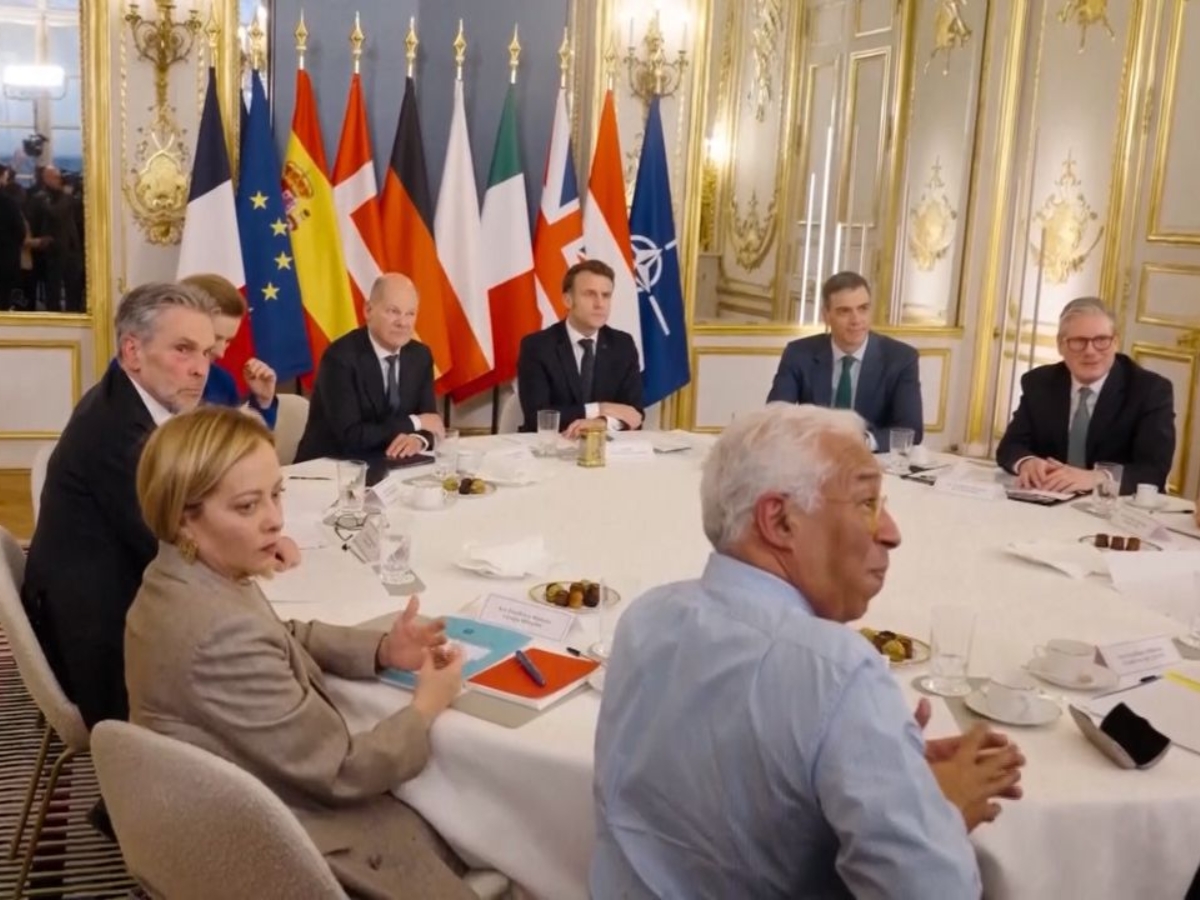

Donald Trump is on a literal war with Europe right now. On January 18, European Union ambassadors reached a broad agreement to step up efforts to dissuade US President Donald Trump from imposing new tariffs on European allies, while simultaneously preparing retaliatory options should Washington proceed with its threats.
The discussions come after Trump announced that eight NATO countries would face a 10% tariff on all goods exported to the United States, effective February 1, unless the US is allowed to purchase Greenland. The tariff would rise to 25% on June 1 if no deal is reached, Trump said. Major EU states have denounced the move as blackmail.
The proposed measures have triggered fresh debate in Brussels over whether to activate the European Union’s anti-coercion instrument, widely referred to as the bloc’s “trade bazooka.”
Emmanuel Macron Pushes for Coordinated European Response To Donald Trump
French President Emmanuel Macron raised the possibility of using the anti-coercion instrument against the United States during exchanges with fellow European leaders. According to the diplomat, Macron emphasized the need for a firm and coordinated European Union response to Trump’s threats.
Irish Prime Minister Micheál Martin, however, urged caution. While stressing that there should be no doubt about the EU’s willingness to retaliate, Martin said it was “a bit premature” to activate the instrument at this stage.
European Union Tariff Retaliation Plans Already on the Table
The European Union has recent experience in preparing countermeasures against U.S. tariffs. In May 2025, the bloc announced plans to impose tariffs on $107 billion worth of US imports following Trump’s sweeping tariff announcement. Those measures were later suspended for six months after an agreement was reached between the president and EU ambassadors.
According to Euronews, the proposed EU tariffs were designed to target industries concentrated in Republican-leaning US states, including bourbon, airplane components, soybeans, and poultry.
However, the deal underpinning the suspension has not been ratified. The Financial Times reported that lawmakers in Brussels signaled the renewed threats linked to Greenland could derail its approval entirely.
Reuters, citing an EU source, reported that the tariff package currently enjoys broader support as an initial response than other anti-coercion measures, where internal consensus remains “very mixed.”
NATO Allies Warn of Damage to Transatlantic Ties
The eight NATO countries affected by Trump’s announcement, including Denmark, issued a joint statement warning that the proposed tariffs could severely harm relations across the Atlantic.
“Tariff threats undermine transatlantic relations and risk a dangerous downward spiral,” the countries said, describing the move as “dangerous” for the broader U.S.-Europe partnership.
What Is the European Union’s ‘Trade Bazooka’?
Formally known as the anti-coercion instrument, the mechanism was adopted in 2023 to prevent and address what the EU defines as “situations of economic coercion.”
“It especially aims to deter the economic coercion of the Union or a Member State and to enable the Union, as a last resort, to counteract economic coercion through Union response measures,” the regulation states.
The instrument was initially conceived to prevent economic “bullying” by China. However, Euronews has reported that it was designed to counter both China and the United States, particularly in cases where tariffs or control over natural resources are used to advance national interests.
Under the instrument, the EU can restrict or halt imports of goods and services, impose limits on foreign investment, and introduce constraints on intellectual property rights, among other measures.
The European Commission has stressed that any response must be carefully calibrated. On its Q&A page, the Commission notes that action must be “proportionate to the harm” caused.
“The range of potential measures is designed to be broad, in order to allow the selection and design of an effective and efficient response to an individual case of economic coercion with minimal or no impact on the EU economy,” the Commission said.
How the European Union’s Anti-Coercion Instrument Would Be Deployed
Once a country is formally accused of economic coercion, the European Commission has up to four months to assess the claim, according to the regulation. Following the investigation, a majority of EU member states must agree to proceed.
If approved, the EU would first seek negotiations with the accused country. Retaliatory measures would only be implemented if those talks fail.
Since its adoption, the instrument has never been used, according to Agence France-Presse.
Why It Is Seen as a ‘Nuclear Option’
Invoking the anti-coercion instrument against the United States could inflict serious damage on one of the world’s most important trading relationships. Euronews has described its use as a “nuclear option” in response to Trump’s tariff threats.
Trade between the U.S. and the EU reached nearly $2 trillion in 2024, accounting for almost 30% of global trade and 43% of global GDP, according to EU Council data.
“The European Union and the United States have the largest bilateral trade and investment relationship and the most integrated economic relationship in the world,” the Council said.
Zubair Amin is a Senior Journalist at NewsX with over seven years of experience in reporting and editorial work. He has written for leading national and international publications, including Foreign Policy Magazine, Al Jazeera, The Economic Times, The Indian Express, The Wire, Article 14, Mongabay, News9, among others. His primary focus is on international affairs, with a strong interest in US politics and policy. He also writes on West Asia, Indian polity, and constitutional issues. Zubair tweets at zubaiyr.amin




