
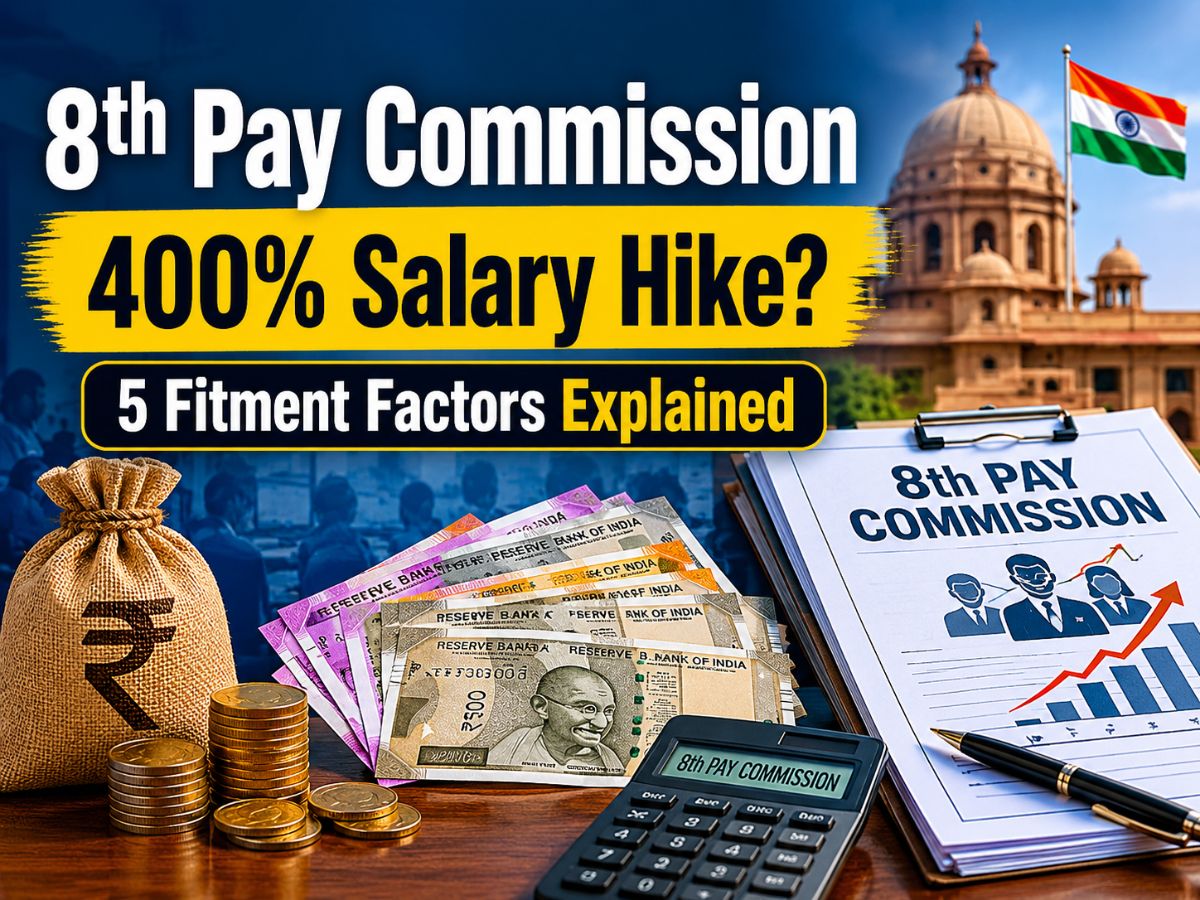
The 8th Pay Commission has now emerged as one of the biggest policy discussions involving central government employees, pensioners and unions across India. What began as consultations over salary revisions and pension reforms has quickly evolved into a nationwide debate on employee welfare, rising inflation and the government’s financial capacity.
The latest discussions were ignited by a proposal to raise salaries by over 400 per cent for some of the top-level employees, put forward by the Indian Railway Technical Supervisors’ Association (IRTSA), a key employee body involved in talks with the 8th Pay Commission.
The association has proposed a completely new methodology for revision of salary by introducing five different fitment factors for different levels of pay of employees, instead of applying a common multiplier for all categories of staff.
Proposed Five-Fitment Factor Formula Explained
The proposal is a significant change from the structure followed by the previous pay commissions. According to the suggested formula:
- Levels 1 to 5 would receive a fitment factor of 2.92
- Levels 6 to 8 would receive 3.50
- Levels 9 to 12 would receive 3.80
- Levels 13 to 16 would receive 4.09
- Levels 17 to 18 would receive 4.38
If implemented, the impact on salaries could be massive across departments.
For example, an employee earning a basic salary of Rs 2.5 lakh under Levels 17-18 could reportedly see revised basic pay rise to nearly Rs 10.95 lakh under the proposed 4.38 fitment factor. Similarly, a mid-level employee drawing Rs 45,000 basic pay under Levels 6-8 could see the revised basic salary increase to around Rs 1.57 lakh.
The proposal has generated widespread discussion among government employees because it directly challenges the traditional one-size-fits-all approach used in earlier pay commissions.
🚨 8वें वेतन आयोग पर बड़ा अपडेट! 🚨
केंद्रीय कर्मचारियों और पेंशनर्स के लिए बड़ी खबर 👇
✅ 8th Pay Commission ने जून 2026 के लिए नए Consultation Meetings Schedule जारी किए✅ 22-23 जून को लखनऊ में बड़ी बैठक होगी
✅ Fitment Factor, HRA, Pension और Salary Hike पर तेजी से चर्चा… pic.twitter.com/33AhaHYKRs
— Priyanka (@Pinky209E) May 25, 2026
Why Railway Employee Unions Want Higher Salary Multipliers
The Indian Railway Technical Supervisors’ Association argues that the current pay structure unfairly narrows the salary gap between junior and senior employees, especially technical staff involved in safety-sensitive operations. The association said that the employees engaged in highly specialised railway operations needed separate pay structures and higher remuneration because of the complexity and risks involved in their jobs.
Apart from higher fitment factors, the association has also demanded:
- Faster promotions
- Annual increments of 5%
- Separate pay structure for technical railway staff
- Merger of 50% Dearness Allowance into basic pay before salary revision calculations
These demands are indicative of the increasing pressure from the employee unions for enhanced financial support in the face of rising household expenses and inflation.
What Is The Fitment Factor In The 8th Pay Commission?
One term that is now the buzzword in discussions around the 8th Pay Commission is the ‘fitment factor’. The fitment factor is essentially a multiplier to calculate revised salaries under a pay commission. The formula is simple:
New Basic Pay=Current Basic Pay x Fitment Factor
For the 7th Pay Commission, the fitment factor was fixed at 2.57. However, several unions are now demanding significantly higher multipliers under the 8th Pay Commission.
Some employee organisations have reportedly asked for a fitment factor of 3.83, while others have pushed for figures above 4.0.
The National Council-Joint Consultative Machinery has demanded a minimum basic pay of Rs 69,000. Meanwhile, Bharatiya Pratiraksha Mazdoor Sangh has reportedly sought Rs 72,000 minimum pay along with a 4.0 fitment factor.
OPS VS NPS Debate Resurfaces in 8th Pay Commission Consultations
The Old Pension Scheme (OPS) debate has resurfaced as a key issue during the consultations for the 8th Pay Commission. Some employee unions still demand restoration of the OPS, saying the National Pension System (NPS) exposes retirement income to risks associated with the market. However, after years of implementation, some employee representatives now realise that the total abolition of NPS may not be practically feasible. As a result, many unions are now seeking ‘OPS-like protections’ rather than calling for a full repeal. These proposals include:
- Guaranteed pension mechanisms
- Minimum assured pension structures
- Dearness Allowance-linked pension protection
- Another major proposal gaining traction is revising the “family unit” formula from 3 to 5.
Employee unions say that modern families have to shoulder significantly higher financial burdens than earlier generations did, due to rising costs for health care, education, housing and elder-care.
🔴 Breaking , Bhubaneswar
🔴 Last date: 31 May 2026🔴 Dear leaders of Union/ Federation around Odisha. 8th Pay Commission is about to visit Bhubaneswar on 6th & 7th July but Last date to submit memorandum us 31st May.
🔴 So do submit it before deadline pic.twitter.com/RmtYZGgDoJ
— 8th Pay Commission (@8thCPC_update) May 27, 2026
8th Pay Commission In Consultation Process Across Parts Of India
The 8th Pay Commission, headed by Justice (Retd) Ranjana Prakash Desai, has now entered into an intensive consultation process across various parts of the country. The panel has already held meetings in Delhi and several other places. Further consultations are scheduled to be held in:
- Bhubaneswar on July 6 and 7
- Lucknow
- Hyderabad
- Srinagar
- Ladakh
- Jammu & Kashmir
The recommendations of the 8th Pay Commission are likely to impact more than 1.1 crore beneficiaries, including central government employees, pensioners and their families. On November 3, 2025, the government formally constituted the 8th Pay Commission, a system that has been in place in India since 1946.
ALSO READ: Why Air India And IndiGo Are Slashing Domestic Flights Across India From June 1? Explained
Harshita is a journalist and digital content writer specializing in breaking news, current affairs, travel, education, and trending stories. She is focused on delivering accurate, timely, and engaging content with a strong emphasis on clarity and audience relevance.





