

India’s Global Power Play: 4th Largest Economy!
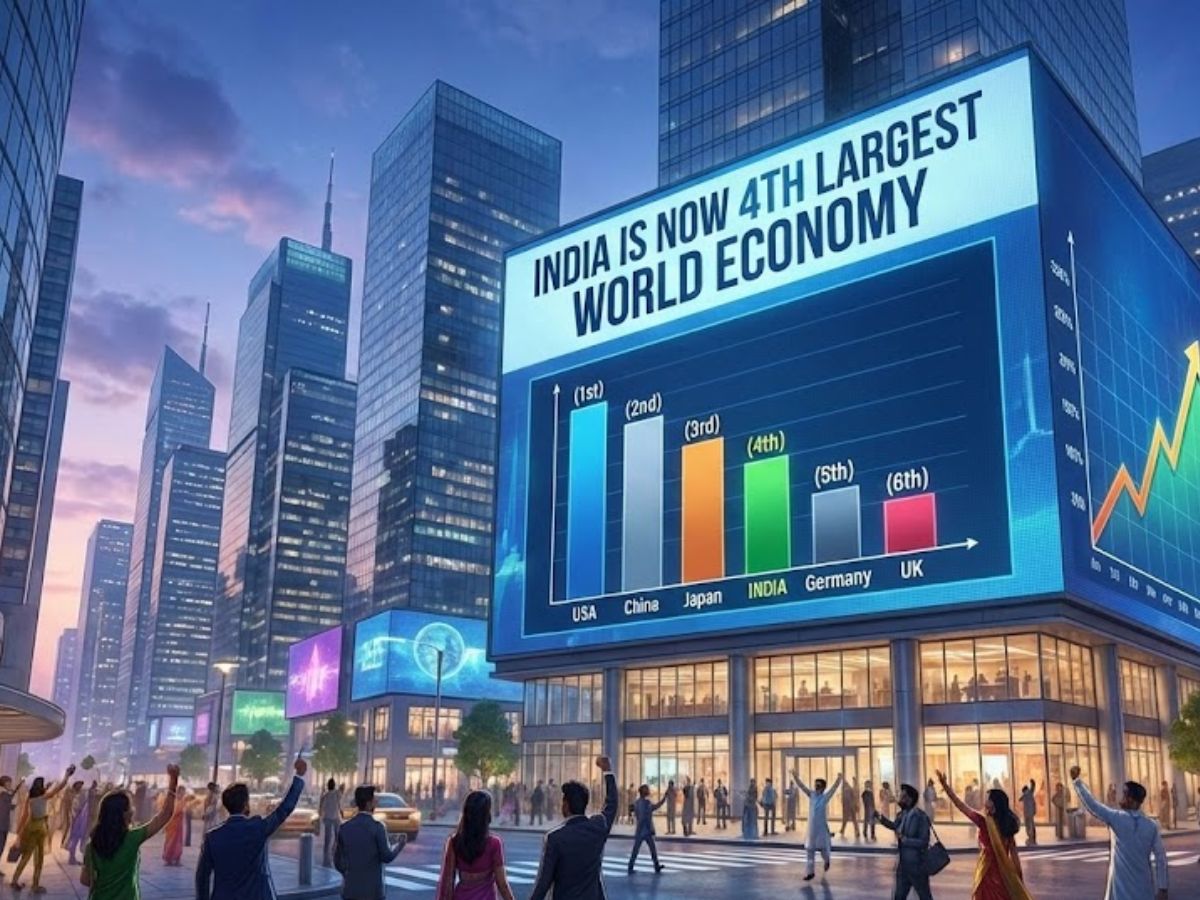
Boom! India just shook the world, overtaking Japan to become the 4th largest economy in 2025 with a jaw-dropping $4.18 trillion GDP. Six leaps since 2014 prove it: India doesn’t follow trends, it sets them.
With a young, unstoppable workforce, roaring industries, and digital marvels like UPI and ONDC, the nation is sprinting toward the top. Challenges exist, sure, but today, we celebrate a historic moment that’s unapologetically Indian, fiercely ambitious, and globally unmissable.
What is the the message that the world needs to see? India is here, India is rising, and the world better take notice!
India’s Road To The No. 3 Spot And Far Beyond That
The idea of being the world’s 4th largest economy as the end point is a wrong one. On the other hand, India is already in a fast lane to surpass Germany by the year 2027–2028, with financial giants like the IMF, Morgan Stanley, and Goldman Sachs predicting a GDP of $5.2–$5.7 trillion. But India is not only aiming for third place and that’s it. The government is dreaming of a whopping $7.3 trillion economy by the year end of 2030, a precursor to “Viksit Bharat” or Developed Nation status by 2047.
What brings about this rapid rise? A mix of a young, vibrant, and energetic workforce, flourishing strategic manufacturing, digital public infrastructure in the form of UPI and ONDC, and continuous investments in logistics and infrastructure are the main contributors.
Even though the challenges of skill gaps and global trade uncertainties are there, still India is a story of inexorable momentum. It is not a question of whether India will make history, it is only a matter of how fast it will run past the expectations and change the perception of what a growing economy can achieve.
What Is Pushing As The Main Factors Behind India’s Entitlement to the 3rd Place
The strategy mix of the government and the country’s inherent advantages, coupled with the large population, are the important factors that presently support India in the race to become the world’s 3rd largest economy. Here, we take a closer look at the power of India to move up the ranking:
-
The Fastest Growing Major Economy: India has consistently been the leading country as far as real GDP growth is concerned and has managed to remain at the level between 6.2% and 8.2% throughout 2025 while several economies are still recovering from the pandemic. The main contributory factors to India’s rapid growth are very strong domestic consumption, increasing exports, and the ability of the economic policies to absorb global uncertainties by keeping the economy going.
-
Strategic Manufacturing (PLI Schemes): Through the Production-Linked Incentive (PLI) schemes, India is being developed into the world’s manufacturing powerhouse. The prominent sectors of electronics, pharma, and green energy not only serve to increase India’s exports but also bring in employment and skills in technology necessary for the country to act as a vital supplier in the world market.
-
Digital Public Infrastructure (DPI): The huge uptake of India Stack projects, UPI, ONDC, and other digital platforms, has apportioned vast parts of the economy to the formal sector. This infrastructure allows millions to access financial services, making credit for small businesses less expensive and quicker, facilitating general economic transactions on a large scale, thus making the transactions more efficient and faster across the country.
-
Infrastructure & Capital Expenditure: The continuous investment in logistics, railways, ports, and industrial corridors is effectively removing the ‘invisible tax’ of high logistics costs. Better connectivity not only eliminates bottlenecks but also accelerates trade and thus attracts both domestic and foreign investors.
-
Demographic Dividend: India’s population has a median age of 29 years, making it one of the youngest countries among the major economies. The increasing number of people in the working-age bracket not only has a positive impact on productivity but also gives a savings and investment advantage over the likes of aging Japan and Germany, thus creating a long-term growth opportunity.
These factors work together as a very strong combination, which will help India speed up the race against competitors, tackle structural problems, and secure its position as a global economic powerhouse.
What Are The Challenges Ahead For Indian Economy To Step Up? Here Is What Investors Should Watch And Keep A Track
The economic growth of India is remarkable, but it is always wise for investors to be alert to possible problems. To begin with, low per capita income, the average Indian earns only $2,900, which is very low compared to developed countries.
This is a big opportunity to enter the market, but at the same time, it is a reminder that consumers will not be able to spend much. The next thing is global trade issues, high tariffs, trade conflicts, and the US are the main culprits of these external shocks; they could have a negative impact on exports and supply chains.
Lastly, skill gaps and employment, the question here is whether India can effectively utilize its huge and young workforce in a world that is almost entirely dominated by AI and automation.
These are all very crucial for the intelligent investor. Despite the growth story being attractive, these adversities are indications of areas where caution, strategy, and innovation are needed. The big question: how India overcomes these challenges will decide if your investments will be on the wave, or get stuck in turbulence.
(With Inputs)
Also Read: India Imposes Steel Tariffs For 3 Years: How The Move Targets China And Protects
Aishwarya is a journalism graduate with over three years of experience thriving in the buzzing corporate media world. She’s got a knack for decoding business news, tracking the twists and turns of the stock market, covering the masala of the entertainment world, and sometimes her stories come with just the right sprinkle of political commentary. She has worked with several organizations, interned at ZEE and gained professional skills at TV9 and News24, And now is learning and writing at NewsX, she’s no stranger to the newsroom hustle. Her storytelling style is fast-paced, creative, and perfectly tailored to connect with both the platform and its audience. Moto: Approaching every story from the reader’s point of view, backing up her insights with solid facts.
Always bold with her opinions, she also never misses the chance to weave in expert voices, keeping things balanced and insightful. In short, Aishwarya brings a fresh, sharp, and fact-driven voice to every story she touches.




