

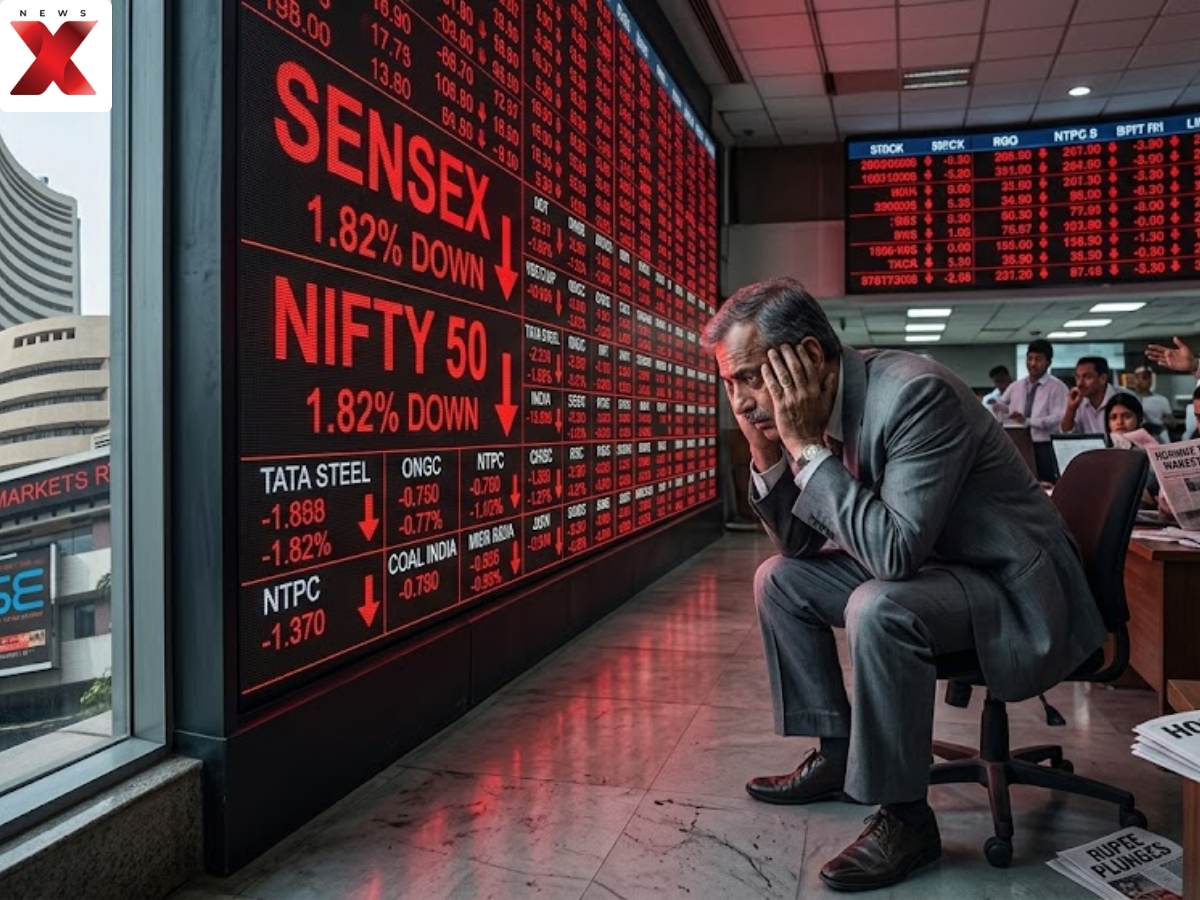
Heightened volatility across global markets, triggered by the ongoing U.S.-Iran conflict and surging crude oil prices, has left investors grappling with uncertainty. With Indian benchmark indices correcting nearly 10% year-to-date and gold prices swinging between gains and losses, the question dominating Dalal Street is clear: should investors turn greedy or remain cautious? The recent market turbulence is largely driven by geopolitical tensions and macroeconomic concerns. The collapse of U.S.-Iran ceasefire talks and disruptions in the Strait of Hormuz have pushed Brent crude prices above $100 per barrel, raising fears of inflation and slowing economic growth.
This has triggered a broader risk-off sentiment globally. Equity markets, including India’s Sensex and Nifty 50, witnessed sharp intraday declines before recovering partially. However, the underlying sentiment remains fragile as investors weigh the impact of rising oil prices and a strengthening U.S. dollar.
Is This a Market Crash or Just a Correction?
Despite the nervousness, experts suggest the current phase does not yet qualify as a full-fledged bear market. Historically, a bear market is defined by a 20% fall from peak levels. Current corrections, hovering around 10–13%, are still within normal market cycles.
Valuation metrics also indicate relative stability. The Nifty 50’s price-to-earnings (P/E) ratio near 20x and price-to-book (P/B) ratio around 3.0x are close to long-term averages. This suggests that markets are not in an overheated zone and may offer reasonable long-term return potential.
Should Long-Term Investors Turn Greedy Now?
While the famous Warren Buffett adage “be greedy when others are fearful” often resonates during corrections, experts advise against aggressive positioning at this stage.
Data shows that while long-term returns tend to improve when valuations are reasonable, the current environment calls for balance rather than boldness. Investors with a 3–5 year horizon may still benefit from gradual accumulation, but indiscriminate buying could expose portfolios to short-term volatility.
What Does History Say About Market Recoveries?
Market corrections are not unusual they are structural features of equity investing. Historical trends suggest that markets typically recover to previous highs within 2–4 years, depending on the depth of the downturn.
Importantly, the probability of losses reduces significantly over longer holding periods due to the power of compounding. Even when investments are made at relatively higher valuations, long-term outcomes tend to stabilize, reinforcing the importance of patience.
Why Do Investors Panic During Crashes?
Market crashes are as much psychological events as financial ones. Behavioral biases often lead investors to make poor decisions during volatile phases.
The “two selves” theory explains this well:
-
The rational self focuses on long-term goals and data
-
The emotional self reacts to fear, panic, and short-term losses
During downturns, the emotional self often takes over. This leads to panic selling, chasing trends, and regret when markets recover.
Is ‘This Time It’s Different’ a Dangerous Mindset?
One of the most common traps investors fall into is believing that every crash is unprecedented. The phrase “this time it’s different” reflects a psychological bias rather than reality.
History shows that markets move in cycles. However, recency bias and constant negative news amplify fear, making the current downturn feel worse than previous ones.
Which Sectors Can Offer Stability in Uncertain Times?
In the current environment, experts are identifying relatively resilient sectors such as telecom, FMCG, and insurance. These sectors tend to be less sensitive to energy price shocks and economic slowdowns.
Selective investing in fundamentally strong companies within these sectors can provide stability while positioning portfolios for recovery.
What Should Investors Do Now?
The key takeaway is clear: discipline matters more than timing. Investors should:
-
Avoid panic selling during downturns
-
Stick to long-term investment strategies
-
Recognize and control emotional biases
-
Invest gradually rather than aggressively
Greed or Caution?
The answer lies somewhere in between. While valuations are not stretched and long-term prospects remain intact, the current uncertainty demands a measured approach. Investors don’t need to turn aggressively greedy but staying invested, patient, and selective could be the smartest strategy in navigating this volatile phase.
Sofia Babu Chacko is a journalist with over five years of experience reporting on Indian politics, crime, human rights, gender issues, and stories about marginalized communities. She believes journalism plays a crucial role in amplifying unheard voices and bringing attention to issues that truly matter. Sofia has contributed articles to The New Indian Express, Youth Ki Awaaz, and Maktoob Media. She is also a recipient of the 2025 Laadli Media Awards for gender sensitivity. Beyond the newsroom, she is a music enthusiast who enjoys singing. Connect with Sofia on X: https://x.com/SBCism





