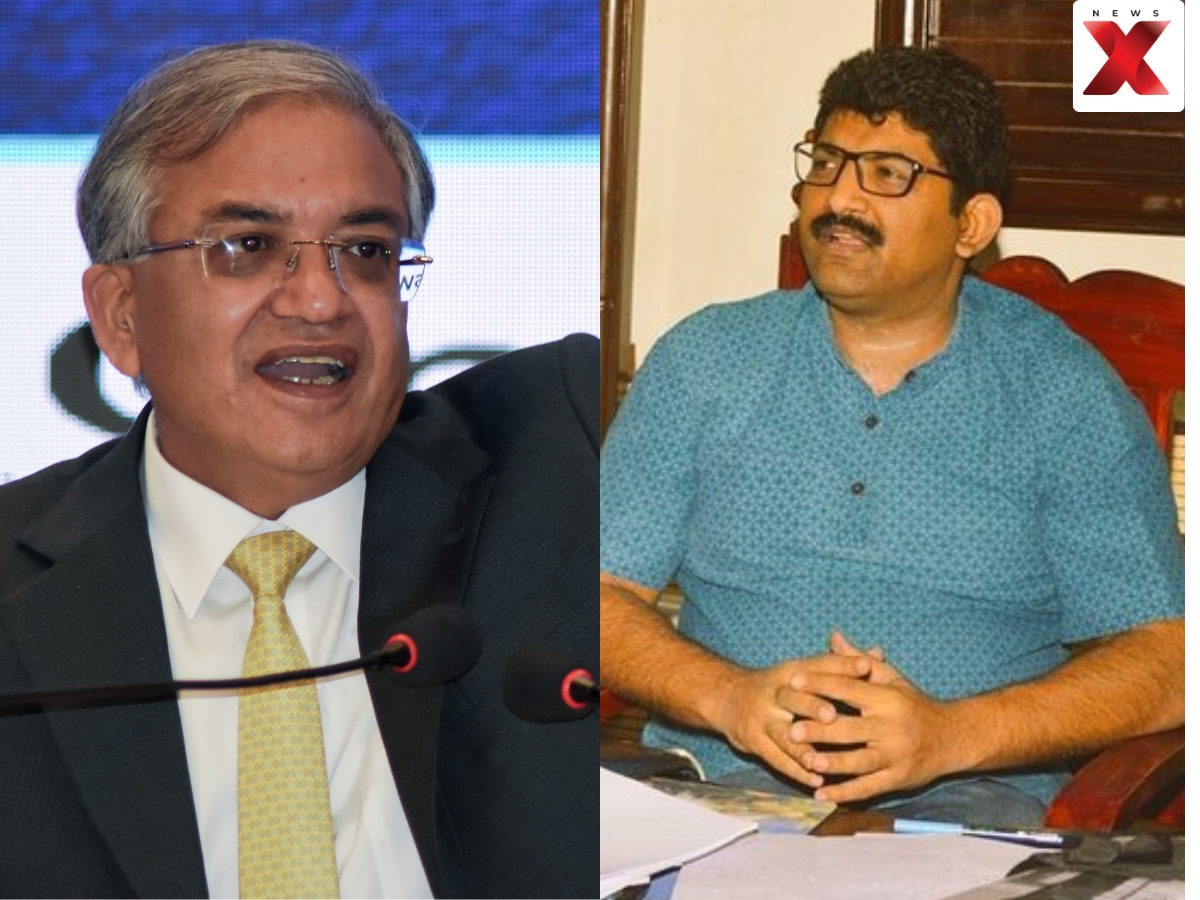

The Election Commission of India on Wednesday removed senior bureaucrat Anurag Yadav from his post as Observer for Cooch Behar South constituency ahead of the West Bengal Assembly elections.
Yadav was reportedly removed by ECI Gyanesh Kumar after a heated verbal exchange with Chief Election Commissioner Gyanesh Kumar during a virtual meeting on April 8.
Reports mentioned that ECI took the decision based on what it described as “insubordination” and alleged administrative lapses.
Reportedly, Yadav was unable to share basic information regarding the number of polling booths in the Cooch Behar South Assembly constituency.
Reports say that ‘inefficiency to provide the information’ infuriated the CEC, leading to sharp criticism of the senior officer.
“How can an Observer who does not even know the number of booths in his own area be expected to conduct a free and fair election?” NAI reported, quoting sources.
Reports say Kumar lost his cool during the meeting and told Yadav “to go back home.” However, Yadav, who has over 25 years of experience in administration, reportedly confronted the ECI.
Yadav reportedly said, “You cannot speak to me like that. I have served for 25 years. You can’t treat us like this.”
The confrontation reportedly took place during a meeting of election observers from Tamil Nadu and West Bengal. The meeting was convened by ECI.
Yadav is a 2000-batch IAS officer of the Uttar Pradesh cadre. According to the reports, Yadav is a senior IAS officer serving at the rank of principal secretary in the UP government.
Part of the attention the episode has drawn comes from Yadav’s own position in government. The source material identifies him as a senior IAS officer serving at the rank of principal secretary in the Uttar Pradesh government.
Meanwhile, Congress leader Abhishek Manu Singhvi argued that the impeachment process has been reduced to the discretion of a single individual, thereby eliminating the intended scrutiny by the Parliament.
“The impeachment process is reduced to the decision of one person. It eliminates any further scrutiny by the temple of democracy, by an adjudicatory body appointed by the Supreme Court and consultation of the Supreme Court,” Singhvi said in a press conference here.
He questioned the powers of the presiding officer (Speaker or Chairperson) in this matter.
“Did the constitution makers, ever did Dr Babasaheb Ambedkar, whose anniversary is coming next week, ever imagine that you would put certain things in the hands of a single person to an extent where his accountability would be reduced to zero?” Singhvi asked.
Highlighting the six stages of impeachment outlined by the Supreme Court, the senior Congress leader said that the apex court’s order “ends everything at the first stage” by “telescoping” the six stages of impeachment.
“The court there itemised that impeachment has roughly six stages. The problem with this order is that it ends everything at the first stage. It triangulates all the six stages; it telescopes all the six stages as if that power, that architecture, that sequence at the threshold can be so narrowly looked at only by the presiding officer. If this approach is followed, you tell me, how will you ever go to impeachment in a committee? How will you ever go to the collective process of parliamentary wisdom?”
(With inputs from ANI)
Zubair Amin is a Senior Journalist at NewsX with over seven years of experience in reporting and editorial work. He has written for leading national and international publications, including Foreign Policy Magazine, Al Jazeera, The Economic Times, The Indian Express, The Wire, Article 14, Mongabay, News9, among others. His primary focus is on international affairs, with a strong interest in US politics and policy. He also writes on West Asia, Indian polity, and constitutional issues. Zubair tweets at zubaiyr.amin