
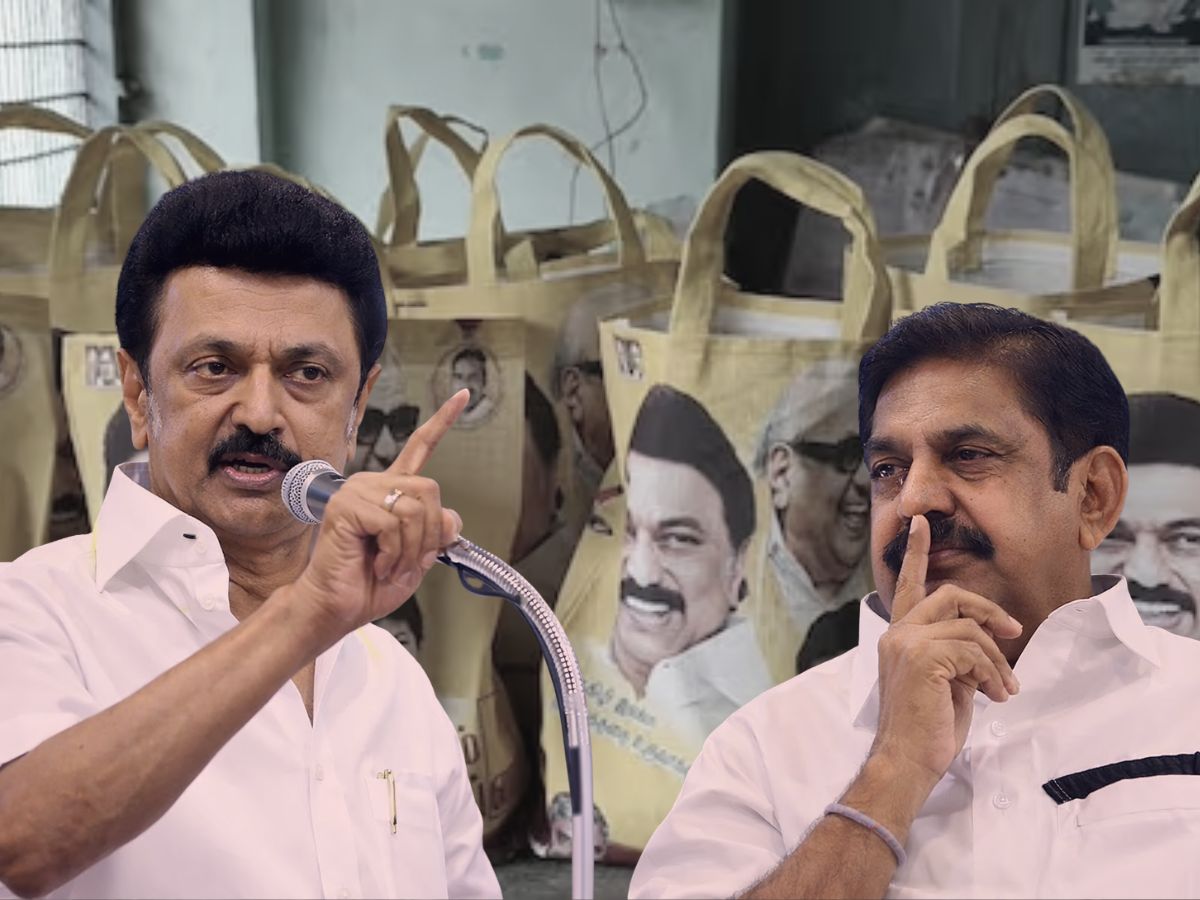

Tamil Nadu is heading into the 2026 Assembly elections. The state’s decades-old politics of freebies has once again taken centre stage.
From refrigerators and laptops to cash coupons, the ruling DMK and opposition AIADMK are offering voters an array of welfare incentives, showing that the state remains a pioneer in India’s “freebies politics.”
Yet, the question arises: in an era of rising costs and economic challenges, are voters still impressed by these electoral tactics?
Are Freebies a Core Political Strategy?
In India, pre-poll freebies, cash doles, and concessions have long been a competitive tool for winning votes, and Tamil Nadu has arguably set the template.
The DMK recently credited ₹5,000 to 1.31 crore women under the Kalaignar Magalir Urimai Thittam, marking one of the largest financial aids in state history.
The AIADMK, in response, has promised ₹2,000 monthly under its Kula Vilakku Scheme for ration card holders, along with a free refrigerator for every beneficiary.
This strategy, observers note, is not new. Tamil Nadu pioneered welfare-oriented politics through the Dravidian movement, highlighting state-led social justice and public welfare.
Over decades, welfare schemes have evolved from mid-day meals and free school uniforms introduced by K. Kamaraj to rice subsidies promised by C.N. Annadurai in 1967, to the large-scale school meal programs expanded under M.G. Ramachandran.
Leaders like M. Karunanidhi and J. Jayalalithaa later expanded benefits to include free uniforms, footwear, educational support, cooking gas, electricity subsidies, and even household appliances.
The Freebies Bidding War Soars
By the 2000s, freebies had escalated into a “bidding war.” In 2006 and 2011, parties competed with free color TVs, laptops, grinders, fans, livestock, gold, scooters, and educational tools.
Jayalalithaa’s Amma Canteens, launched in 2013, offered subsidized meals and became a signature welfare initiative. DMK, in 2021, introduced free bus travel for women, improving mobility and access to education and work.
The current election cycle has intensified this race. Where AIADMK promises a free refrigerator for every rice ration card holder and one-time cash support of ₹10,000 per family, the DMK has proposed a choice-based ₹8,000 coupon for women to purchase appliances like refrigerators, washing machines, or televisions.
In addition, the DMK plans to double the Kalaignar Magalir Urimai Thogai to ₹2,000, expand the school breakfast program to Class 8, increase social security pensions, provide free laptops to 35 lakh college students, and create 50 lakh jobs through massive investments.
Welfare Versus Populism Debate
While such freebies are politically popular, they raise questions about fiscal sustainability. The monthly cash transfer alone could cost around ₹36,000 crore annually, and Tamil Nadu’s state debt currently exceeds ₹8 lakh crore with annual interest payments around ₹40,000 crore.
Critics argue that excessive reliance on freebies may strain public finances and fail to address long-term development needs.
Moreover, the debate is no longer just about giving; it is about choice and targeted impact. Where AIADMK offers a refrigerator, DMK gives voters the flexibility to choose the appliance or household item they most need. Welfare programs now aim to combine immediate relief with empowerment, focusing on women, students, and farmers, while also including skill training, housing, and employment generation.
Are they moving with changing Political Priorities?
The 2026 campaign highlights a shift from older emotional triggers like Cauvery water disputes, Katchatheevu, and Sethusamudram to modern welfare instruments such as cash transfers, skill grants, and appliance subsidies.
Both DMK and AIADMK continue to use freebies as a core electoral strategy, but parties like Naam Tamilar Katchi (NTK) focus on ecological sustainability and self-reliance, proposing natural farming, water restoration, and zero-waste industrial models.
Meanwhile, BJP and Congress emphasize social justice, women’s empowerment, and inclusive development alongside infrastructure and employment commitments.
During the Tamil Nadu Elections, AIADMK rolled out a wave of promises:
• Free fridge and 3 LPG cylinders for 2.2 crore families
• ₹2,000 monthly cash support for women (double the current amount)
• Free bus travel for men
• IVF treatment under the CM’s health insurance… pic.twitter.com/7YN2bzU9Es— The Nalanda Index (@Nalanda_index) March 30, 2026
Are Voters Still Impressed?
Social media reactions suggest a growing skepticism. Many voters question the long-term impact of freebies and point out that these programs are funded by taxpayers.
While generous on paper, schemes like free refrigerators, LPG cylinders, and cash grants are increasingly seen as part of an electoral bidding war rather than transformative governance.
Analysts argue that Tamil Nadu’s politics now faces the challenge of balancing immediate relief with sustainable economic growth.
As the April 23 elections approach, the state remains a showcase of India’s most elaborate freebie politics. The electorate will decide whether choice-based coupons and scaled-up welfare programs are enough to secure votes, or whether voters are seeking governance that goes beyond handouts.
Sofia Babu Chacko is a journalist with over five years of experience reporting on Indian politics, crime, human rights, gender issues, and stories about marginalized communities. She believes journalism plays a crucial role in amplifying unheard voices and bringing attention to issues that truly matter. Sofia has contributed articles to The New Indian Express, Youth Ki Awaaz, and Maktoob Media. She is also a recipient of the 2025 Laadli Media Awards for gender sensitivity. Beyond the newsroom, she is a music enthusiast who enjoys singing. Connect with Sofia on X: https://x.com/SBCism




