
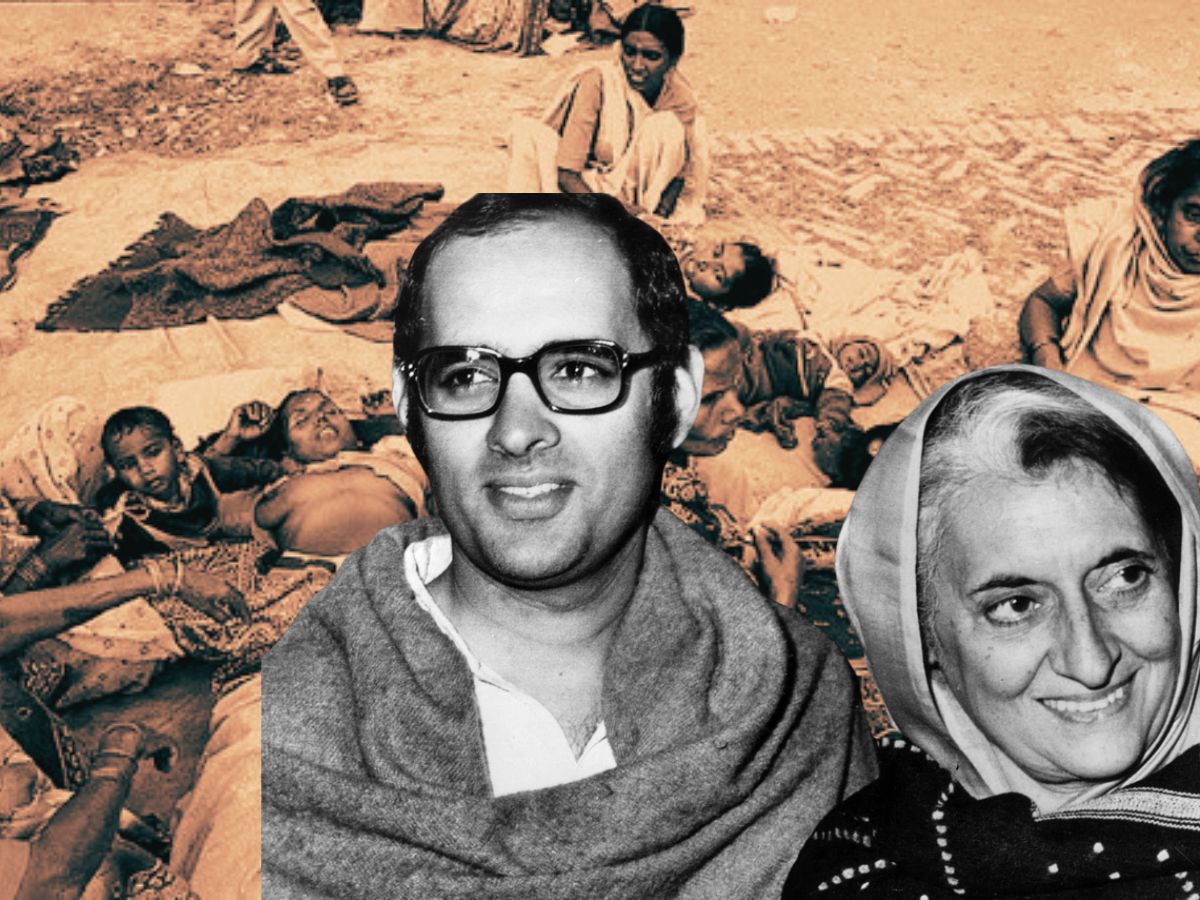

Independent India witnessed its most brutal years in between 1975 and 1977. Democracy rested on the mortuary for two years. The world’s largest democracy had to go through its toughest trial ever before. With fundamental rights suspended, press silenced-censored, and opposition leaders numbering thousands thrown into jail, India saw the rise of a new power centre that occupied no official position but shaped the direction of national politics like few others before him. That man was Sanjay Gandhi.
The younger son of Prime Minister Indira Gandhi, Sanjay held enormous power during national emergency without even in an elected office or constitutional position. Only 29 years old, Sanjay was regarded as the de facto ruler of the nation. He imposed policies with an authoritarian and dictatorial tone and reorganized the internal politics of the Congress party. His ‘no-office’ rise is perhaps the most scandalous period in the political history of independent India.
Politics to fascination over car
Unlike his older brother Rajiv Gandhi, who had initially avoided politics, Sanjay showed his early ambitions. Sanjay lacked a formal higher education and was highly fascinated with cars. He completed his training at Rolls-Royce in England and also earned a pilot’s license after that. However it was only when the Emergency period was imposed in June 1975 that Sanjay’s political career really developed.
Critics say that with most of Indira Gandhi’s trusted advisors sidelined or arrested, Sanjay filled the empty space. In fact, Sanjay acted as his mother’s closest aide. Then he soon started calling the shots attending key meetings, directing bureaucrats, and issuing orders that bore the weight of authority even without an official mandate.
Controversial five-point program
Sanjay Gandhi became even more popular through his political vision over his much-celebrated five-point program, that includes family planning, adult education, tree planting, a ban on dowry, and the abolition of caste discrimination.
The most notorious one was the family planning campaign. Under the motto “Stop at two,” the scheme aimed to bring India’s over growing population under control. But the tactics he used had left India and the world shocked. In a campaign disproportionately directed against the poor and the marginalised, lakhs of men were forced into being sterilized. Whole villages were said to be sealed off, and underprivileged men corralled into vasectomy camps. Reports say that over 6 million sterilizations were performed in a single year.
However, the critics point out that even though family planning had been a part of India’s policy for ages, Sanjay was the one who politicized it and made it a weapon of state power to target common people during national Emergency. Stories heard from those days are of inflated numbers, bribery, intimidation, and even brutality. Critics pointed out emergency was a time to show the muscle and money power.
Bulldozer politics
Sanjay Gandhi’s interest for “beautifying” Delhi ended in another most-criticized effort mass-scale demolitions in densely populated, working-class areas. In places like Turkman Gate and around Jama Masjid, bulldozers moved in, buildings were destroyed, and many left homeless overnight.
The following protests were smashed with police brutality. The Shah Commission, established after the national Emergency to probe excesses, characterized the demolition drive as one of the “greatest acts of excess”.
Critics argued that all these renewal schemes were a symptom of a fundamentally flawed developmental imagination one that valued superficial improvements over the urban poor’s rights and lives.
Sanjay’s interference on arts
Sanjay Gandhi’s so called intolerance for criticism also affected the artistic freedom. The satirical film Kissa Kursi Ka, which mocked Sanjay’s growing influence, was totally destroyed allegedly on his orders at the Maruti factory in Haryana. Following this a Delhi court later convicted him for this act, however the Supreme Court overturned the verdict in 1980.
This banning and burning of the film symbolized a deep attack on dissent and freedom of expression during the Emergency period.
Major political shift after emergency
The Emergency authoritarian period ended up in political shift. Indira Gandhi was voted out of office in 1977, and for the first time, the Congress lost its grip on power in political epitome and Janata Party came to power. Yet by 1980, the tide again shifted. Voter burnout at the instability of the Janata Party, crime, and inflation assisted Indira Gandhi in storming back to power. Sanjay also entered electoral politics that year, winning a Lok Sabha seat and becoming the second most influential man in India.
Later, Sanjay Gandhi died on June 23, 1980, in a Delhi plane crash. The incident is remembered by eyewitnesses as the aerobatics buff who took off on a solo flight against warning and proper equipment. The accident brought an end to the life of one of the most controversial political personalities of 20th century, even though his legacy is being argued over even today, decades later.
While his supporters saw him as a dynamic young leader with a bold vision for India, critics recall him as the face of Emergency excesses, an unelected person who bulldozed democratic norms.
ALSO READ: 50 Years Of National Emergency: Meet The Leaders Who Resisted Indira Gandhi’s ‘Iron’ Rule
Sofia Babu Chacko is a journalist with over five years of experience reporting on Indian politics, crime, human rights, gender issues, and stories about marginalized communities. She believes journalism plays a crucial role in amplifying unheard voices and bringing attention to issues that truly matter. Sofia has contributed articles to The New Indian Express, Youth Ki Awaaz, and Maktoob Media. She is also a recipient of the 2025 Laadli Media Awards for gender sensitivity. Beyond the newsroom, she is a music enthusiast who enjoys singing. Connect with Sofia on X: https://x.com/SBCism




