
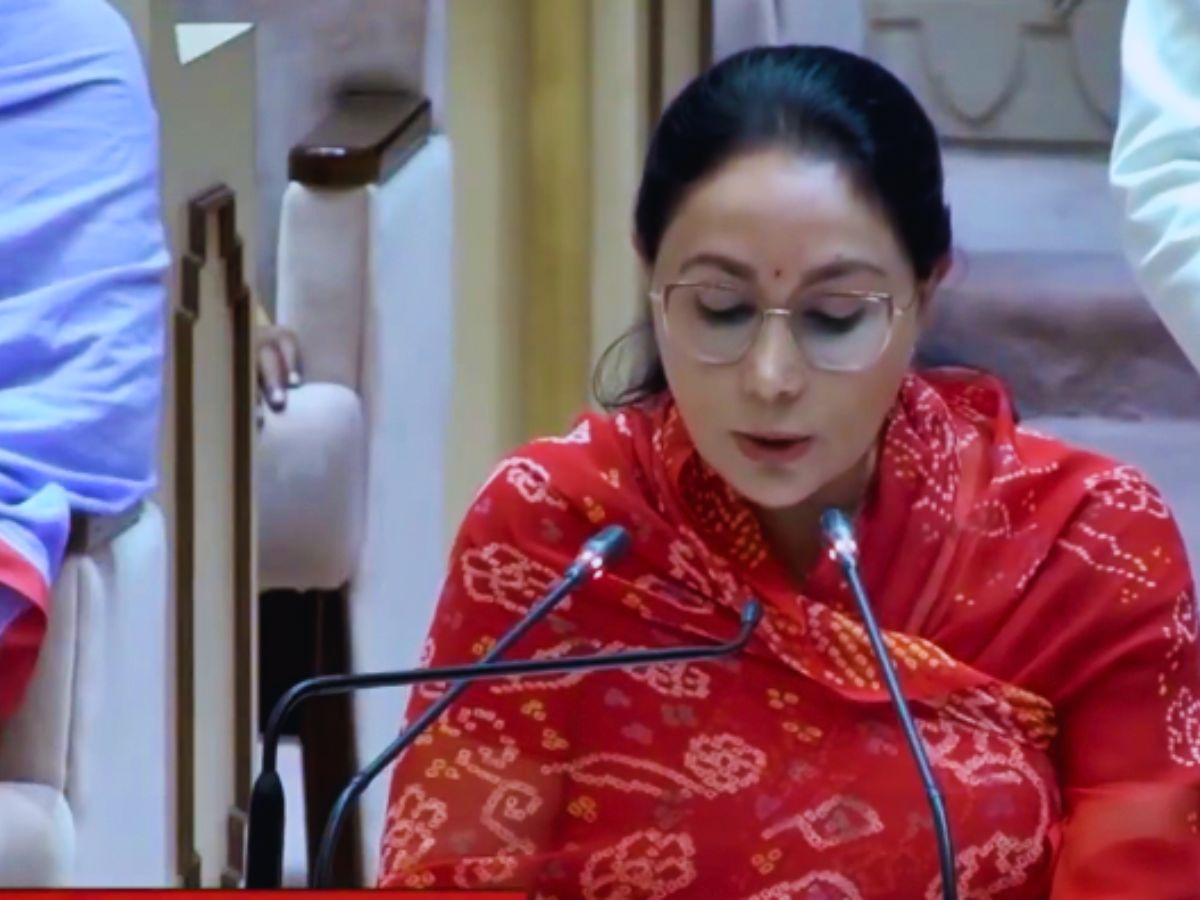

Rajasthan Deputy Chief Minister and Finance Minister Diya Kumari presented the State Budget for 2026–27 on Wednesday, announcing major allocations for tap water connectivity and renewable energy projects.
The Budget proposed ₹6,800 crore to ensure tap water supply across rural and urban Rajasthan and nearly ₹3,000 crore for developing new solar parks in Bikaner and Jaisalmer.
In her speech, Kumari underlined the impact of structural reforms and prudent financial management, stating that Rajasthan’s economic size has expanded significantly under the present government.
₹6,800 Crore Push for Tap Water Under Jal Jeevan Mission
A significant portion of the Budget focuses on drinking water. Kumari announced that under the CM Jal Jeevan Mission, every village household will be connected to tap water at a cost of ₹4,500 crore. Additionally, ₹2,300 crore has been allocated to improve drinking water supply in urban areas.
The move aims to ensure universal access to potable water across Rajasthan.
₹3,000 Crore for Solar Parks in Bikaner and Jaisalmer
Emphasising renewable energy, the Finance Minister proposed ₹2,950 crore for setting up new solar parks in Bikaner and Jaisalmer. The project is expected to strengthen Rajasthan’s position as a leading solar energy hub in India.
Roads, Youth Employment and Economic Growth
The Budget also earmarks ₹1,400 crore for non-patchable roads and ₹600 crore for missing link roads to improve infrastructure.
Under the CM Self-Employment Scheme, interest-free loans and grants of up to ₹10 lakh will be provided to benefit 30,000 youth across the state.
Kumari said Rajasthan’s economy is estimated to reach ₹21,52,100 crore in 2026–27, while per capita income is projected to rise from ₹1.67 lakh to ₹2.02 lakh by the end of 2025–26.
Inspired by ‘Sabka Saath, Sabka Vikas’
In her address, Kumari said the government is working towards the vision of a developed Rajasthan by 2047 under the leadership of Chief Minister Bhajan Lal Sharma, guided by the principles of “Sabka Saath, Sabka Vikas, Sabka Vishwas, Sabka Prayas.”
She emphasised the role of the poor, youth, farmers, and women in the state’s development journey.
Who Is Diya Kumari?
Born on January 30, 1971, in Jaipur, Diya Kumari belongs to the erstwhile Jaipur royal family and is the granddaughter of Maharaja Man Singh II. She is the daughter of Bhawani Singh, a decorated Army officer, and Padmini Devi.
Educated at Modern School (New Delhi), G.D. Somani School (Mumbai), and Maharani Gayatri Devi Girls’ School (Jaipur), she later pursued a diploma in Fine Arts from the Chelsea School of Arts, London.
Before entering politics, Kumari managed heritage properties including the City Palace, Jaigarh Fort, and several trusts, schools, and hotels. She also runs the Princess Diya Kumari Foundation, which focuses on women’s empowerment and livelihood generation.
From Royalty to Politics
Kumari joined the BJP in 2013 and was elected as an MLA from Sawai Madhopur the same year. In 2019, she won the Rajsamand Lok Sabha seat with one of the highest victory margins in the country. She currently represents Vidhyadhar Nagar as an MLA and serves as Rajasthan’s Deputy Chief Minister and Finance Minister.
Popularly known as the “princess who walks on the streets,” Kumari is often noted for her public outreach and accessibility.
With her 2026–27 Budget, Diya Kumari has placed water access, renewable energy, infrastructure, and youth employment at the centre of Rajasthan’s development agenda.
Sofia Babu Chacko is a journalist with over five years of experience covering Indian politics, crime, human rights, gender issues, and stories about marginalized communities. She believes that every voice matters, and journalism has a vital role to play in amplifying those voices. Sofia is committed to creating impact and shedding light on stories that truly matter. Beyond her work in the newsroom, she is also a music enthusiast who enjoys singing.




