
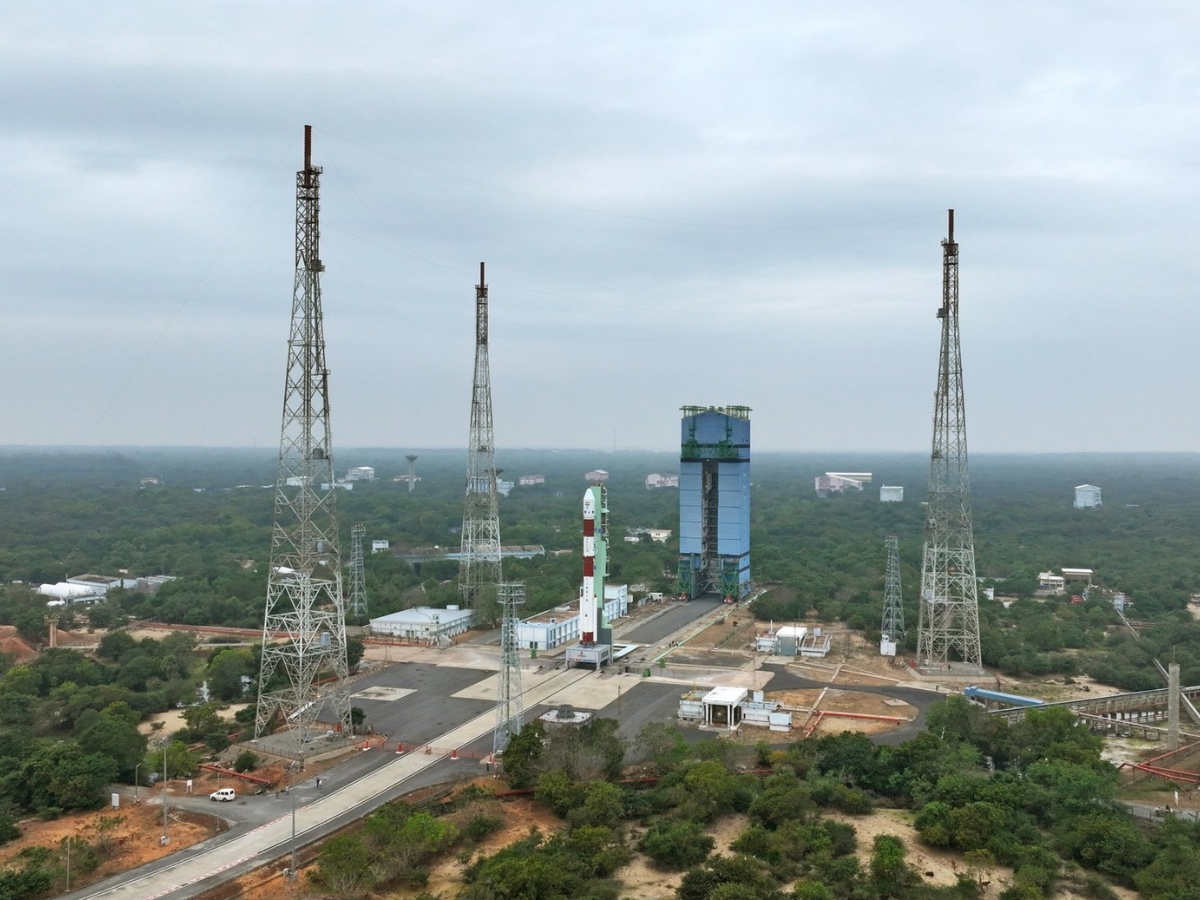

PSLV-C62: ISRO is set to launch its first space mission of 2026 with the PSLV-C62 rocket, which will carry an advanced Earth observation satellite and 14 co-passenger satellites into orbit on Monday, January 12. The launch will take place from Sriharikota.
PSLV-C62 Launch
The countdown for the PSLV-C62 mission began Sunday afternoon. Reports from the Indian Space Research Organisation (ISRO) told agencies that the countdown started at 12:48 pm, with a duration of 22 hours and 30 minutes. The launch is scheduled for 10:18 am on Monday.
The 260-tonne PSLV-C62 rocket will deploy its primary payload, the EOS-N1 satellite, also known as Anvesha, into a polar sun-synchronous orbit a few hundred kilometres above Earth.
PSLV-C62: Mission Profile and Payloads
In addition to EOS-N1, the rocket will carry 14 co-passenger satellites arranged through ISRO’s commercial arm, NewSpace India Ltd, from domestic and international customers. The mission will also feature an in-orbit demonstration of a re-entry capsule from a Spanish startup.
The deployment sequence is planned as follows:
The main Earth observation satellite will be deployed first.
PSLV-C62 will carry EOS-N1 and 15 co-passenger satellites.
EOS-N1 and 14 co-passengers are planned for injection into Sun Synchronous Orbit; the KID capsule is planned for a re-entry trajectory.
🗓️ 12 Jan 2026 | 🕘 09:45 IST onwards
🚀 Liftoff at 10:18:30 ISTLivestream link:… pic.twitter.com/PZrd1CpgR8
— ISRO (@isro) January 11, 2026
The remaining co-passenger satellites will follow within 17 minutes of lift-off.
Over two hours after launch, ISRO scientists will restart the fourth stage to demonstrate de-boost and re-entry of the Kestrel Initial Technology Demonstrator capsule (25 kg). Both the PS4 stage and capsule are expected to splash down in the South Pacific Ocean.
Significance of EOS-N1 (Anvesha)
At the centre of the mission is EOS-N1, developed by the Defence Research and Development Organisation (DRDO). Nicknamed Anvesha, it features hyperspectral imaging technology, capable of capturing hundreds of narrow colour bands per pixel.
These detailed images allow scientists to:
Monitor crop health and soil moisture
Identify mineral deposits
Track urban growth
Dr. B.R. Guruprasad, Director of the Jawaharlal Nehru Planetarium, told ANI, “Tomorrow, January 12, 2026, marks India’s first launch of the year. The PSLV is among the most reliable launch vehicles in the world and has earlier carried missions such as Chandrayaan-1, Mangalyaan and Aditya-L1. This will be the 64th PSLV launch.”
Co-Passenger Satellites of PSLV-C62
The rocket will carry a total of 15 satellites, including:
Eight satellites from Indian companies
Five satellites from Brazil for mapping, communication, and technology experiments
A UK-Thailand joint Earth observation satellite
A technology demonstration satellite from Nepal
Kestrel Initial Technology Demonstrator (KID) from Spain and France
One of the mission’s innovations is AayulSAT, developed by Bengaluru startup OrbitAID Aerospace, which will test India’s first in-space satellite refuelling technology.
Strategic Applications of Hyperspectral Imaging of PSLV-C62
Hyperspectral imaging, the core technology of EOS-N1, also has strategic uses:
Ground mapping: Determines soil types, helping plan safe vehicle or troop movement.
Detecting hidden dangers: Identifies camouflaged or unusual materials in urban and rural terrains.
Planning operations: Enables 3D simulations for route planning and visibility assessments.
Monitoring environmental changes: Tracks floods or earthquakes for early warnings.
Zubair Amin is a Senior Journalist at NewsX with over seven years of experience in reporting and editorial work. He has written for leading national and international publications, including Foreign Policy Magazine, Al Jazeera, The Economic Times, The Indian Express, The Wire, Article 14, Mongabay, News9, among others. His primary focus is on international affairs, with a strong interest in US politics and policy. He also writes on West Asia, Indian polity, and constitutional issues. Zubair tweets at zubaiyr.amin




